
A data lake is a centralized repository that stores data in progressive layers of refinement—from raw ingestion to cleaned, enriched, and business-ready formats. This makes it a powerful foundation for modern analytics, AI, and large-scale data processing. When a data lake is purpose-built to collect, store, and enrich security-related logs and telemetry, it becomes what the industry calls a security lake.
A security lake is a central, scalable repository for storing and analyzing large volumes of security data, including logs, events, and telemetry in raw or normalized form. A SIEM, on the other hand, is optimized for real-time detection, alerting, and operational workflows.
Customers get the most value when they use a security lake as a long-term, low-cost data foundation and rely on their SIEM for real-time monitoring and response. These are not competing systems. They solve different problems and are strongest when used together.
On Oracle Cloud Infrastructure, this architecture maps cleanly:
- Object Storage provides durable, scalable storage
- OCI AI Data Platform provides transformation and intelligence
- Existing security tools continue to handle detection and response
OCI AI Data Platform is well suited for this job. It combines scalable object storage, built-in data transformation, and native machine learning capabilities into a single integrated platform. There is no need to stitch together separate ingestion, processing, and analytics tools. The platform is designed to handle high data volumes, schema diversity, and long-term retention, which are core requirements of a security lake. This makes it the right foundation to turn raw security telemetry into actionable intelligence.
Why a Security Lake Matters
Using a security lake with AI Data Platform fills gaps that operational tools alone cannot.
Cost and Scale
High-volume and long-retention data—such as detailed cloud logs or network telemetry—can live in the security lake, while operational tools retain only recent or high-value data. This keeps costs under control without losing visibility.
On AI Data Platform, Object Storage provides strong cost efficiency, allowing organizations to store petabytes of logs at a fraction of the cost of long-term SIEM retention. Archive tiers further reduce costs for compliance data that must be retained for years but is rarely accessed. Lifecycle policies can automatically move older data to cheaper storage tiers, making multi-year retention practical. Separating hot operational data in the SIEM from warm and cold historical data in the lake delivers both performance and cost benefits.
Better Analytics and Threat Hunting
With years of normalized data available, analysts can run deep queries, extended investigations, and machine learning analysis that are difficult or expensive to perform in operational tools alone.
AI Data Platform allows threat hunters to correlate events across months or years, helping identify slow-moving attacks or insider threats that evade real-time detection. Native machine learning capabilities support behavior baselines, anomaly detection in user access patterns, and identification of deviations from normal infrastructure behavior. Analysts can explore data using SQL, Python notebooks, or BI tools and ask questions that traditional SIEMs are not designed to handle.
Tool and Vendor Flexibility
A security lake built on open formats allows multiple tools to consume the same data without repeated ingestion and normalization.
Storing data in open formats such as Parquet or ORC on Object Storage avoids vendor lock-in. SIEM platforms can consume enriched datasets from the lake. Threat intelligence tools can reference historical patterns. Compliance tools can access auditable records. Data science teams can build custom models. All tools read from the same authoritative data source, eliminating security data silos.
Simpler Ingestion Model
The security lake becomes the single ingestion and normalization layer. Downstream tools consume curated and enriched datasets instead of managing dozens of direct integrations.
Rather than each security tool maintaining its own connectors, AI Data Platform acts as the central hub. Raw logs from OCI services, applications, and infrastructure flow into Object Storage. Transformation pipelines parse, normalize, and enrich this data into Bronze, Silver, and Gold datasets. Security tools then consume clean, structured data instead of raw logs. When a new log source is added, it is integrated once and immediately becomes available to all downstream tools.
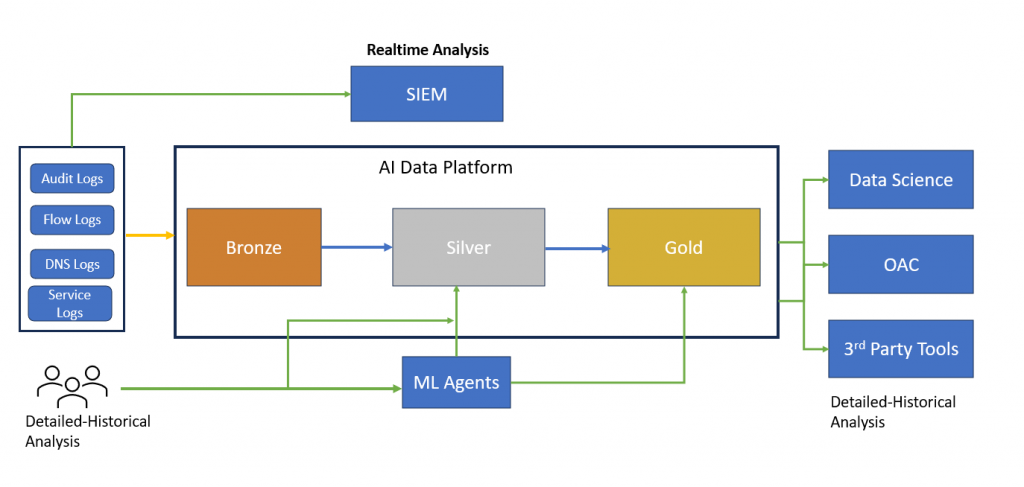
Data Lake vs. SIEM — Two Tools, One Strategy
A common misconception is that a security lake can replace a SIEM. That is not true. They are designed for different jobs.
A SIEM focuses on speed: real-time detection, alerting, and incident response. A security lake focuses on depth: long-term retention, historical analysis, threat hunting, and machine learning across large data volumes.
| Dimension | Security Lake | SIEM |
|---|---|---|
| Primary Purpose | Long-term storage, deep analytics, ML-based threat hunting | Real-time detection, alerting, incident response |
| Data Retention | Months to years | Days to weeks |
| Data Format | Raw and open formats; refined via Bronze, Silver, Gold | Vendor-normalized schemas |
| Analytics Depth | Deep queries, ML models, behavior baselines | Rule-based correlation |
| Cost Model | Storage-based and cost-efficient at scale | Often ingestion-based and expensive at scale |
| Best Used For | Compliance, forensics, threat hunting | SOC operations and alerting |
The bottom line is simple: a security lake does not replace a SIEM. It feeds it. By offloading high-volume, long-retention data into the lake and surfacing enriched, high-confidence signals to the SIEM, organizations get faster detection, deeper investigation, and a security stack that scales.
Where OCI AI Data Platform Fits
A security lake, on OCI, is implemented using OCI AI Data Platform and turns raw security telemetry into usable, scalable security intelligence.
AI Data Platform provides the managed data and AI foundation that a security lake needs to operate reliably at scale. It removes the heavy lifting of building and operating data infrastructure, so teams can focus on detection, investigation, and insight instead of plumbing.
With AI Data Platform, teams can:
- Transform raw security logs into structured Bronze, Silver, and Gold datasets using managed pipelines
- Enrich events with identity, workload, network, and environment context
- Build long-term behavior baselines across users, workloads, and infrastructure
- Apply machine learning to detect anomalies, rare patterns, and risky behavior
Managed Spark for Security Workloads
AI Data Platform provides fully managed Apache Spark clusters that are purpose-built for large-scale security data processing.
- Spark clusters are provisioned, scaled, and maintained by the platform
- Teams do not manage nodes, patching, or cluster lifecycle
- Jobs can process massive log volumes efficiently using distributed compute
- Spark integrates directly with Object Storage and curated lake datasets
This is critical for security lakes, where ingestion rates are high, schemas vary, and transformation logic evolves over time. Teams can parse, normalize, deduplicate, and enrich logs at scale without running their own Spark infrastructure.
Built-in AI and Machine Learning Integration
AI Data Platform is not just a data engine. It includes native AI and ML integration designed for enterprise use.
- Machine learning workflows run close to the data, minimizing data movement
- Teams can build anomaly detection, behavior modeling, and risk scoring directly on lake data
- GenAI and agent frameworks can be layered on top of curated security datasets
- AI pipelines can be orchestrated alongside data transformation pipelines
This allows security teams to move beyond rule-based detection and apply learning-based approaches that improve over time as more data is retained.
AI Data Platform Workbench
AI Data Platform Workbench provides a unified, governed development environment for security data and AI workflows.
- A single workspace for data engineering, analytics, and ML
- Shared notebooks for Spark, SQL, and Python
- Reproducible pipelines for ingestion, transformation, and modeling
- Built-in governance with lineage, versioning, and access control
Data engineers, threat hunters, and data scientists work in the same environment, using the same datasets, without copying data across tools or environments.
Code Repository
All the code for this OCI Security Logs Data Lake project is available in this GitHub repository. The notebooks cover ingestion, transformation, and exploration of audit and flow logs.
Included Notebooks
The root folder AIDP-Code contains the following Jupyter notebooks:
| File | Purpose |
|---|---|
01_bronze_ingest_audit_logs_clean.ipynb | Ingest OCI audit logs into bronze and perform initial cleaning. |
02_bronze_ingest_flow_logs.ipynb | Ingest VCN flow logs into the bronze layer. |
03_silver_transform_audit_logs.ipynb | Apply transformations on audit logs for the silver layer. |
04_silver_ingest_flow_logs.ipynb | Transform and clean flow logs for the silver layer. |
05_gold_transform_audit_logs.ipynb | Refine audit logs for the gold layer (enriched and curated). |
06_gold_ingest_flow_logs.ipynb | Refine flow logs for the gold layer. |
07_silver_to_delta_conversion.ipynb | Convert silver parquet tables into Delta Lake format. |
11_Investigate_Queries.ipynb | Sample queries to explore and analyze log data. |
Investigate_Queries.ipynb | Additional exploratory queries against the datasets. |
These notebooks implement the core data ingestion and transformation steps for building a Security Logs Data Lake on OCI.
Conclusion
The security lake is built to enhance existing security tools, not replace them. It works alongside SIEMs, SOAR platforms, and other operational systems to make them more effective.
OCI AI Data Platform delivers clean, enriched, and high-confidence data that security tools can use for better detection, faster investigation, and stronger response. Large volumes of historical data remain in the lake, while high-value insights move into operational systems where action happens.
In short, OCI AI Data Platform provides the managed data, compute, and AI foundation that allows a security lake to scale, improve over time, and deliver measurable value without adding operational complexity.