

A single AI request can travel through applications, agents, external tools, and enterprise data stores before producing a response. Each step introduces a security decision: who can act, which services can communicate, what information can return, and how the application should handle potentially harmful content.
Consider a simple request: “Summarize all of my financial data.” The user expects a useful answer about their own information. Behind the scenes, an agent may search documents, call a tool, and query a database. The challenge is keeping every action within that user’s authority, even when the agent has access to much more.
Organizations need to apply a clear principle to this expanding environment: every request must earn the minimum access it needs through continuous verification. On Oracle Cloud Infrastructure (OCI), this means combining identity, network, database, and AI controls throughout the request’s journey.
AI expands the trust boundary
AI applications introduce risks that reach beyond the user’s initial prompt. Retrieved documents can contain hidden instructions. Agents can call tools and services at machine speed. Retrieval-augmented generation (RAG), which brings retrieved information into a model’s context, can expose sensitive data when retrieval fails to respect the requester’s entitlements.
An authenticated user therefore needs carefully bounded access throughout the workflow. Every downstream tool call and data retrieval must stay within that user’s authority and the application’s approved purpose. A helpful agent still needs clear boundaries.

An agent’s ability to act needs boundaries that reflect the person and task it serves.
Identity and delegation establish who may act
Runtime authorization and access governance serve different purposes. OCI Identity and Access Management (IAM) authenticates users and workloads and authorizes OCI actions. Oracle Access Governance (OAG) supports access requests, approvals, certifications, and policy reviews to help reduce stale or excessive access.
As agents invoke tools, delegated credentials should preserve the relevant user and workload context while narrowing the target and scope at each step. Downstream services need that verified context to make their own authorization decisions. A shared application credential alone does not tell a database which person is asking for information. People remain accountable for access decisions, with governance supporting ongoing review. Therefore, it is important that security frameworks, such as OAuth, OpenID and the relevant token scope be part of the Agent Harness. If appropriate invoke HITL (Human-in-the-loop) for approvals.
Network controls constrain where requests can go
Network Security Groups (NSGs) and Zero Trust Packet Routing (ZPR) work together to restrict workload communication. NSGs define permitted sources, destinations, protocols, and ports. ZPR uses security attributes and policies to express which supported resource paths may communicate.
For a ZPR-protected flow, the applicable network rules and ZPR policy must both permit communication, and a valid route must exist. An NSG rule permitting a database port does not establish an approved path by itself. If no ZPR policy allows that connection, traffic is blocked.
In the reference architecture below, the RAG application makes separate connections to the model endpoint and the database. It retrieves authorized data and supplies relevant context to the model. Apply these controls to the endpoints and database deployments that support them.
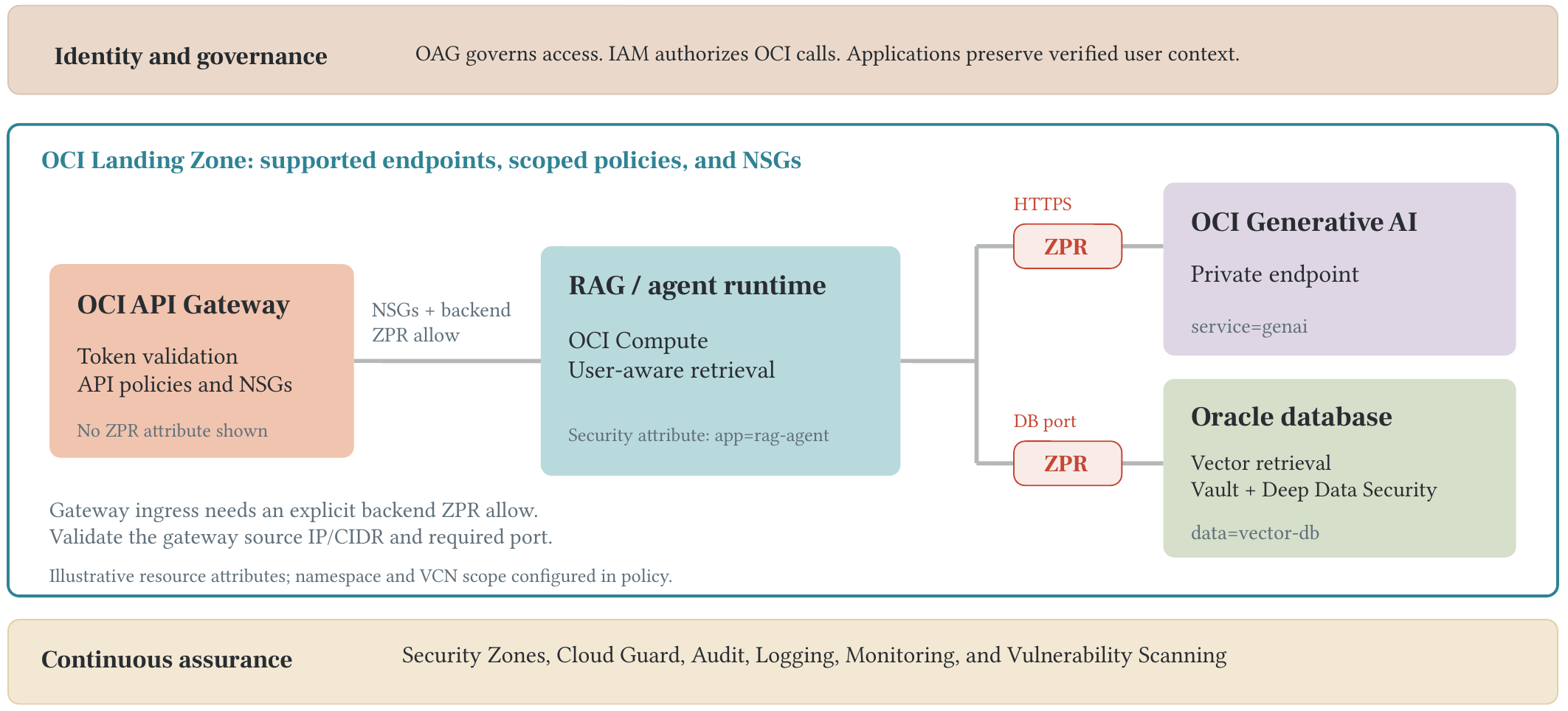
ZPR markers represent policy checks. Resource attributes are illustrative and require the appropriate policy namespace and network scope.
Data authorization limits what retrieval can return
Reaching a database is only one part of the access decision. The application must also retrieve information within the requester’s entitlements, before that information reaches the model.
Complementary database controls address different boundaries. Database Vault constrains privileged access and sensitive operations through realms and command rules. In supported Oracle AI Database deployments, Deep Data Security uses data roles and grants to control access at the row, column, and cell levels, based on authenticated user and application context. Both applicable policy layers must be satisfied.
Returning to the financial-data example, an approved application may reach a protected customer table while data policy limits retrieval to the records that requester is entitled to see. Permission to connect to the database does not grant access to every customer’s information.
Guardrails and operational evidence complete the picture
Configure OCI Generative AI Guardrails explicitly at the relevant points in the application, including user input, retrieved context, and model output. Content moderation, personally identifiable information (PII) detection, and prompt injection detection help identify risky content. The application must act on the results, for example by blocking a request or withholding a response. Detection results alone do not enforce that decision, and database policy independently limits what retrieval may return.
Operational controls support this architecture over time. Security Zones deny resource changes that violate the configured security policies. Cloud Guard detects risky configurations and activity. Vulnerability Scanning routinely checks supported hosts and container images that run AI applications and agent tooling.
Audit records, application logs, and monitoring help teams follow a request across layers and investigate unexpected behavior. Logs may be less glamorous than models, but they become very useful the morning after an incident.
Adoption starts with visibility
Start with one AI workflow that matters to the business. Map its applications, identities, data sources, and service paths. Establish landing zones, network baselines, and shared logging, then introduce enforcement around the paths and data that matter most.
Before expanding, test the boundaries: can one user retrieve another user’s records? Can a retrieved document redirect an agent toward an unauthorized tool? Can a workload reach an unapproved destination? Use the findings to refine policy, then continue regular access reviews and monitoring.
For organizations building AI across cloud, on-premises, and enterprise systems, this approach makes security an ongoing part of how requests execute. Every service interaction has a defined boundary, and every data response reflects the authority of the person and application requesting it – and should be part of the Agent Harness. A useful starting question is simple: can we explain, for one AI request, who acted, where it went, and why that data was allowed to return?
Explore more
OCI Identity and Access Management • Oracle Access Governance
Zero Trust Packet Routing • Oracle Database Vault