
Introduction
Digital commerce today is about much more than just selling products online. Customers expect immediate order confirmations, real-time payment processing, accurate inventory visibility, fast fulfillment, and seamless support experiences. Behind every successful online transaction lies a complex network of systems that must work together flawlessly.
This is the story of how a growing retail company modernized its digital commerce operations by connecting Shopify, Mercado Pago (Payment Processing Platform), and Oracle Integration Cloud (OIC) using Oracle Cloud Infrastructure (OCI) services.
The result was a secure, scalable, and event-driven integration architecture that transformed disconnected business processes into a real-time digital ecosystem.
The Customer Challenge
Our customer was a rapidly expanding retailer serving customers across multiple markets. The company had chosen:
- Shopify as its e-commerce platform
- Mercado Pago as its payment processing platform
- Oracle Integration Cloud (OIC) as its enterprise integration and orchestration platform
The setup worked well individually. The challenge emerged when the business wanted these platforms to work together in real time.
A Typical Customer Journey
Consider a simple online purchase:
- A customer places an order on Shopify.
- The customer completes payment using Mercado Pago.
- Inventory must be reserved.
- The warehouse must begin fulfillment.
- Finance systems must record the transaction.
- Customer notifications must be sent.
- Support teams must have visibility into order status.
Although this sounds straightforward, each step involves different systems generating different events. Shopify generates order events while Mercado Pago generates payment events and Oracle Integration Cloud orchestrates business processes. The retailer needed a reliable way to bring all these events together.
The Hidden Integration Problem
Both Shopify and Mercado Pago communicate through webhooks. Whenever something important happens, they send an HTTPS notification to a configured endpoint. For example:
Shopify Events
- New Order Created
- Order Updated
- Fulfillment Created
- Inventory Updated
- Refund Issued
Mercado Pago Events
- Payment Approved
- Payment Rejected
- Payment Refunded
- Payment Updated
- Chargeback Notifications
The retailer initially considered sending these webhook notifications directly to Oracle Integration Cloud. However, a challenge quickly appeared. Oracle Integration Cloud (OIC) APIs are typically secured using OAuth 2.0 through Oracle Identity Domains, requiring valid bearer access tokens to invoke protected REST endpoints.
Meanwhile, webhook providers simply send HTTP requests and expect an endpoint to receive them. There was a clear gap between external event producers and enterprise-grade secured integrations. The company needed a secure bridge.
The Solution: An OCI-Powered Event Gateway
How Shopify Events Flow Through the Platform
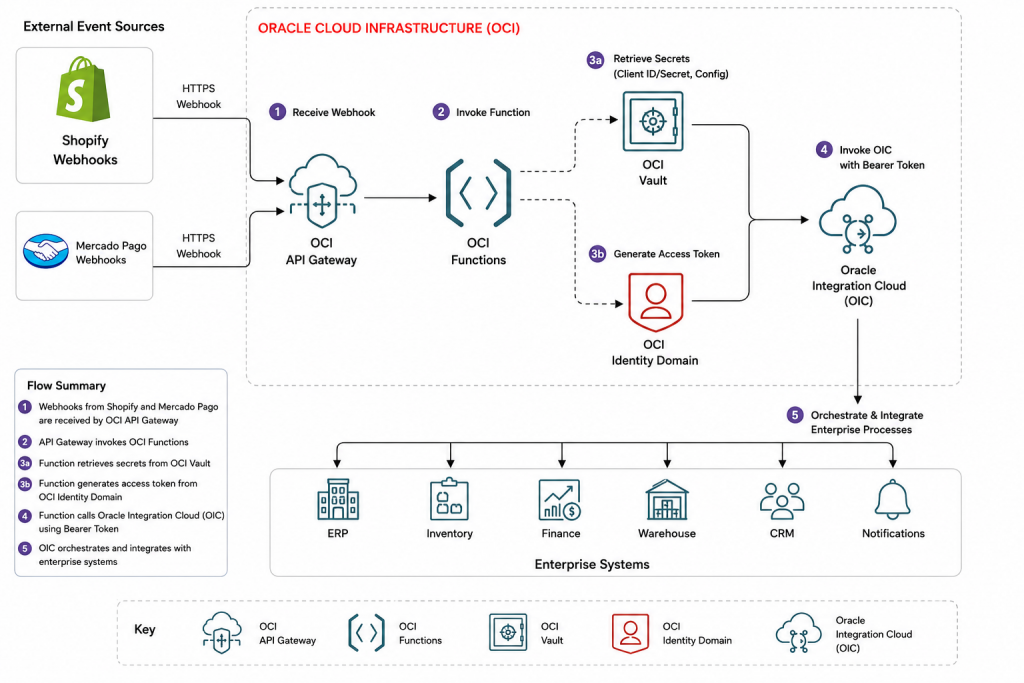
When a customer places an order on Shopify, an Order Created webhook is generated and sent to OCI API Gateway. The gateway invokes an OCI Function, which securely retrieves the Shopify webhook secret from OCI Vault and validates the incoming request using the X-Shopify-Hmac-SHA256 signature. Once validated, the function obtains an OAuth access token from OCI Identity Domain and securely forwards the event to Oracle Integration Cloud (OIC).
OIC then orchestrates the downstream business processes, such as creating ERP transactions, reserving inventory, notifying warehouse systems, triggering customer communications, and updating CRM records, all in near real time.
How Mercado Pago Events Flow Through the Platform
When a customer makes a payment through Mercado Pago, a payment webhook is sent to OCI API Gateway. The gateway invokes an OCI Function, which securely retrieves the Mercado Pago secret from OCI Vault, validates the webhook using the x-signature, x-request-id, and data.id values, and then generates an OAuth access token from Oracle Identity Domain. The verified event is then forwarded to Oracle Integration Cloud (OIC), which triggers the downstream business process in near real time.
This process can reconcile payments, release orders, update finance records, notify warehouse systems, trigger customer communications, and synchronize CRM data.
The business now has real-time visibility into payment status across enterprise systems.
Deploying the OCI Function and API Gateway Configuration
Both Shopify and Mercado Pago integrations use the same architecture. To implement these integrations, deploy the respective OCI Functions from the GitHub repositories listed below. Use the configuration Parameters as highlighted below and then configure the function as the backend for OCI API Gateway routes.
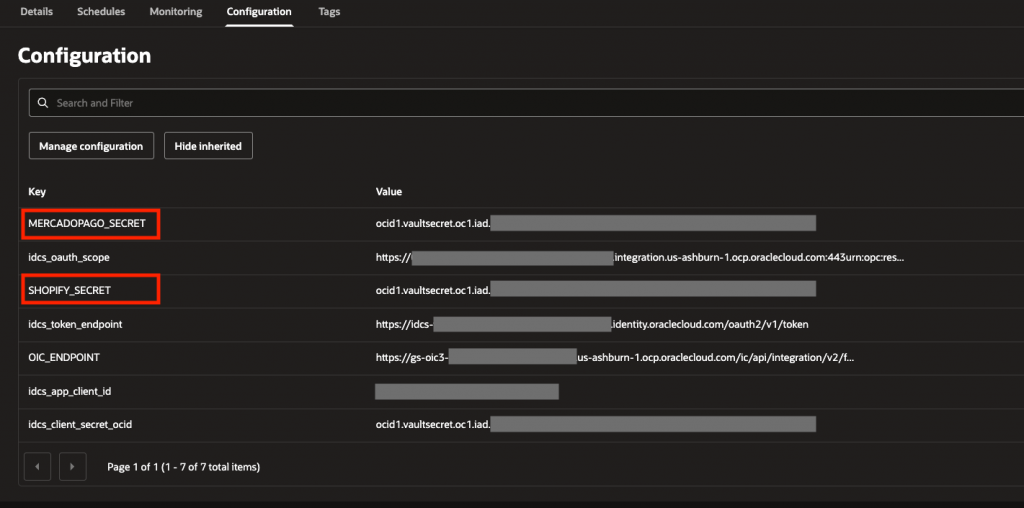
The OCI Function validates the incoming webhook, retrieves secrets securely from OCI Vault, generates an OAuth access token using Oracle Identity Domain, and invokes Oracle Integration Cloud (OIC).
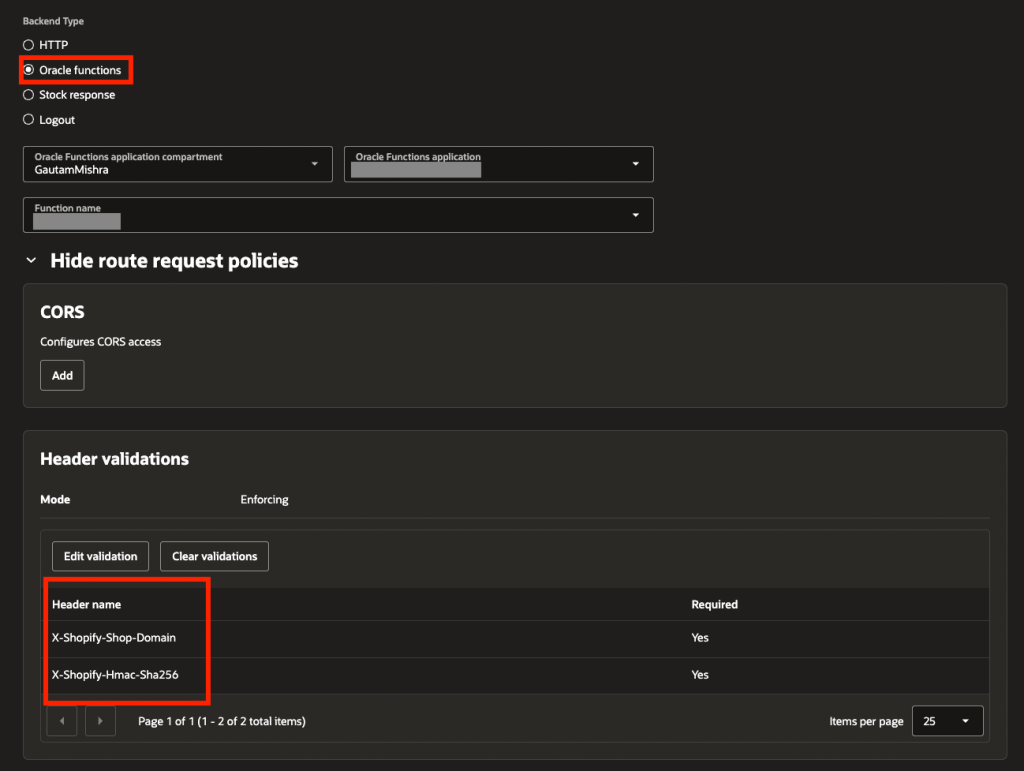
The only difference between the two implementations is the webhook-specific validation headers:
Shopify
X-Shopify-Shop-DomainX-Shopify-Hmac-Sha256
Mercado Pago
x-signaturex-request-id
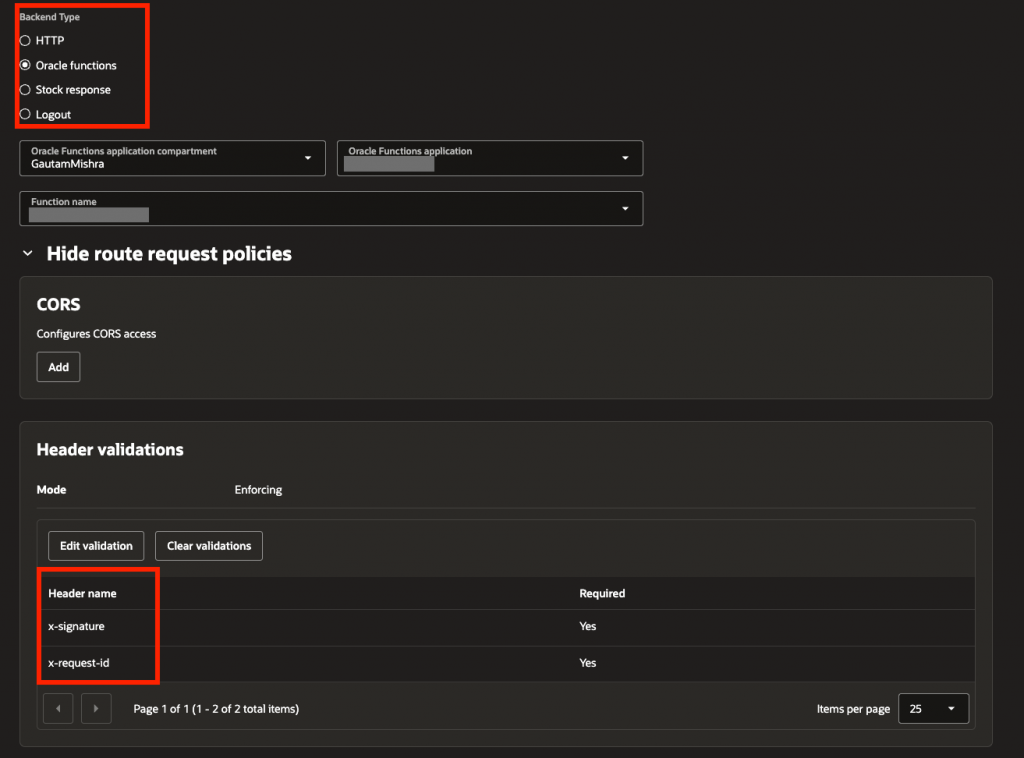
This demonstrates how a single OCI integration pattern can be reused across multiple commerce and payment platforms with minimal provider-specific changes.
Security Built Into Every Step
Security was a key requirement for the retailer. By leveraging OCI Vault for secret management, Oracle Identity Domains for OAuth-based authentication, webhook signature validation for request verification, and OCI API Gateway as the controlled entry point, the solution delivers enterprise-grade security while maintaining the flexibility and scalability needed for modern commerce integrations.
Beyond Shopify and Mercado Pago
One of the biggest advantages of this architecture emerged after deployment: its reusability.
While initially designed to process Shopify order events and Mercado Pago payment notifications, the retailer quickly realized that the pattern was not tied to any specific platform. Any application capable of sending webhooks could now be securely integrated with Oracle Integration Cloud through the same OCI-based framework.
This opened the door to integrating a wide range of systems, including Stripe, PayPal, Salesforce, ServiceNow, logistics providers, marketplace platforms, loyalty applications, and more.
What began as a solution for commerce and payments soon evolved into the retailer’s standard blueprint for event-driven integration, enabling new business applications to be onboarded faster, more securely, and with significantly less development effort.
Conclusion
Every order, payment, or business event has the potential to trigger meaningful enterprise actions. With a secure OCI-based webhook gateway and Oracle Integration Cloud, the retailer created a modern integration foundation that turns real-time events into real-time business outcomes.