
When AI compresses the gap between discovery and exploitation, shared responsibility stops being a governance slide and becomes an execution test.
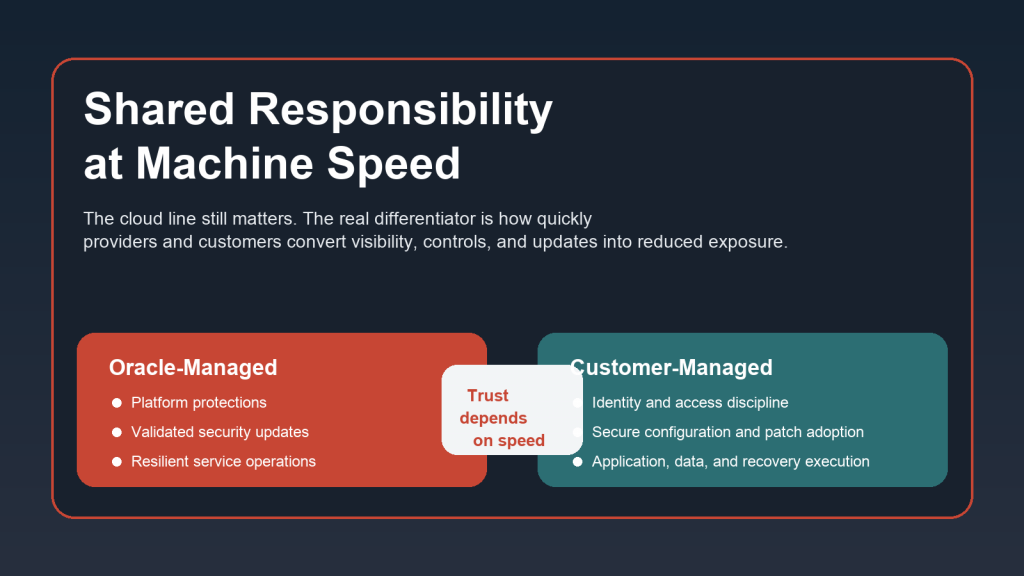
Shared responsibility still defines who secures what in cloud environments. What has changed is the pace. In a machine-speed threat environment, CISOs need providers and customers to convert visibility, patches, controls, and resilience plans into reduced business exposure much faster.
Shared responsibility was once a model for allocating control. At machine speed, it becomes a model for sustaining trust.
Shared responsibility used to be a boundary. Now it is a speed test.
For years, shared responsibility was treated as a line on an architecture diagram. The provider secured the underlying service. The customer secured how that service was configured, integrated, and operated. That model still matters, but it no longer describes the full risk picture.
AI is accelerating vulnerability discovery, exploit analysis, attack-path mapping, and security testing faster than most organizations can adapt their operating models. For CISOs, the real issue is not simply whether vulnerabilities exist. It is whether the enterprise can understand exposure, assign accountability, act quickly, and recover with confidence before machine-speed threats turn technical weaknesses into business disruption.
That shift changes shared responsibility from a static control model into a live coordination model. The question is no longer just who owns the control. The question is whether both sides can move fast enough to reduce exposure before an attacker turns a finding into an incident.
The line between Oracle and the customer still matters
Oracle-managed cloud services allow Oracle to deliver resilient infrastructure, platform protections, and security capabilities at scale. Customers still remain responsible for securing their applications, identities, data, and customer-managed workloads.
That distinction is not new. What is new is the pace at which each side has to perform. Providers need to identify issues earlier, validate them rigorously, and move protections, mitigations, and patches into production safely. Customers need to stay on supported versions, apply security updates, harden configurations, limit unnecessary exposure, and run identity controls with discipline.
Both parties may be doing their part on paper and still lose in practice if the operating tempo is too slow. Machine-speed risk punishes any gap between responsibility and execution.
- Oracle-managed side: service operation, platform protections, validated security updates, and resilient infrastructure.
- Customer-managed side: identity hygiene, application security, configuration hardening, patch adoption, data protection, and recovery execution.
What each side has to do now
| Oracle-managed cloud services | Customer-managed environments |
|---|---|
| Service operation and platform protections | Identity, application, and data security |
| Validated security updates and mitigation guidance | Patch adoption, configuration hardening, and exposure reduction |
| Resilient infrastructure and security capabilities at scale | Recovery execution, business continuity, and accountable action |
Shared responsibility is really a resilience conversation
In a machine-speed environment, prevention is necessary but not sufficient. Vulnerabilities will exist, some weaknesses will be discovered quickly, and some attacks will succeed. The organizations that sustain trust will be the ones that can contain impact and recover rapidly.
That is why shared responsibility has to be evaluated through operational outcomes, not just ownership matrices. Provider-managed protections reduce baseline risk. Customer-managed identity, segmentation, workload isolation, backup design, incident response, and business continuity determine whether a technical event becomes a contained issue or a business crisis.
For CISOs, this is the practical leadership challenge: make sure the provider relationship, internal engineering rhythms, security operations, and resilience plans all work as one system under pressure.
Measure exposure, not just finding volume
One of the biggest mindset shifts for security leaders is moving from vulnerability management to exposure management. A vulnerability is a technical weakness. Exposure is the degree to which that weakness can create meaningful business harm based on reachability, asset criticality, identity paths, data sensitivity, operational dependency, and compensating controls.
That distinction matters because shared responsibility does not create value when a vulnerability is merely disclosed. It creates value when the organization can answer harder questions quickly: Is the issue real in our environment? Is it reachable? What service does it affect? Can we patch safely? If not, what mitigation reduces risk fastest?
AI can help surface and correlate findings faster. But security value still comes from validation, evidence, prioritization, remediation, and assurance. A bigger queue of findings without ownership and execution discipline only creates more noise.
Five questions every CISO should ask right now
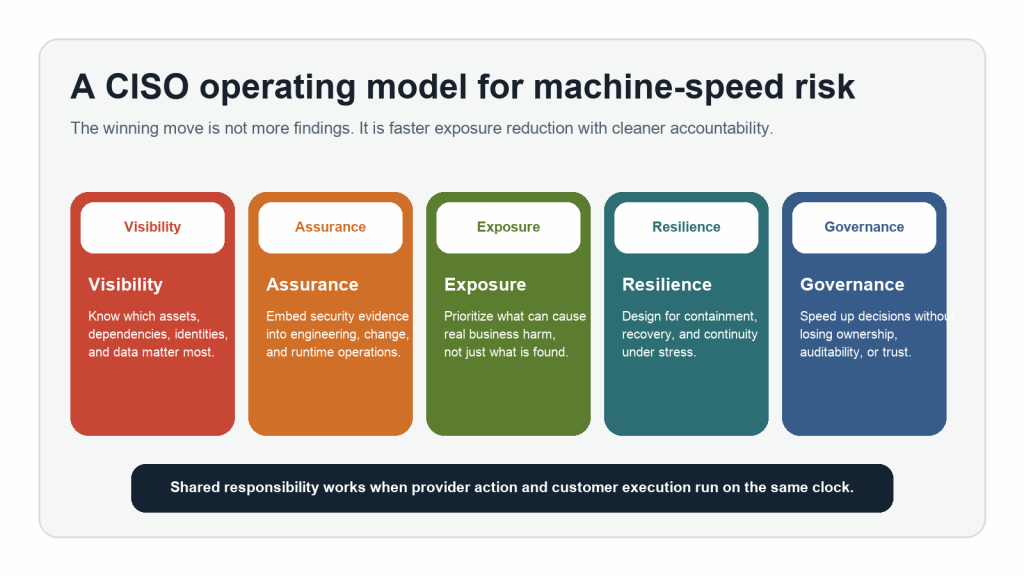
If shared responsibility is going to hold up at machine speed, executive teams need a clearer operating cadence. These are the questions that matter most.
- How quickly can we determine whether a newly disclosed issue affects critical services, regulated data, or privileged identities?
- Do we know which applications, dependencies, and cloud configurations make a weakness materially reachable?
- Can accountable owners patch, mitigate, isolate, or monitor within hours when risk warrants it?
- Have recovery paths been exercised against realistic cyber scenarios, including identity compromise and dependency failure?
- Are provider advisories, contact paths, and escalation routes integrated into enterprise risk governance rather than treated as routine notifications?
The new standard for CISOs
The next phase of cybersecurity will not be defined by which organization finds the most vulnerabilities. It will be defined by which organizations reduce exposure fastest, sustain trust under pressure, and recover effectively when disruption occurs.
For CISOs, that means treating shared responsibility as a board-level operating model. Visibility, accountability, patching, compensating controls, crisis communication, and recovery readiness all have to work at a different tempo now.
Shared responsibility still defines who secures what. In the machine-speed era, it also defines how quickly trust can be defended.