
Organizations seldom measure compliance against a single compliance framework. The CIS Oracle Cloud Infrastructure (OCI) Foundations Benchmark helps organizations evaluate the security configuration of an OCI tenancy. The CIS Controls are a prioritized set of CIS Safeguards to help organizations defend against the most common cyber attacks against their infrastructure. They are mapped many legal, regulatory, and compliance frameworks. This helps organizations relate technical OCI configuration findings to broader compliance objectives.
The OCI CIS Compliance Checker now maps CIS OCI Foundation Benchmark checks and Oracle Best Practice checks to CIS Safeguards. Teams can use these relationships alongside published CIS mappings to connect technical findings to related framework requirements.
What the mapping covers
The mapping identifies the CIS Safeguards supported by individual OCI CIS Foundations Benchmark recommendations and Oracle Best Practice checks. It adds context to findings about the OCI resources and configurations the checker inspects.
What it does not cover
The checker’s mapping ends at CIS Safeguards. Relationships to other frameworks come from published CIS crosswalks and require a separate assessment. A passing check provides point-in-time technical evidence; it does not establish implementation of an entire Safeguard or compliance with a framework. Broader processes, ownership, review cadence, and controls outside the checker’s scope require additional evidence.
The complete mapping is available in the OCI CIS Compliance Checker repository.
More than a benchmark assessment
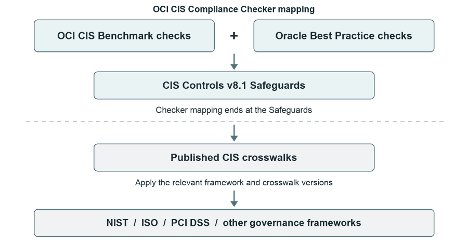
The Compliance Checker’s primary purpose remains assessing an OCI tenancy against the CIS OCI Foundations Benchmark and Oracle Best Practices. Safeguard mappings add context to the results, helping security and GRC teams identify the control objectives a finding may support.
For example, the repository maps IAM-7, the check for MFA on all users with a console password, to CIS Safeguard 6.5 and a few others, this Safeguard which requires MFA for administrative access. The mapping identifies this as partial coverage. If IAM-7 finds a user without MFA, the team can investigate the account, remediate the configuration, and use the result as supporting evidence for Safeguard 6.5. It must still assess administrative access beyond the OCI accounts checked.
A security architect can then consult the relevant CIS crosswalk to identify related framework requirements and the additional evidence needed. Check the CIS Controls and target framework versions before applying a crosswalk.
Structured mapping outputs
The project provides three output formats:
- Markdown – explains the mapping rationale for architects, auditors, and GRC teams.
- JSON – supports automation, dashboards, GRC platforms, and custom integrations.
- CSV – supports spreadsheet analysis, reporting, and evidence review.
The structured JSON and CSV summaries include recommendation identifiers and titles, compliance status, finding counts, mapped CIS safeguards, remediation guidance, and supporting references. Oracle Best Practice checks include their identifiers and documentation links where applicable. This context helps teams bring technical findings into existing governance workflows.
Putting the mappings to work
Consider a few practical examples:
- A GRC team can import CSV or JSON results into an internal reporting process to identify which Safeguards have supporting OCI findings and where further evidence is needed.
- A security architect preparing for an ISO 27001 or NIST CSF assessment can use the Safeguard mappings as a starting point, then apply published CIS crosswalks to identify related framework requirements.
- Engineering teams can prioritize remediation using the benchmark recommendation, the risk of the finding, and the cybersecurity Safeguards it supports.
Conclusion
The new mappings help teams connect OCI configuration assessments to CIS Safeguards and organize supporting evidence for broader governance work. Start with the repository mapping, review the findings in your tenancy, and use the relevant CIS crosswalks to plan the additional assessment your framework requires.
References
CISO perspectives on the OCI CIS Landing Zone for security and compliance