
In practice, prompts are rarely perfectly refined. This post explores a two-phase agentic workflow: return a shortlist, let the user choose, then use the selected ID to drive a confident drill-down.
The problem: natural language often maps to multiple records
In enterprise systems, “Show me Acme” or “Find the Smith account” is rarely a single exact match. If an agent guesses, it risks taking the user down the wrong path. A better design is to embrace ambiguity and resolve it explicitly.
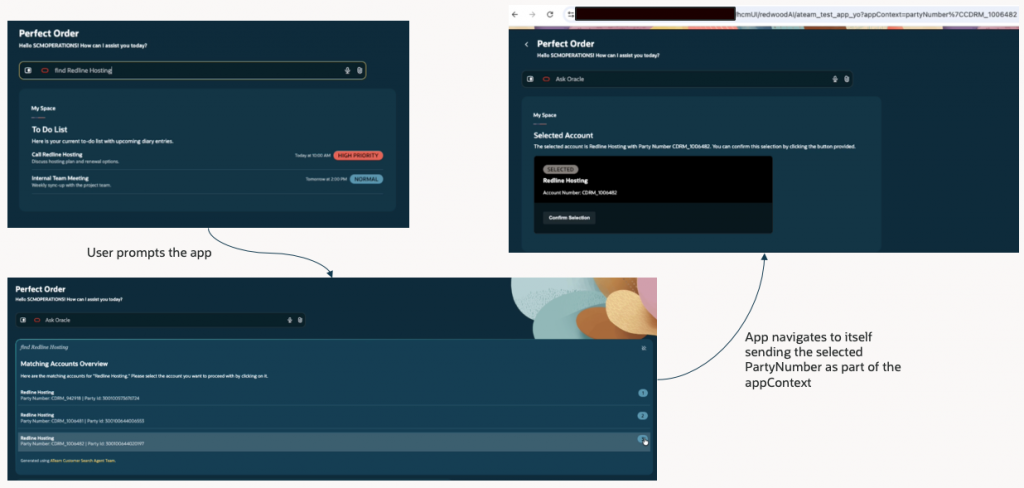
The pattern: two-phase flow in one app
This pattern has two modes, often implemented within the same agentic app:
- Discovery mode: run a broad query and return a shortlist of candidate results with enough information for a confident choice.
- Drill-down mode: after the user selects a result, re-invoke the experience with the chosen record’s unique ID passed via app context, and fetch authoritative details for that record.
This creates a clean “many matches → pick one → go deep” experience without forcing the user to refine prompts repeatedly.
How it worked (internal prototype)
During a recent internal project, this pattern was implemented as part of a prototype to address ambiguity in natural language queries against enterprise datasets.
The flow was structured as follows:
- Precise retrieval and drill-down
With the identifier available, the agent executed a targeted flow: validating the input, enforcing authorisation, retrieving authoritative data, and presenting detailed information along with relevant next actions. - Initial interpretation and broad retrieval
The agent processed the user’s prompt and executed a broad query. Given the nature of enterprise data, this frequently resulted in multiple potential matches. - Structured shortlist response
Rather than requiring the user to refine their input, the application returned a structured shortlist. Each entry included a clear label along with key differentiating attributes (such as status, business unit, location, or recent activity) to support informed selection. - User-driven disambiguation
The user selected the most relevant item from the shortlist. The application captured the corresponding record’s unique identifier. - Context-driven re-invocation
The application transitioned into a second phase by re-invoking the experience in a dedicated “detail mode,” passing the selected identifier via application context.
This “single app, two modes” approach kept the user journey coherent and reduced duplicated logic across separate experiences.
Security and correctness considerations
- Treat the selected ID as untrusted input. Validate format and type; reject unexpected values.
- Keep context lean. Pass IDs and intent, not sensitive data payloads.
Wrap-up
Great agentic UX treats ambiguity as a normal starting point, not an error case. A shortlist acts as a controlled disambiguation step, and the user selection becomes shared context that the experience can reliably carry forward. By passing only the chosen identifier into drill-down, you move from exploration to precision with minimal data exposure—while maintaining enterprise essentials such as input validation, consistent authorisation checks, auditability, and clear governance boundaries.