
Introduction
Back in 2019 we announced a partnership with Microsoft to provide an Interconnect service (Oracle Interconnect for Azure) between OCI and Azure. This simplified the provisioning of the network connectivity between the two cloud service providers and achieving a latency of 2ms.
In 2022 we strengthen this partnership with the release of the Oracle Database Service for Azure (ODSA)
The latest release was the 2023 Oracle Database Service at Azure (OD@A).
The scope of this blog is to bring clarity between the two Database services offerings by doing a compare between them from the networking point of view.
Oracle Database Service for Azure (ODSA)
The official release describes the service as: “ With this new fully managed service, Azure customers can easily provision, access, and operate enterprise-grade Oracle Database services in Oracle Cloud Infrastructure (OCI) with a familiar Azure-like experience. Users can seamlessly build Azure applications using the high-performance, high-availability, and automated management of Oracle Database services such as Autonomous Database running on OCI.”
In a nutshell, an Azure customer was able to provision a database service in OCI, and the required network connectivity, by using the Azure console.
The Database service provisions on to the OCI customer’s tenancy (existing tenancy or a brand new one) and connectivity between OCI and Azure leverages the Oracle Interconnect for Azure but for the customer this is transparent, and it is done behind the scenes.
On the Azure side, the customer needs to do a VNET peering between his VNET and a service VNET owned by Oracle.
Below you can find a high-level diagram of the service.
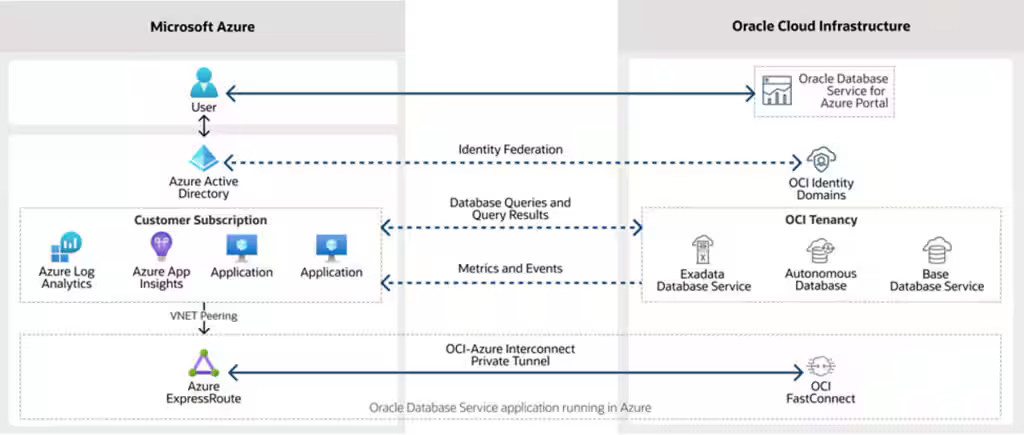
The announced latency between the applications hosted in Azure and database service from OCI was around 2 ms. For a transaction intensive application, this latency would take a huge toll on the end-to-end performance.
Oracle Database Service at Azure (OD@A)
Oracle and Microsoft have expanded their partnership to deliver Oracle database services running on Oracle Cloud Infrastructure (OCI), collocated in Microsoft data centers. Azure customers can now procure, deploy, and use Oracle database services running on OCI within the native Azure portal and APIs, giving them an OCI-in-Azure-like experience.
When a customer provisions the service, he will be asked to provide a VNET and a subnet in this VNET that will be delegated to Oracle.Database/networkAttachement. That subnet will be used for provisioning the service.
Bellow you can see the network diagram of the service after provisioning. Notice, on the center of the diagram, the OCI child site collocated in Azure’s datacenter hosting the Exadata Engineered System. The data plane of the system is in Azure, but the control plane is connected to the closest OCI region. This ensures that Oracle has access to do operations and maintenance on the system, but the customer is the only one having access to their data.
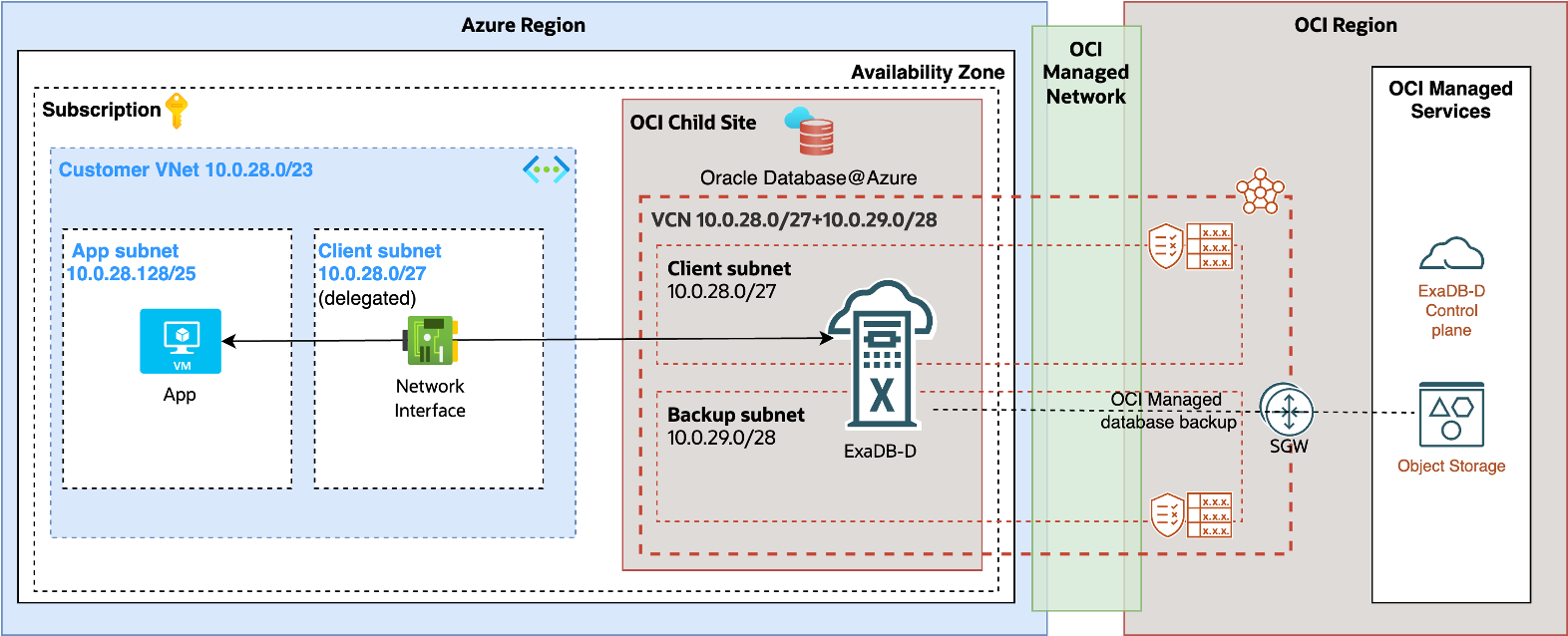
The simplest way to consume this service, is to provision another subnet in the same VNET. In this way, there are no extra configuration needed for the application to reach the database. This ensures minimal latency between the two tiers.
Conclusion
The latest adition to this partnership provides a better performance than the old one and it minimize the networking configuration needed for a customer to connect from an application to the database.