
TL;DR
A successful Oracle Fusion Cloud implementation is driven by architectural decisions, not just system capabilities. This framework introduces seven key implementation pillars – Data, Integration, Security, Extensibility, Environment, Monitoring, and Governance – operating as a continuous lifecycle. By adopting standard business processes, defining data early, and following a structured transformation path, organizations can design implementations that are scalable, maintainable, and ready for AI-enabled innovation.
Introduction: From Implementation to Intelligent Enterprise Platform
A practical architecture framework to guide Oracle Fusion Cloud implementations focused on data, integration, security, extensibility, and governance – designed for scalability, standardization, and AI-enabled transformation.
Oracle Fusion Cloud Applications provide a unified platform built on standardized business processes and a common data model. However, the success of an implementation is not determined by the platform and applications themselves, but by how effectively it is implemented. The goal is not to recreate the past – but to adopt, standardize, and evolve.
This blog introduces a practical implementation architecture framework, based on our experience across customer engagements. It focuses on the key architectural decisions that shape successful deployments – covering data definition, integration patterns, security models, extensibility, governance, and readiness for scale and AI.
Rather than describing how Fusion Cloud is built, this framework outlines how it should be implemented to achieve consistent, scalable, and future-ready outcomes across ERP, SCM, HCM, and CX domains.
Oracle Fusion Cloud Applications implementations typically succeed when architectural decisions and process adoption are aligned with the platform’s design principles. Challenges often arise when implementation approaches diverge from these principles, particularly in areas such as data definition, integration patterns, and process standardization.
Across implementations, a consistent set of architectural challenges tend to emerge:
- Replication of legacy processes instead of adopting standard Fusion capabilities
- Use of REST APIs for high-volume data loads or extracts outside intended patterns
- Migration of data without sufficient harmonization
- Use of BI Publisher (BIP) for large-scale extraction or near real-time integrations
- Growth of complex security models with large numbers of roles and access combinations
- Increased reliance on customization and extensions
These are not limitations of the platform, but rather indicators of architectural decisions that are not fully aligned with Fusion Cloud design principles.
Scope: Applicable Across All Fusion Cloud Implementations
Fusion Cloud supports enterprise processes across:
- ERP (Finance)
- SCM (Supply Chain)
- HCM (Human Capital)
- CX (Customer Experience)
This framework applies whether you are:
- Implementing a single pillar
- Deploying multiple pillars simultaneously
- Rolling out capabilities in a phased transformation
Strong POV: Even single-pillar implementations should be designed with future expansion in mind.
The Fusion Cloud Implementation Framework
This framework is built on four architectural layers, as represented in the diagram:
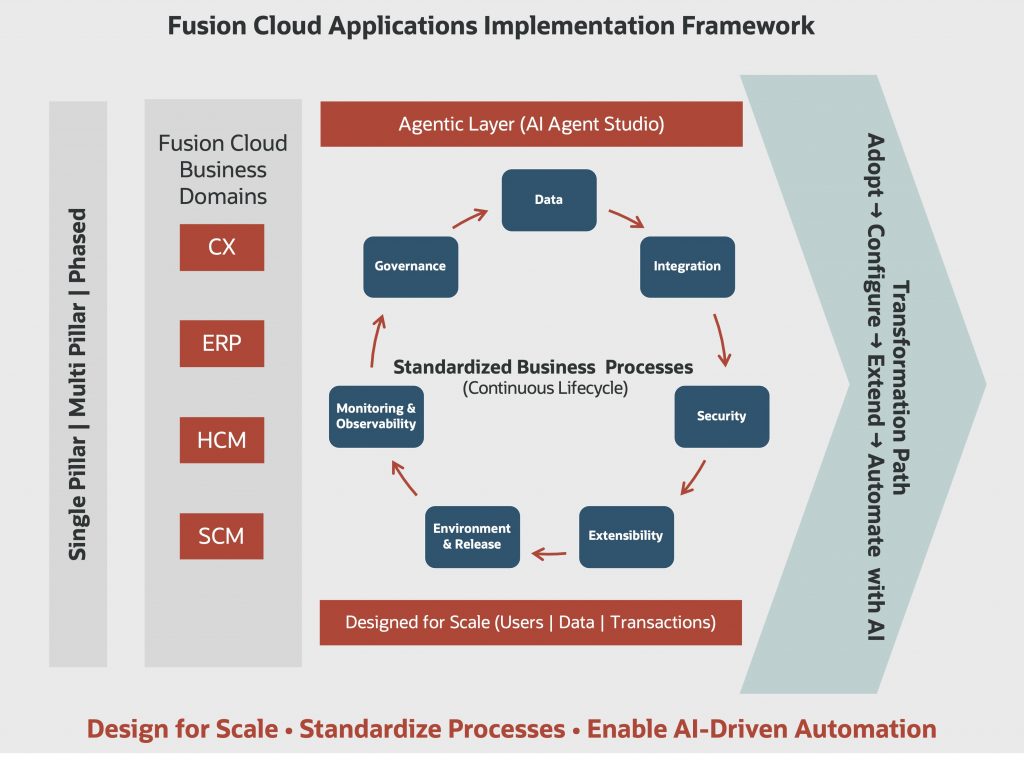
1. Business Domains (What You Implement)
At the foundation are the Fusion Cloud business domains: ERP, SCM, HCM, CX. These domains provide end-to-end standardized business processes.
👉 The key is not customization – but adoption of these processes.
2. Architecture Layer: The 7 Pillars (How You Build It)
At the core of every successful implementation are seven architectural pillars, operating as a continuous lifecycle:
| Pillar | Purpose |
| Data | Foundation for transactions, reporting, and AI |
| Integration | Enables system connectivity and execution |
| Security | Controls access and ensures compliance |
| Extensibility | Enables controlled enhancements |
| Environment & Release | Supports continuous updates |
| Monitoring & Observability | Provides visibility and insights |
| Governance | Provides operational visibility, monitoring, and run-time insights |
Each pillar is supported by standard Oracle Fusion Cloud capabilities. For example, Functional Setup Manager (FSM) supports configuration, Integration Cloud (OIC) enables integration patterns, Visual Builder and Redwood UX support extensibility, and embedded analytics and monitoring capabilities support observability. These capabilities are most effective when aligned with the architectural principles outlined in this framework.
Continuous Lifecycle Across Pillars
These pillars do not operate independently. They form an interconnected and continuous lifecycle where decisions in one area directly influence outcomes in others.
- Data drives integration
- Integration enforces security
- Security impacts extensibility
- Extensibility affects environments
- Environments require monitoring
- Monitoring informs governance
- Governance reinforces data and process integrity
This closed-loop lifecycle ensures scalability, resilience, and continuous improvement.
Core Principle: Standardization First
At the center of the framework: Standardized Business Processes (Continuous Lifecycle)
Every decision should follow: Adopt → Configure → Extend → Automate
Business owns data and process decisions; IT enables design, governance, and execution. Data definition should be established before business process workshops.
This sequence ensures that standard capabilities are fully leveraged before introducing additional complexity.
| Stage | Approach | Risk |
| Adopt | Use standard Fusion processes | Low |
| Configure | Adjust using Functional Setup Manager | Low |
| Extend | Use VB Studio / platform services | Medium |
| Automate | Use AI Agent Studio | Medium |
| Over-Customize | Recreate legacy systems | High |
👉 If Fusion is redesigned to mimic legacy systems, this often introduces long-term complexity and limits scalability.
3. Agentic Layer (AI-Driven Execution)
Above the architecture sits the Agentic Layer, enabled by:
- AI Agent Studio
- Embedded AI capabilities in Fusion
AI agents:
- Interpret business context
- Trigger actions via APIs
- Orchestrate multi-step processes
- Provide recommendations or autonomous execution
Architectural Implication
AI should be considered a dependent architectural layer rather than a standalone feature.
- Requires clean and well-governed data
- Depends on APIs and event-driven integrations
- Operates within defined security boundaries
- Requires governance and monitoring controls
👉 The effectiveness of AI capabilities is directly influenced by the strength of the underlying architecture.
4. Transformation Path (How You Evolve)
On the right side of the framework is the Transformation Path:
Adopt → Configure → Extend → Automate with AI
This represents the correct progression of a Fusion implementation:
- Adopt standard processes
- Configure using built-in capabilities
- Extend only when necessary
- Automate using AI agents
Common Failure Pattern
In practice, organizations may accelerate or bypass certain steps:
- Jump directly to customization
- Build integrations around legacy processes
- Introduce AI without architectural readiness
👉 This can result in:
- Increased complexity
- Scalability challenges
- Reduced effectiveness of AI-driven capabilities
5. Designed for Scale (Non-Negotiable)
At the base of the framework: Designed for Scale (Users | Data | Transactions)
Every decision must consider:
- User volume
- Data volume
- Transaction throughput
Why This Matters
Designs that perform well at smaller scales may require re-architecture as user volumes and transaction loads increase.
👉 Scalability must be built in from day one
Cross-Cutting Principles
The following principles apply consistently across all pillars and guide architectural decision-making:
| Principle | Key Message |
| Standardization | Adopt before you customize; avoid replicating legacy systems |
| Data First | Data drives integration, reporting, and AI outcomes |
| Architecture First | Make early decisions that scale across domains |
| Lifecycle Thinking | Treat all pillars as interconnected |
| Design for Scale | Build for enterprise from day one |
| Governance | Control enables consistency and scalability |
| AI Readiness | AI depends on strong architectural foundations |
| Anti-Patterns to Avoid | Recreating legacy workflows Over-customization Using REST APIs for bulk data Weak governance Deploying AI without readiness |
Why This Framework Works
When these principles are applied consistently, the benefits are measurable:
Organizations that follow this model:
- Scale without re-architecture
- Reduce technical debt
- Improve performance
- Enable AI-driven automation
- Accelerate time-to-value
Organizations that do not align with these principles may experience:
- Integration complexity
- Increasing complexity in security models
- Data inconsistencies
- Increased cost of change
Successful Oracle Fusion Cloud implementations are not defined by how closely legacy systems are replicated, but by how effectively organizations adopt standard processes, define data early, and make consistent architectural decisions across all pillars.
By following this implementation architecture framework, organizations can reduce complexity, improve scalability, and establish a strong foundation for continuous innovation including AI-driven capabilities. This master framework serves as a starting point, with each pillar explored in detail through the subsequent deep-dive blogs, enabling teams to translate architecture into execution.
Next in the Series: Deep Dives
The following deep dives explore each pillar of the implementation architecture framework in more detail, providing practical guidance, patterns, and considerations drawn from customer engagements to help teams design and deliver scalable, resilient, and AI-ready Oracle Fusion Cloud implementations.
To explore this in more detail, refer to the deep dives in this series: