
In my discussions with customers, I have noticed a common misconception where the terms “Data Mesh” and “Modern Data Platform” are often used interchangeably and considered to be the same thing. However, it is important to highlight that these are distinct concepts with fundamental differences in their principles, architectures, and organisational implications.
In this blog, I aim to shed light on the disparities between a Data Mesh and what a Modern Data Platforms is and clarify their respective meanings and implications. By providing a comprehensive understanding of these approaches, it is intended that readers will gain valuable insights into the nuances of each and be better equipped to make informed decisions when exploring data management strategies.
Introduction:
In today’s data-driven world, organisations are constantly seeking innovative approaches to manage and harness the power of data. Two emerging paradigms in the field of data management are Data Mesh and Modern Data Platforms. While both aim to improve data capabilities within organisations, they differ in their fundamental principles, architectural design, and organisational impact. This article provides a comprehensive exploration of the differences between Data Mesh and Modern Data Platform’s, along with their respective benefits and considerations.
Understanding Modern Data Platforms:
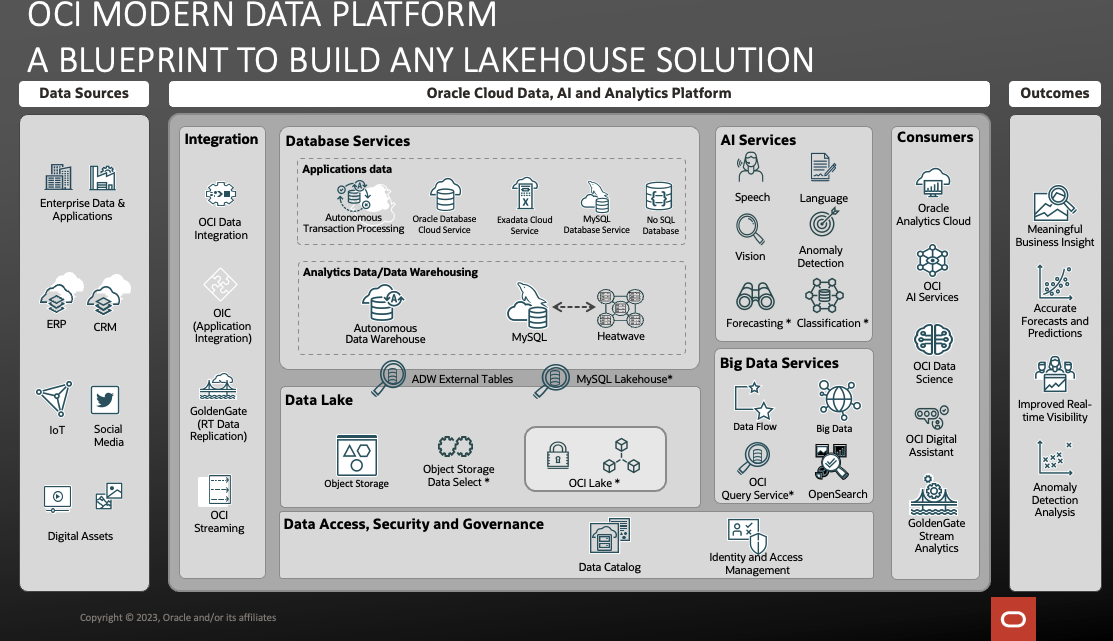
Image credit: Oracle A-Team: Jerome Francoisse, Jeff Thomas, Matthieu Lombard & OCI Product Management Team
Modern data platforms are centralised infrastructures that provide organisations with a unified environment for storing, processing, and analysing data. They typically encompass technologies such as data warehouses, data lakes, ETL pipelines, and analytics tools. The main objective of a modern data platform is to establish a standardised and integrated approach to data management, enabling organisations to derive valuable insights and make data-driven decisions. By centralising data assets into a unified repository, modern data platforms facilitate easier access, collaboration, and control over data.
Examples of technologies used in modern data platforms include:
1. Data Warehouses: Platforms like Oracle Autonomous Data Warehouse provide scalable and high-performance data warehousing capabilities for structured data storage and analysis.
2. Data Lakes: Technologies such as the Oracle OCI Lake; Oracle Autonomous Database/Warehouse, Object Storage, Big Data; Apache Hadoop, Apache Spark, Oracle Data Flow; Data Catalog; Query Service,etc enable the storage and processing of large volumes of raw, semi-structured, and unstructured data.
3. ETL (Extract, Transform, Load) Tools: Platforms like Oracle Data Integrator facilitate data ingestion, transformation, and loading processes, ensuring data quality and integration across different sources.
4. Analytics and Visualisation Tools: Solutions like Oracle Analytics Cloud, Fusion Analytics Warehouse (for Oracle Fusion Applications) Look to provide intuitive interfaces for exploring and visualising data, enabling users to gain insights and communicate findings effectively.
There are some notable benefits for adopting a Modern Data Platform. These include:
1. Centralised Data Governance: Modern data platforms provide a unified governance framework that ensures data quality, security, and compliance. Centralised governance enables organisations to maintain consistency, enforce standards, and adhere to regulatory requirements.
2. Scalability and Performance: These platforms are designed to handle massive volumes of data and support parallel processing, enabling organisations to scale their data infrastructure as data needs grow. High-performance computing capabilities facilitate faster data processing and analytics, empowering real-time decision-making.
3. Improved Collaboration: By centralising data assets, modern data platforms foster collaboration among different teams and departments. Shared access to reliable and up-to-date data promotes cross-functional insights and facilitates collaborative decision-making.
4. Simplified Data Integration: Modern Data Platforms offer a consolidated environment for data integration, making it easier to combine data from multiple sources, perform transformations, and create a holistic view of the organisation’s data assets.
Unveiling the Data Mesh Approach:
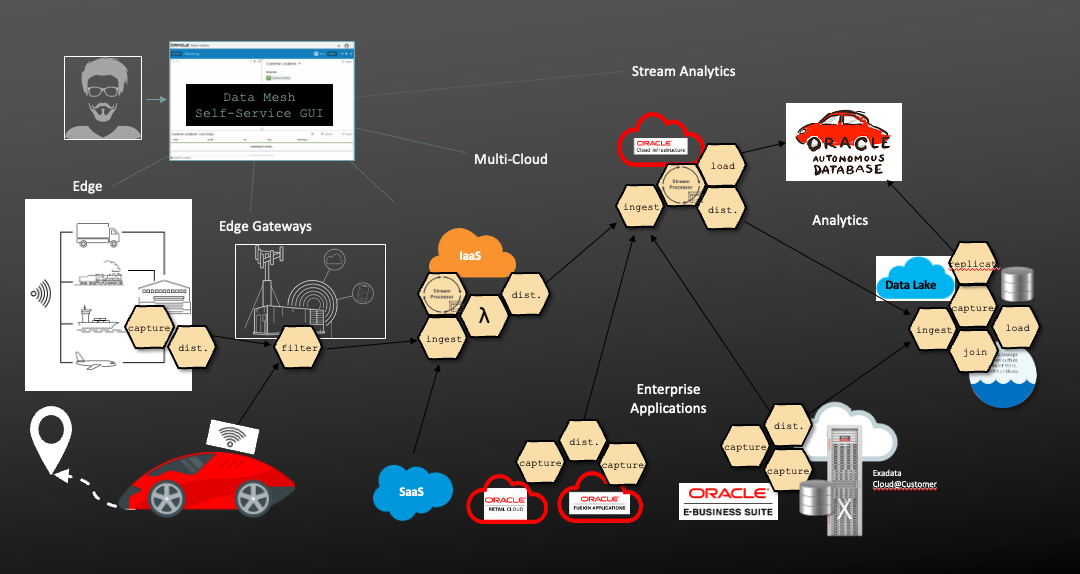
Image credit: Oracle GoldenGate Product Management Team
A Data Mesh is a decentralised and domain-oriented approach to data architecture that advocates for treating data as a product and assigning ownership to individual domains or teams within an organisation. Under the Data Mesh paradigm, each team becomes responsible for the data products within their domain, including data quality, accessibility, and APIs. This approach distributes data infrastructure and empowers domain experts to manage and curate data within their respective areas of expertise.
Examples of concepts associated with Data Mesh include:
1. Domain-Oriented Data Platforms: Instead of relying on a centralised data platform, Data Mesh emphasises the creation of domain-oriented data platforms. Each domain has its own data infrastructure, tools, and processes tailored to its specific needs.
2. Data Product Ownership: Data Mesh promotes the concept of data product ownership, where domain teams are accountable for the end-to-end lifecycle of their data products. This includes data discovery, data quality monitoring, data access, and API management.
3. Federated Data Governance: Rather than relying solely on centralised data governance, Data Mesh advocates for federated data governance. This approach allows domain teams to establish their own governance processes, standards, and policies while aligning with broader organisational guidelines.
Benefits of adopting a Data Mesh approach include:
1. Increased Autonomy and Agility: Data Mesh empowers domain teams to have ownership and control over their data products, allowing them to make quick decisions, experiment, and iterate. This distributed approach fosters agility and responsiveness to changing business requirements.
2. Improved Data Quality and Usability: With data product ownership, domain teams are more invested in ensuring the quality, reliability, and usability of their data products. This results in improved data quality, as domain experts have the contextual knowledge and domain-specific expertise to curate and maintain high-quality data.
3. Scalable Data Architecture: Data Mesh’s decentralised nature enables organisations to scale their data infrastructure by adding or modifying domain-specific platforms as needed. This flexibility supports the growing diversity and complexity of data sources and processing requirements.
4. Enhanced Collaboration and Innovation: Data Mesh promotes a culture of collaboration and knowledge sharing among domain teams. By enabling domain experts to work closely with data, insights and innovations are more likely to emerge, fostering a culture of continuous improvement and learning.
Considerations and Implications:
1. Organisational Complexity: Implementing a modern data platform requires organisations to establish a centralised infrastructure, develop data governance frameworks, and ensure data quality and security across the board. On the other hand, Data Mesh introduces a distributed model that requires careful coordination, communication, and shared understanding of data standards and practices.
2. Skill Sets and Roles: Modern data platforms often rely on specialised roles, such as data engineers and data architects, to design and maintain the centralised infrastructure. Data Mesh demands a shift towards domain-oriented roles, where domain experts become responsible for managing data within their specific areas of expertise. This transition necessitates upskilling and the creation of new roles, such as data product owners.
3. Collaboration and Communication: Modern Data Platforms promote centralised collaboration and communication channels, as teams work within a shared infrastructure. Data Mesh, however, encourages cross-domain collaboration, communication, and the establishment of well-defined interfaces and APIs to enable data exchange and interoperability.
4. Scalability and Cost Consolidation: Data Mesh offers opportunities for cost consolidation, as domain teams take ownership of their data products and associated costs. By distributing data responsibilities, organisations can optimise resource allocation, avoid duplication of efforts, and achieve cost efficiencies.
Conclusion:
In summary, the differences between Data Mesh and Modern Data Platforms lie in their architectural design, ownership and governance models, cultural implications, and impact on organisational scalability and collaboration.
While Modern Data Platform’s provide centralised infrastructures that promote standardisation, governance, and scalability, Data Mesh favours decentralisation, autonomy, and domain-oriented ownership. The choice between these approaches depends on an organisation’s specific needs, cultural readiness, and data management goals. By understanding the differences between Data Mesh and modern data platforms, organisations can make informed decisions regarding their data management strategies and harness the full potential of their data assets.