
Introduction
As organizations accelerate cloud adoption, a common question emerges: Is this compliant?
A more effective question is: How can we use cloud capabilities to achieve and demonstrate compliance?
In cloud environments, compliance is not inherited—it is designed. Oracle Cloud Infrastructure (OCI) provides a comprehensive set of security services, but regulatory alignment depends on how those services are implemented, configured, and governed.
For security leaders, the focus must shift from platform capabilities to control outcomes how identity is managed, how data is protected, how access is enforced, and how risk is continuously monitored.
A Framework for Understanding OCI and Compliance
Compliance in OCI can be understood through three layers:
- Core control domains: Identity, network, data protection, workload security, and monitoring
- Enabling constructs: Shared responsibility, landing zone architecture, and encryption models
- Governance and operations: Continuous monitoring, response, and audit readiness
The following visual summarizes this model:
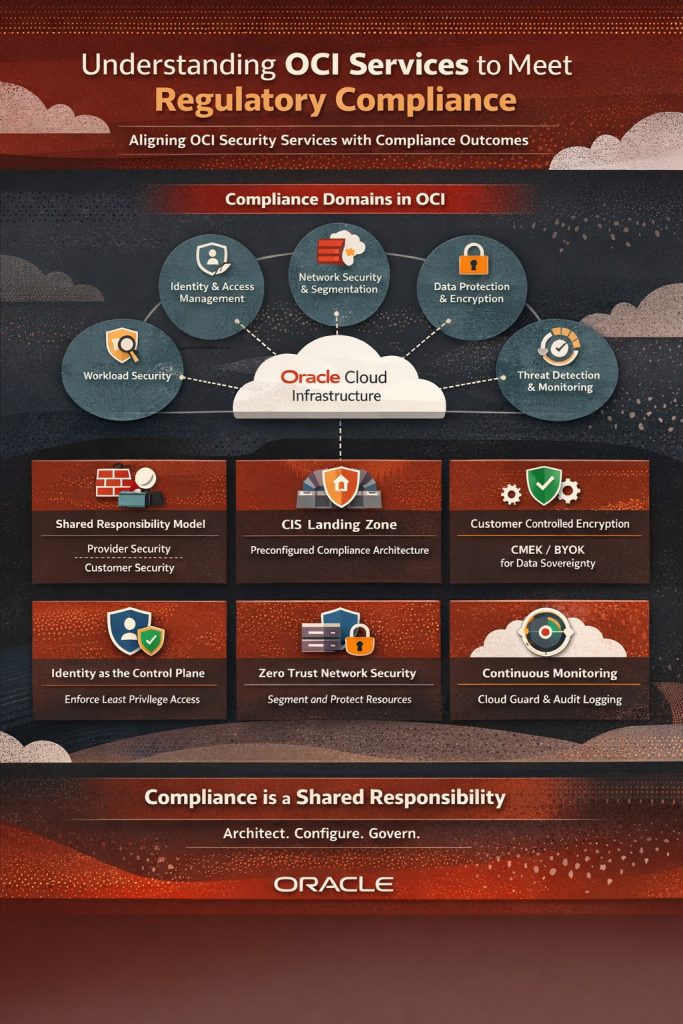
At the center is OCI. Surrounding it are the control domains that determine how compliance is achieved in practice.
The Shared Responsibility Model
OCI operates under a shared responsibility model.
Oracle is responsible for securing the underlying infrastructure. Customers are responsible for securing:
- Identities and access policies
- Workload configurations
- Network architecture
- Data classification and protection
- Logging and monitoring
This distinction is critical. Most compliance gaps do not originate from the platform itself, but from how services are configured and managed.
Common risks include:
- Overly permissive identity policies
- Misconfigured network exposure
- Insufficient data protection controls
- Lack of centralized logging and response processes
Understanding and operationalizing shared responsibility is foundational to achieving compliance.
Identity and Access Management
Identity is the primary control plane in cloud environments.
OCI Identity and Access Management (IAM) enables organizations to define and enforce access through:
- Policy-based authorization
- Identity domains for segmentation
- Federation with enterprise identity providers
- Multi-factor authentication and credential controls
Effective compliance requires:
- Enforcement of least privilege access
- Clear role-based access models
- Strong credential lifecycle management
Regulatory frameworks consistently emphasize identity governance as a core requirement. In OCI, IAM provides the mechanisms—but effectiveness depends on disciplined implementation.
Network Security and Segmentation
OCI networking services enable organizations to design secure, segmented environments that align with zero trust principles.
Key capabilities include:
- Virtual Cloud Networks (VCNs) for isolation
- Network Security Groups (NSGs) for granular traffic control
- Web Application Firewall (WAF) and Network Firewall for threat protection
- Private access patterns to reduce internet exposure
From a compliance perspective, network design should:
- Minimize attack surface
- Enforce controlled communication paths
- Prevent unintended public exposure
Misconfigured networking remains one of the most common sources of compliance findings in cloud environments.
Data Protection and Cryptographic Control
Data protection is central to regulatory compliance.
OCI provides encryption capabilities across the full data lifecycle:
- Encryption at rest
- Encryption in transit
- Encryption in use (for sensitive workloads)
Beyond encryption, OCI enables customer control through:
- OCI Vault for centralized key management
- Customer-Managed Encryption Keys (CMEK)
- Bring Your Own Key (BYOK)
- External key management (HYOK patterns)
These models allow organizations to align with requirements related to:
- Data sovereignty
- Key ownership
- Separation of duties
For many regulatory frameworks, demonstrating control over encryption keys is as important as encryption itself.
Workload Security and Configuration Control
OCI provides multiple capabilities to support secure workload deployment and ongoing configuration management.
These include:
- Security Zones to enforce preventative guardrails
- Hardened compute images and patching capabilities
- Vulnerability Scanning Service for continuous assessment
- Fleet Application Management for consistency at scale
The objective is to reduce risk introduced by:
- Configuration drift
- Unpatched systems
- Inconsistent security baselines
Preventative controls play a critical role in maintaining compliance over time.
Monitoring, Detection, and Auditability
Compliance requires continuous visibility and the ability to demonstrate control effectiveness.
OCI supports this through:
- Cloud Guard for posture management and threat detection
- Logging and Audit Services for traceability
- Service Connector Hub for centralized log integration
Cloud Guard provides continuous evaluation of:
- Configuration risks
- Identity exposure
- Network misconfigurations
- Indicators of suspicious activity
These capabilities enable organizations to move from periodic audit preparation to continuous compliance monitoring.
Automated Response and Incident Management
Modern compliance expectations extend beyond detection to include response capability.
OCI provides tools for automation and remediation:
- Cloud Guard responder recipes
- OCI Events for event-driven workflows
- OCI Functions for serverless automation
These services allow organizations to:
- Reduce response times
- Enforce consistent remediation actions
- Maintain audit trails for incident handling
Automation strengthens both security posture and compliance readiness.
The Role of the CIS Landing Zone
OCI’s CIS Landing Zone provides a prescriptive starting point for secure cloud deployment.
It includes:
- Structured tenancy and compartment design
- Predefined identity and access policies
- Integrated security services
- Standardized networking architecture
The value of this approach is consistency—an essential requirement for compliance at scale.
For a deeper perspective on how the CIS Landing Zone supports security and compliance outcomes, see:
https://www.ateam-oracle.com/ciso-perspectives-using-the-oracle-cloud-infrastructure-oci-cis-landing-zone-for-security-compliance
Conclusion
OCI provides a robust set of capabilities to support regulatory compliance. However, compliance is not achieved through platform adoption alone.
It is achieved through:
- Intentional architecture
- Controlled configuration
- Continuous monitoring and governance
For CISOs, the priority is clear:
Align cloud security services to control objectives, not just technical features.
When implemented effectively, OCI can serve not only as infrastructure but as a foundation for measurable, defensible, and scalable compliance.
Compliance in OCI is not declared. It is designed, implemented, and continuously validated.