
Why every agent hop needs target-bound, delegated authority
Introduction
Token-based identity propagation belongs in the security architecture for Agentic AI. Agents select tools, reach different systems and act autonomously or on behalf of human users.
Consider an employee, Alice, asking an AI agent to prepare for a customer meeting. The agent reads her calendar, retrieves the customer record, checks support cases and orders, and drafts a summary. To Alice, this is one request. To the security architecture, it is a sequence of calls to multiple components, potentially crossing different trust boundaries.
At each boundary, we need to know the user, the agent or service making the call, the delegated operation and intended resource. A shared service account loses the user identity. Forwarding the original user token is not the alternative either: it can carry excess privilege, and an MCP server must not accept or forward a token issued for another resource.
Identity, once attached at the start of an agent flow, must travel across. Identity propagation aligns agent autonomy with enterprise authority, by governing how authority moves from a user, through an agent and its tools, to enterprise resources (aka backend systems). The user’s identity and the credentials used along the path are different things. The identity context remains available while each credential is adapted to its next hop.
The Blueprint Alliance’s Governing Agentic Execution paper offers a broader frame: agent discovery and identity, access management, runtime authorization and control, and active containment.
Two of its principles run through this article: access scoped to the task and delegation that remains traceable across hops. We’ll look at how per-hop credentials and Last Mile Enforcement help put them into practice.
Why Agents Make This More Important
Over-privileged accounts, confused deputy problems and ambient authority predate agentic AI. A confused deputy is a trusted component that uses its broad authority to serve a less-authorized caller. Ambient authority is authority a component already possesses through standing credentials, rather than authority explicitly delegated for the current task.
A conventional application follows known paths, defined by developers when the application is written. On the other hand, an agent dynamically selects tools at runtime and may combine valid operations in a sequence nobody modeled during development. This raises at least four considerations:
- Dynamic reach: When a next target is selected within the agentic flow, a broadly accepted credential is turned into ambient authority. Instead, authority should follow the selected task and target. Being allowed to read a calendar should not quietly become permission to query every system the agent discovers.
- Multi-hop delegation: A user may authorize an agent to act on his/her behalf. That agent may delegate part of the task to another agent, which then calls a tool through an MCP server. Knowing the originating user alone is not enough. Each hop needs trusted context about who is acting for whom, with authority bounded to its part of the task. Delegating work should not automatically delegate authority.
- Autonomous fan-out: An agent can chain, retry and parallelize tool calls without a person reviewing each step. One authorization mistake can therefore create a larger blast radius before being noticed. Limits must be applied on every branch, and sensitive operations should require explicit user approval.
- Accountability: A shared application principal shows that a trusted application acted, but not which user or workload was involved. Accountability means retaining the originating principal and the acting agent or workload, so each operation can be attributed as the flow expands.
A Boarding Pass for Every Leg
Air travel provides a good analogy.
A passport represents your identity. A trusted authority issues it, but it grants access to no particular flight.
A boarding pass is a scoped, expiring credential derived from that identity. It identifies one flight, seat and date. The gate agent accepts it only for the intended flight and can validate it without calling the passport authority on every scan.
A multi-leg journey has a separate pass for each leg. A stolen pass is useless at another gate, after departure or on another flight.
At immigration, the traveler presents a passport to establish identity. Having a boarding pass does not, by itself, grant permission to enter the country.
In an agentic flow, the destination validates the credential and trusted identity context it accepts. This does not necessarily mean presenting the original login credential or asking the user to sign in again.
Once admitted, local rules determine what the traveler may do. A citizen, a tourist and a visitor with a work visa have different rights. This is Last Mile Enforcement.
Identity propagation applies the same model to an agent flow:
| Air travel | Agentic system |
|---|---|
| Passport | The user’s authenticated identity at the Identity Domain |
| Boarding pass | A distinct access token for the next-hop audience and scope |
| Gate check | Each resource validating its token’s audience and permitted scope |
| A pass per leg | An access token issued for each next hop |
| Ticketing desk | The trusted token exchange service |
| Journey record | The record of which user and workload were involved at each hop |
| Actions allowed in the destination | Last mile enforcement |
Here is the architecture pattern:
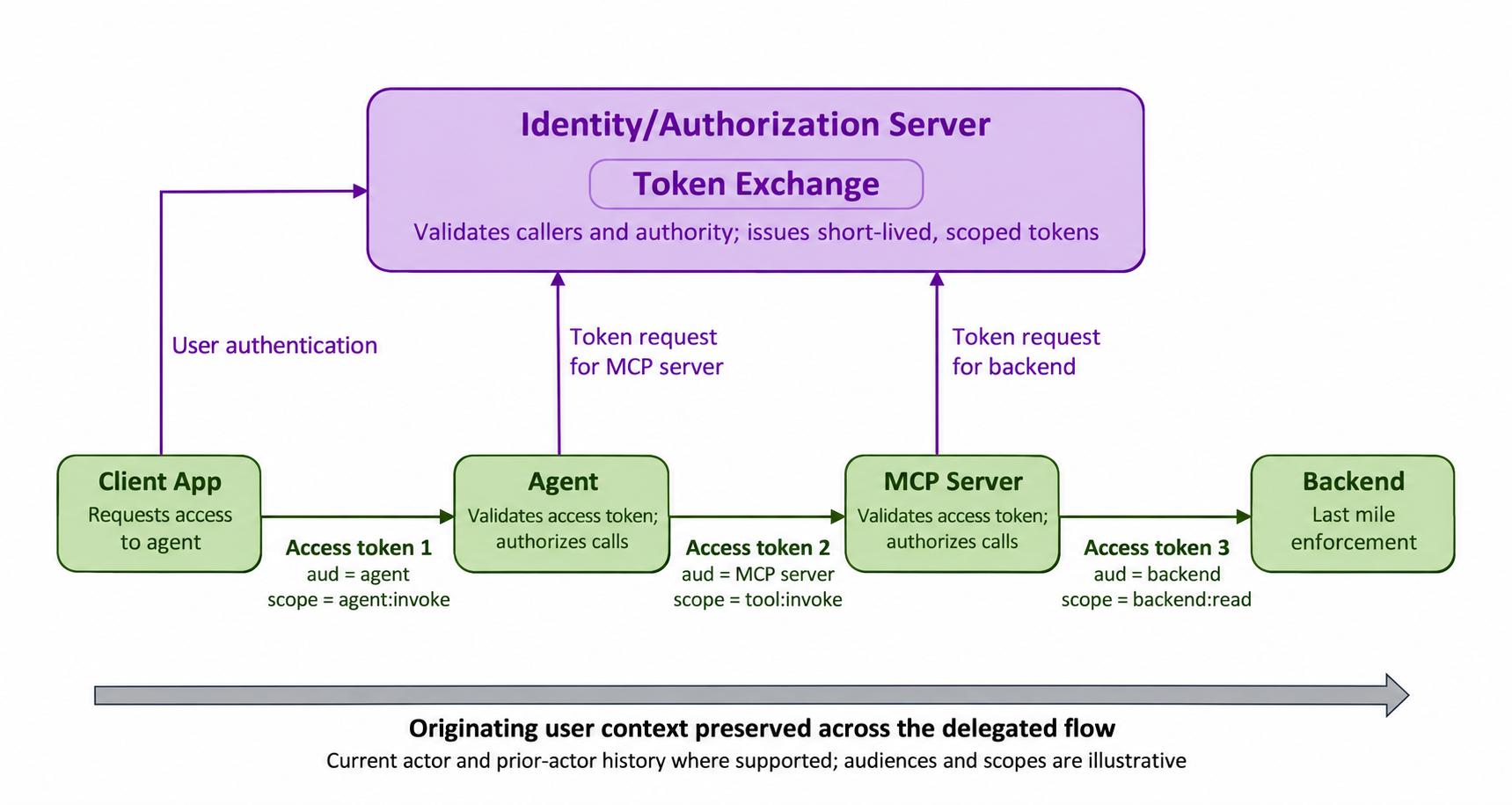
In this article, Backend or Backend system means an API, database or cloud service behind a tool. Both the backend and the MCP server can be resource servers in the OAuth sense.
MCP Servers Are Guardrails, Not the Resource Boundary
An MCP server is a security boundary, but normally not the final resource boundary. MCP treats a protected server as an OAuth resource server: it must validate tokens issued for itself and must not accept or forward tokens for another resource. The MCP authorization specification and security guidance are clear on this point.
That makes the MCP server a valuable enforcement point. It can validate user and actor context, restrict tools and arguments, require approval, rate-limit, redact results and audit. For a purpose-built tool exposing a small capability, these controls may be the primary authorization decision.
They are not enough when the MCP server reaches a broadly privileged backend that simply trusts its service credential. For example, a tool may retrieve Alice’s customer record through an application account that can read every record; filtering to her territory then happens after the data has crossed the boundary. An MCP server defect, direct backend path or leaked credential can expose the MCP server’s broad backend authority without its controls.
Where possible, the backend should validate its target-bound credential and apply resource policy using the trusted user, actor and delegated context it supports.
The MCP server governs the tool call; the backend governs the resource action. Both validate and audit.
Is Last Mile Enforcement Enough?
Last Mile Enforcement is required. A backend system should protect its own assets: a database protects rows and columns, an API authorizes operations and a cloud service applies IAM policy. Some backend systems can go further and authorize more than the end user.
This begs a question as we start making our backend systems available to agentic flows: Can your API tell that Alice is acting through the CRM agent, or Alice working through a traditional application interface? Does the API only see a connector’s shared account? Can it permit reading one customer record without also permitting a bulk export? For a database, does Alice’s context constrain the rows and columns returned?
The Blueprint Alliance applies this principle to gateways too: downstream API gateways validate and authorize each call, even after upstream inspection.
The backend does not need visibility into the exchange itself. It validates the credential and context it accepts, then applies policy to the requested resource and operation.
Oracle Deep Data Security (DDS) is a good example. Its documented flow uses an end-user token for user identity and roles plus a database-access token that authenticates the application. If the agent is a registered application identity, the database can validate both and enable application-specific data roles. This is dual-principal authorization, not merely a username passed to the tool. See DDS two-token flow for more details.
By verifying the user and application identity, Deep Data Security knows Alice is the user, which registered agent is calling and whether both qualify for active data roles.
The Backend Can Only Enforce the Context It Receives.
A fair challenge at this point: if every backend enforces on the user and the calling application, why mint scoped credentials along the way at all?
That enforcement depends on the backend receiving verifiable user and application context. Deep Data Security’s dual-principal model works because those identities are available to it.
A shared platform credential alone does not supply those identities. The flow needs a trusted way to carry and verify them; per-hop exchange is one approach.
This is the problem identity propagation addresses. A backend can enforce the context it receives without knowing how the credentials were obtained.
This post from Uber describes the same practical conclusion from a production agent platform: an MCP gateway can enforce tool-level policy, but preserving execution context required support in the agent application layer. Its security token service issues short-lived, audience-specific tokens at each hop, allowing downstream systems to receive a verifiable user and agent context instead of seeing only a generic service identity.
The failures that survive a correct resource decision
With that said, let’s still assume every backend receives what it needs and decides correctly. A harmful outcome can still arise, even when last mile policies are correctly enforced. Anthropic’s Zero Trust for AI Agents catalogues the underlying failures.
- Unscoped privilege inheritance: a high-privilege agent can delegate a task without narrowing the authority it passes to a worker agent. The worker then holds more authority than the task requires. Issuance-time controls prevent this overbroad grant by limiting the new credential’s audience, scope, lifetime and, where used, sender. Resource controls still govern each resource the worker reaches, but they cannot remove authority already granted for other targets.
- Tool chaining: legitimate calls can be individually composed into a harmful sequence: reading records through an approved tool, then sending them out through another. Each resource may make a correct local decision on the request and context it receives, while the aggregate sequence still violates the intended workflow unless policy has workflow or intent context. Because every command can run through trusted binaries under valid credentials, host-centric monitoring may not flag the misuse.
- Memory-based privilege retention: an agent can retain credentials or secrets from a prior secure session and use them in response to a later request. The resource sees a valid request from an authorized agent; the cross-session leakage occurred before that request. Short lifetimes and session- or agent-bound credentials reduce this exposure but do not replace memory isolation.
Impossible, not merely tedious
Anthropic’s Zero Trust guide proposes a useful test for any control: does it make an attack impossible, or merely tedious? Friction degrades against an adversary with unlimited patience and near-zero cost per attempt, while the controls that hold share a pattern—expiring credentials, cryptographic identity, paths that do not exist rather than paths that are inconvenient.
Last Mile Enforcement plus broad credentials and good logging still leaves broad authority available for misuse.
A credential bound to one audience prevents acceptance by a different resource that validates audience. It does not, on its own, prevent reuse at the intended resource before expiry.
The restriction is established at issuance and enforced by the receiver. RFC 9700 recommends audience-restricted and, where practical, sender-constrained tokens.
Last Mile Enforcement answers the local authorization question: may this caller perform this operation on this resource? The architecture must answer the broader delegation question: what authority should the agent be able to obtain and carry to each resource along the way?
The same principle applies to the network environment. Agents should be able to reach only the destinations their tasks require, through paths that preserve the intended enforcement points.
If backend access is meant to go through an MCP server, a direct connection from the agent can bypass its tool controls. Unrestricted outbound access can also provide a route for data to leave the intended flow.
Removing unnecessary paths makes those routes unavailable, even if an agent tries to use them. The remaining paths still need authentication, authorization and monitoring. Network boundaries and identity controls work together.
Last Mile Enforcement and Delegation Work Together
Delegation governs the authority a caller may obtain and carry. Last Mile Enforcement governs what that authority permits at the destination. The two controls need to agree, even when they are operated by different systems.
That leads to a practical flow:
- The user authenticates through the Identity/Authorization Server, and the client application obtains an access token for the Agent.
- The application establishes the user and acting agent for the request.
- Before a downstream call, the Agent or MCP server requests a token from a trusted token exchange service.
- The token exchange service validates the caller’s authority and obtains a distinct access token for the next-hop audience and scope.
- The MCP server constrains the tool call.
- The backend validates its credential and applies its own resource policy.
The issued credential connects the upstream delegation decision to the downstream call. Its limits still need to be meaningful to the receiver, which validates it and applies resource policy to the operation and data.
If an agent can obtain broader credentials than its task requires, one backend’s correct decision does not fix that exposure. If the backend ignores a credential’s limits, a careful exchange cannot enforce them on its behalf.
How to Assess the Security Model
The following questions provide a quick way to assess the security model of agentic applications:
- Can every relevant action be attributed to both the originating principal and the agent that acted?
- Does the agent receive the user’s standing privilege or a smaller delegated authority for the task and target?
- Are credentials short-lived, audience-restricted and sender-constrained where practical?
- Do MCP servers constrain calls while backend systems apply native policy?
- Can each resource consume the relevant user and current-actor context, and can audits preserve enough of the delegation path?
- Can authority be narrowed, or additional approval requested, as the agent moves from reading to writing?
- If one hop is compromised, which other backend systems can its credential reach?
Answers may reveal security gaps or opportunities for improvement, but any assessment must also consider platform limitations, integration constraints, and explicitly accepted risks.
A Field Still Taking Shape
The field is moving quickly, but many of its building blocks are already established. What is still evolving is how they fit together across agents, tools and enterprise resources.
It helps to know which problem each specification addresses, and whether it is published or still a draft. As of November 2026, these are some of the main references:
- OAuth foundations. The OAuth 2.1 Authorization Framework is still an IETF draft consolidating current practice. RFC 9700 is already a published OAuth Security Best Current Practice.
- MCP authorization. The HTTP authorization specification brings together OAuth flows, metadata discovery, resource targeting, scopes and token validation.
- Client metadata. The Client ID Metadata Document (CIMD) draft describes clients through URL-addressed metadata. See this post from Kiran on Connecting Codex to MCP Server with OCI Identity Domain and CIMD.
- Cross-app access. Identity Assertion JWT Authorization Grant (ID-JAG) is an OAuth working-group draft for using identity assertions to obtain access to third-party APIs. Kiran has also posted about the value of ID-JAG.
- Delegation and targeting. Token Exchange (RFC 8693) supports subject/actor exchange; Resource Indicators (RFC 8707) names the intended resource. Both are published RFCs. Delegation policy and claim support remain deployment choices.
- Stolen-token defenses. Demonstrating Proof of Possession (DPoP, RFC 9449) and OAuth mutual TLS (RFC 8705) provide sender-constraining mechanisms. Binding token use to a key reduces misuse of stolen tokens.
- Richer requests. Rich Authorization Requests (RAR, RFC 9396) carries structured authorization details; Pushed Authorization Requests (PAR, RFC 9126) pushes requests directly to the authorization server. Both are published RFCs.
- Backchannel user interaction. CIBA Core 1.0 is an OpenID Final Specification for backchannel authentication. It can support a user interaction step, but does not itself define approval for a particular tool action.
- Workload identity. SPIFFE defines workload identifiers and short-lived identity documents. It provides an authentication foundation; the authority delegated to an agent still needs its own policy.
- IETF workload and agent work. The IETF’s WIMSE architecture and AI Identity Management System (AIMS) are working-group drafts applying existing identity and security mechanisms to multi-system and agent interactions.
Related OAuth work on Transaction Tokens is also still a draft. It targets identity and authorization context across service-call chains within a trusted domain, making it relevant to multi-hop flows.
These efforts are complementary. They cover client identification, authentication, delegation, credential protection and request context; none, by itself, specifies the complete authorization policy for an agentic application.
Oracle is working in this direction too. Its published work on OCI IAM describes agent identities, temporary authority, contextual authorization and action-specific human approval as capabilities under development.
Conclusion
Constrained identity propagation is a foundational control for Agentic AI. Last Mile Enforcement can authorize the user and current actor at a resource, but the properties that determine how much damage a credential can do are set before it ever arrives.
This is a rapidly evolving field. As protocols and product support change, we need to keep checking what each system enforces and testing how the pieces work together. Support for one standard does not secure the whole flow.
Nevertheless, the key takeaway is simple: the user’s identity should travel through the whole agent flow while each credential is limited to its next destination. This turns a user request into a secure chain of delegated actions rather than a sequence of operations performed with ambient authority.
With the right exchange and resource policies, enterprises can give agents useful autonomy while keeping it bounded, attributable and aligned with the user’s authority: preserve the traveler, issue a new pass for every leg and let each destination apply its own rules.
References
- Anthropic: Zero Trust for AI agents Official article and linked guide.
- Uber Engineering: Solving the Identity Crisis for AI Agents
- Blueprint Alliance: Governing Agentic Execution: An Architectural Blueprint for the Secure Agentic Enterprise White paper.
- Oracle Cloud Infrastructure Blog: Building Trusted Access for AI Agents with OCI IAM October 30, 2026.