
Building, Ranking, and Breaking Attack Paths Before They Become Incidents
Expanded blog focused on items 1-4 from the Oracle CISO Perspective article on modern vulnerability management in the age of frontier cyber models
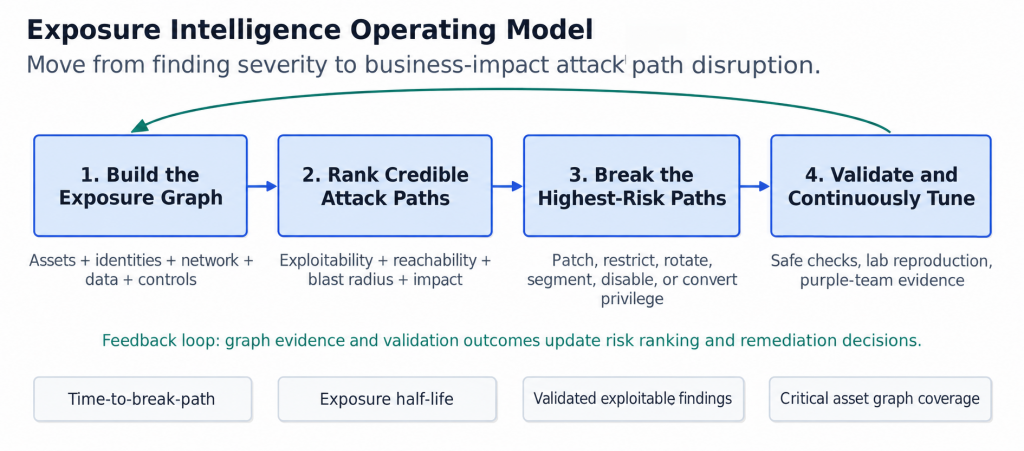
Figure 1: Exposure intelligence operating model.

Reference source article: Oracle CISO Perspective: Modern Vulnerability Management in the Age of Frontier Cyber Models
1. Executive Summary
The reference article argues that vulnerability management must move beyond asking, “How many critical vulnerabilities do we have?” toward a more useful executive question: “Which exploitable exposures create credible paths to business impact, and how quickly can we break those paths?” This document expands on the first four recommendations in that article and converts them into an operating model security teams can implement.
The central shift is from scanner-centric severity management to graph-driven exposure intelligence. A scanner backlog is a list of findings. An exposure graph is a model of how compromise could actually happen. It connects assets, vulnerabilities, identities, network reachability, sensitive data, business services, and defensive controls so teams can prioritize the paths that matter most.
The practical outcome is a ranked set of systems and paths that security, engineering, identity, network, and application teams can act on together. The highest-priority action may be a patch, but it may also be removing internet exposure, disabling a stale account, enforcing phishing-resistant MFA, rotating a secret, tightening a security group, segmenting a crown-jewel subnet, or converting standing privilege to just-in-time access.

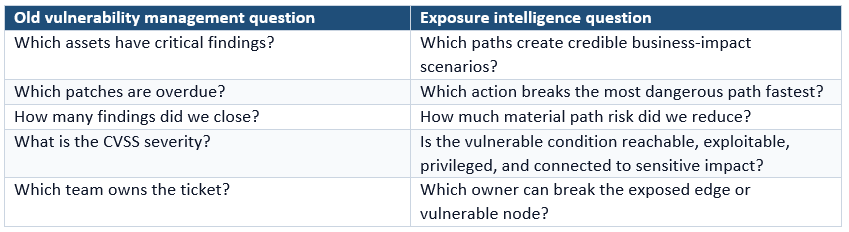
2. Why Scanner Backlogs Are No Longer Enough
Traditional vulnerability programs often begin with scanners and end with tickets. That approach answers useful operational questions: which hosts are missing a patch, which container images include a vulnerable package, or which endpoints have an unsupported version. But it does not reliably answer the risk question that matters to leaders: which exposures create the shortest, most credible route to material impact?
Severity labels can be misleading when they are separated from context. A high-severity vulnerability on an isolated lab asset may not present immediate business risk. A medium-severity weakness in an internet-facing application that runs with broad service-account privileges and reaches a regulated database may require urgent action. CVSS is a severity framework; it should not be treated as a complete measure of enterprise risk [2].

The exposure intelligence model adds missing context. It asks whether the vulnerable component is active, whether an attacker can reach it, whether exploitation yields useful privilege, whether downstream systems or data are sensitive, and whether tested controls actually block the path.
3. Item 1: Build an Enterprise Exposure Graph
An effective exposure graph is the decision engine for modern vulnerability management. It connects technical weakness to reachability, identity, business criticality, data sensitivity, and control effectiveness. The graph should show not only that a system is vulnerable, but whether that vulnerability can be reached, exploited, chained, detected, and remediated by a known owner.
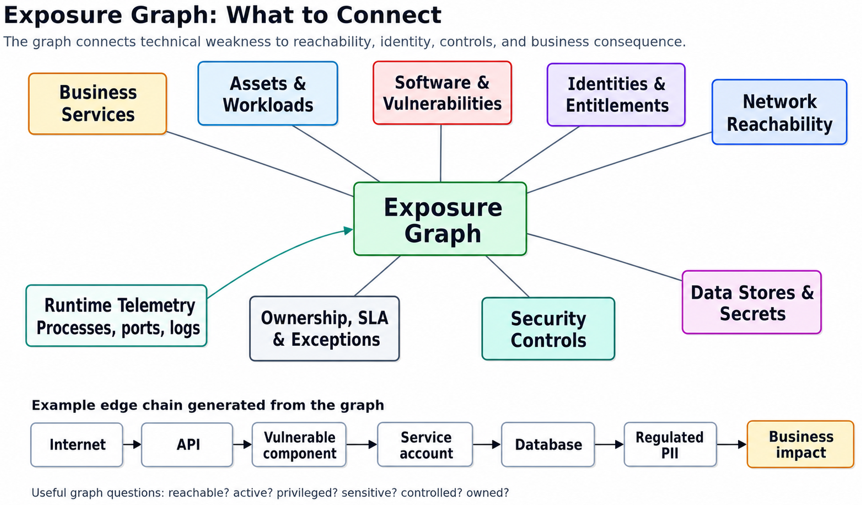
Figure 2: Exposure graph data model and example edge chain.
3.1 What the graph should model
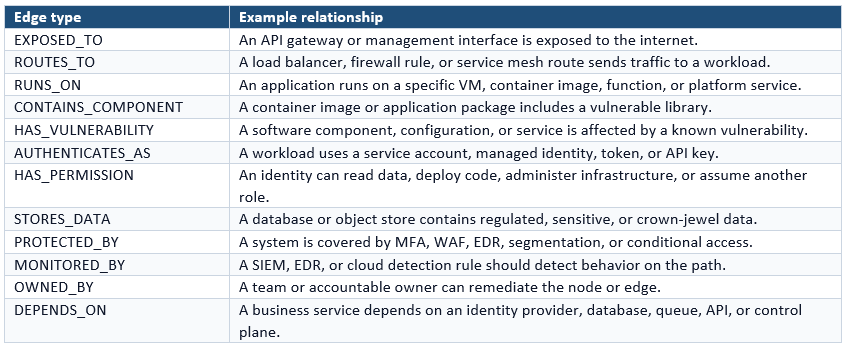
The graph needs two kinds of information: nodes and edges. Nodes represent the things that matter to exposure: systems, workloads, identities, vulnerabilities, data stores, business services, and controls. Edges represent the relationships that make attack paths possible.
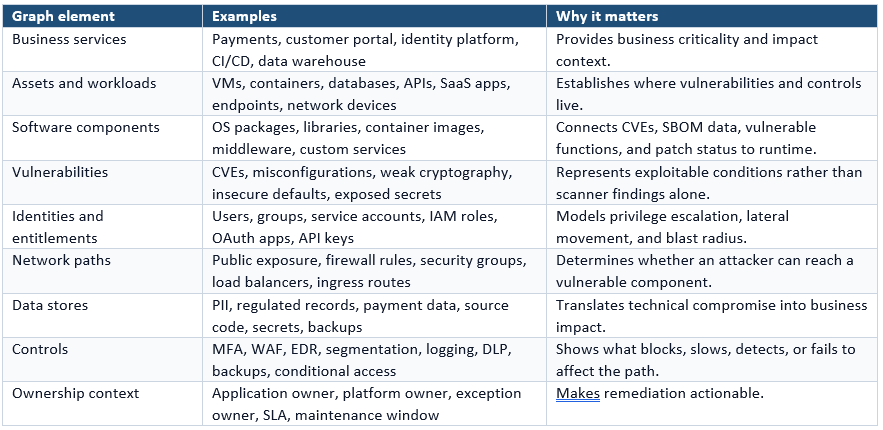
3.2 Edges are where risk becomes visible
The graph becomes useful when relationships are modeled explicitly. The difference between a vulnerability inventory and an exposure graph is the presence of edges that describe reachability, privilege, dependency, data flow, and control coverage.
3.3 Start with crown jewels rather than everything
The fastest path to value is not to model the entire enterprise on day one. Start with the systems whose compromise would create material impact: payment platforms, identity providers, production control planes, customer data stores, regulated workloads, developer platforms, privileged access systems, and high-value SaaS tenants.
For each crown-jewel service, map the following eight dimensions:
1. Business function: what service, transaction, or operating process does the system support?
2. Impact: what happens if confidentiality, integrity, or availability is lost?
3. Ingress: how can traffic, users, vendors, automation, or workloads reach it?
4. Identity path: which human and non-human identities can access it?
5. Privilege path: which roles, groups, tokens, or entitlements allow escalation?
6. Data path: what sensitive records, secrets, source code, or transactions are reachable?
7. Control path: what prevents, detects, or limits abuse on each edge?
8. Owner path: who can remediate each vulnerable node or exposed edge?

3.4 Data sources for the graph
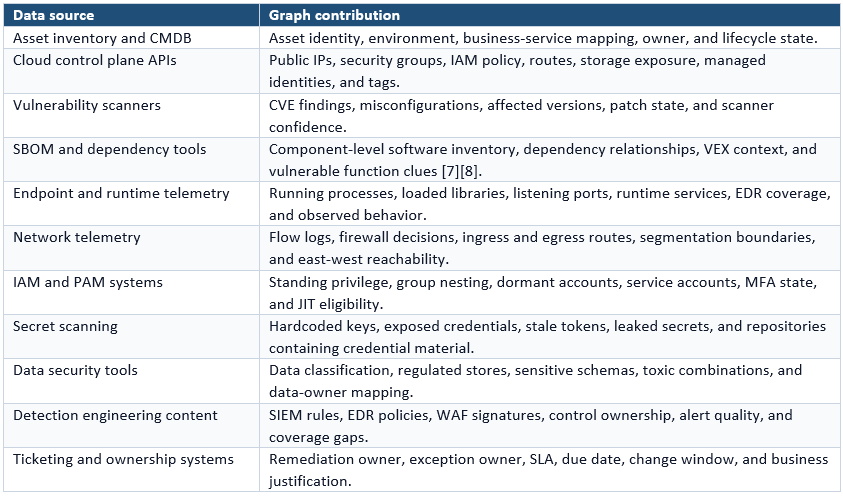
3.5 Build process
A practical build process should use iterative enrichment rather than a large modeling project that takes months before producing value.
1. Define covered systems. Begin with crown-jewel services and their direct dependencies.
2. Normalize asset identity. Resolve duplicates across scanners, CMDB, cloud APIs, endpoint tools, and ticketing systems.
3. Load vulnerability and misconfiguration data. Keep scanner confidence and finding age as attributes rather than treating every finding equally.
4. Add reachability. Model internet exposure, ingress routes, internal network paths, service mesh routes, vendor access, and management-plane access.
5. Add identity. Include users, groups, service accounts, workload identities, tokens, OAuth apps, and role assumptions.
6. Add business impact. Attach business service, data sensitivity, regulatory scope, customer impact, revenue dependency, and operational criticality.
7. Add control evidence. Represent preventive and detective controls as graph nodes and mark whether they are assumed, observed, or validated.
8. Generate candidate paths. Search for plausible routes from entry points to impact targets.
9. Validate priority paths safely. Convert uncertain edges into evidence using passive signals, lab reproduction, and production-safe checks.
10. Feed results into remediation. Create tickets or change requests for the path-breaking action, not just the vulnerability finding.
4. Item 2: Use the Exposure Graph to Risk-Rank Covered Systems
Risk ranking should happen at two levels: path-level risk and system-level risk. A vulnerability alone is rarely the full unit of risk. A system may have many vulnerabilities but few credible paths to business impact. Another system may have fewer findings but much higher risk because it is exposed, privileged, and connected to sensitive data.
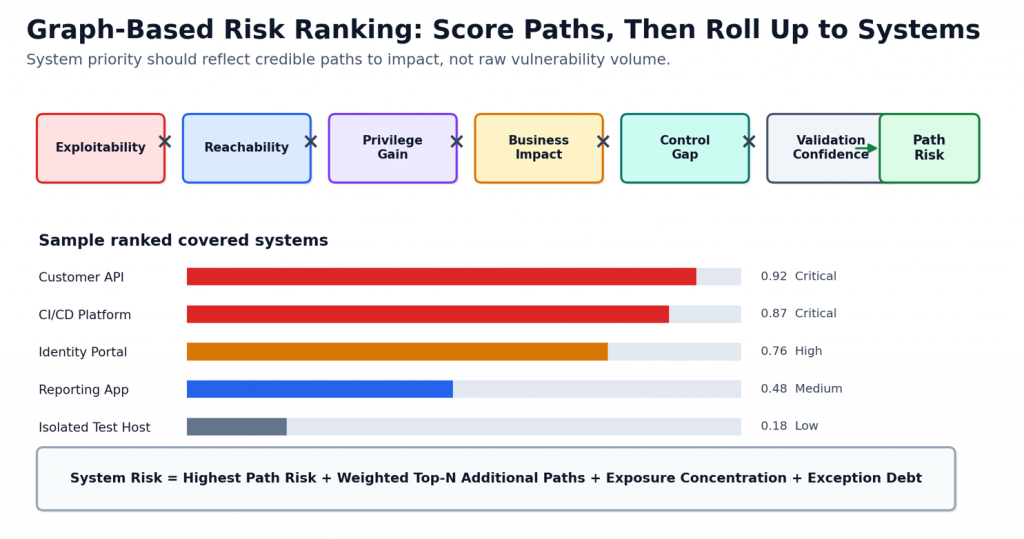
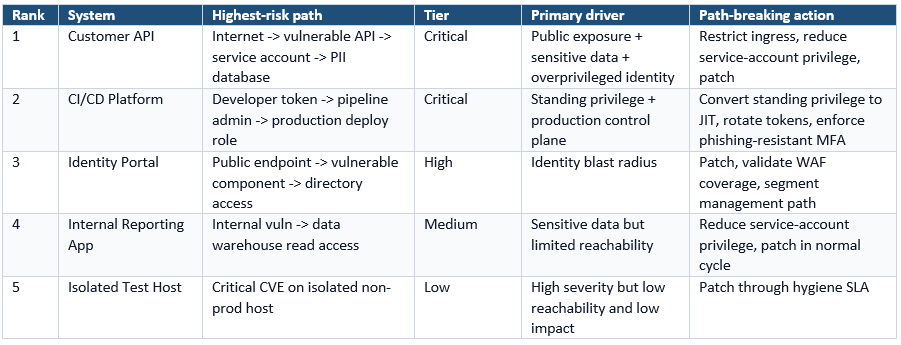
Figure 3: Graph-based risk-ranking model and sample system rollup.
4.1 Define entry points and impact targets
The graph should first identify attacker entry points and high-impact targets. This keeps path generation bounded and business-relevant.
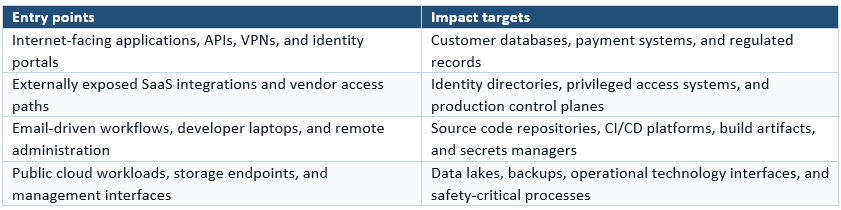
4.2 Generate candidate attack paths
For each covered system, generate plausible paths from entry points to impact targets. The path does not initially need to prove exploitation. It identifies chains that deserve prioritization and validation.
- Internet-facing API -> vulnerable dependency -> application service account -> customer database.
- Phished user -> weak or bypassable MFA -> privileged SaaS role -> sensitive file repository.
- Public admin interface -> insecure default -> cloud instance metadata -> managed identity -> storage account.
- Developer workstation -> stolen token -> CI/CD pipeline -> production deployment role -> production secrets.
- Vulnerable internal service -> excessive east-west access -> crown-jewel subnet -> regulated data store.
4.3 Score each path
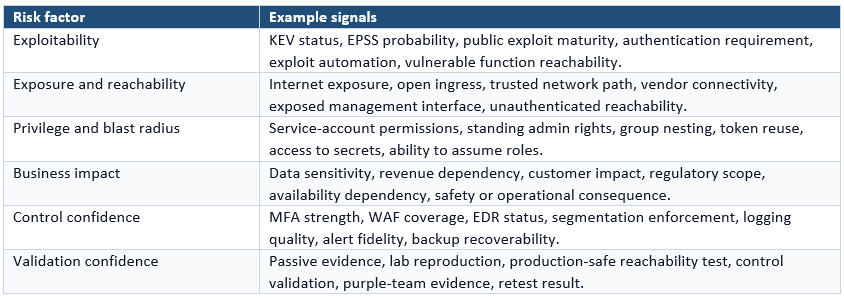
A practical path score should combine exploitability, reachability, privilege gain, business impact, control gap, and validation confidence. CISA KEV is useful because it identifies vulnerabilities known to be exploited in the wild [3]. EPSS adds a probability signal that estimates the likelihood of exploitation in the next 30 days [4]. MITRE ATT&CK provides a common language for adversary behavior across enterprise platforms [5].

4.4 Roll path scores up to system risk
System risk should not be calculated by adding every vulnerability. That rewards noisy assets and can hide the one path that matters. A better roll up starts with the highest-risk path involving the system, then adds a weighted contribution from other independent paths, exposure concentration, and exception debt.

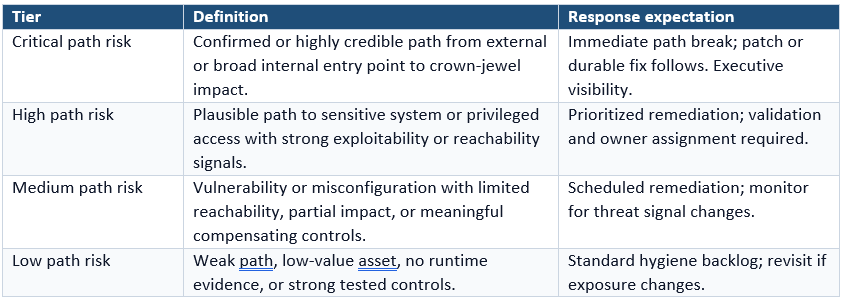
4.5 Assign risk tiers and SLAs
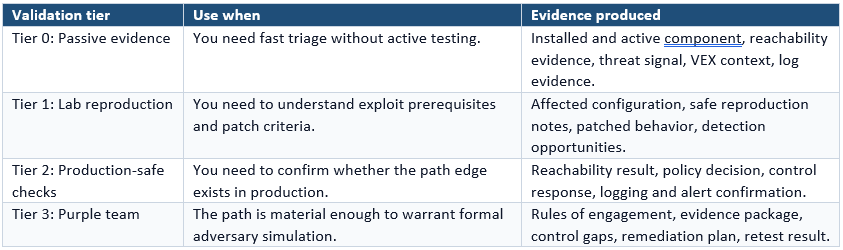
5. Item 4: Add Controlled Exploit Validation
Prioritization improves when assumptions become evidence. Controlled validation helps teams determine whether the graph path is real, whether a control actually blocks it, and whether remediation truly broke it. The objective is not to distribute weaponized proof-of-concept code or to let autonomous tools attack production. The objective is bounded, approved, logged validation that raises confidence without creating unnecessary operational risk.
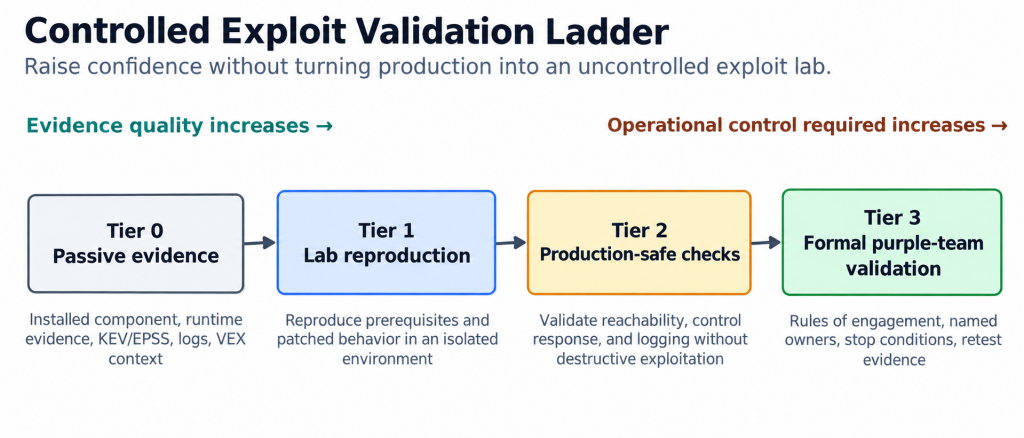
Figure 6: Controlled exploit validation ladder.
5.1 Validation Tier 0: passive evidence
Passive evidence should determine whether a finding deserves deeper review. Examples include vulnerable package installation, runtime evidence that a library is loaded, exposed service banners, internet reachability, KEV or EPSS signals, logs showing scanning, and VEX statements that indicate whether a vulnerable component is exploitable in context [3][4][8].
5.2 Validation Tier 1: lab reproduction
Lab reproduction should identify exploitation prerequisites and remediation criteria without touching production. Useful outputs include affected configurations, patched-versus-unpatched behavior, authentication requirements, network position requirements, safe detection logic, and test cases engineering can use to verify the fix.
5.3 Validation Tier 2: production-safe checks
Production-safe checks validate graph edges without exploiting production systems. Examples include confirming service reachability from a relevant zone, confirming whether a WAF or firewall blocks a benign request class, confirming whether a service account can reach a database, and verifying whether logs or alerts trigger on controlled activity.
5.4 Validation Tier 3: formal purple-team validation
Formal validation should be reserved for the most important paths and governed with written rules of engagement. Required controls include named business and technical owners, approved test windows, non-destructive payloads, rate limits, rollback plans, stop conditions, evidence capture, and retest commitments.
6. Item 3: Break the Path, Not Merely the Ticket Queue
The most important operational question is not, “Which patch is oldest?” or “Which vulnerability has the highest severity label?” The more useful question is: “Which action breaks the most credible route to business impact with the least acceptable disruption?” Patching remains essential preventive maintenance [6], but it is one path-breaking option among several.
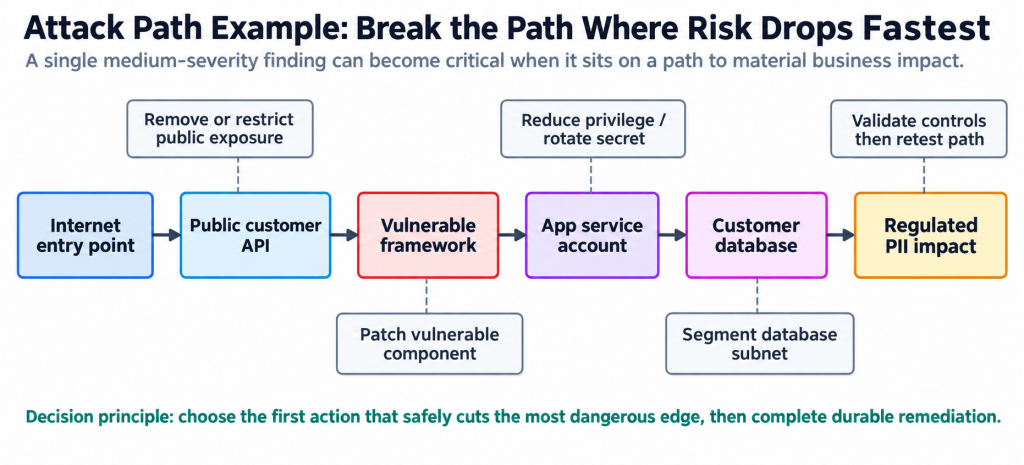
Figure 4: Attack path with candidate breakpoints.
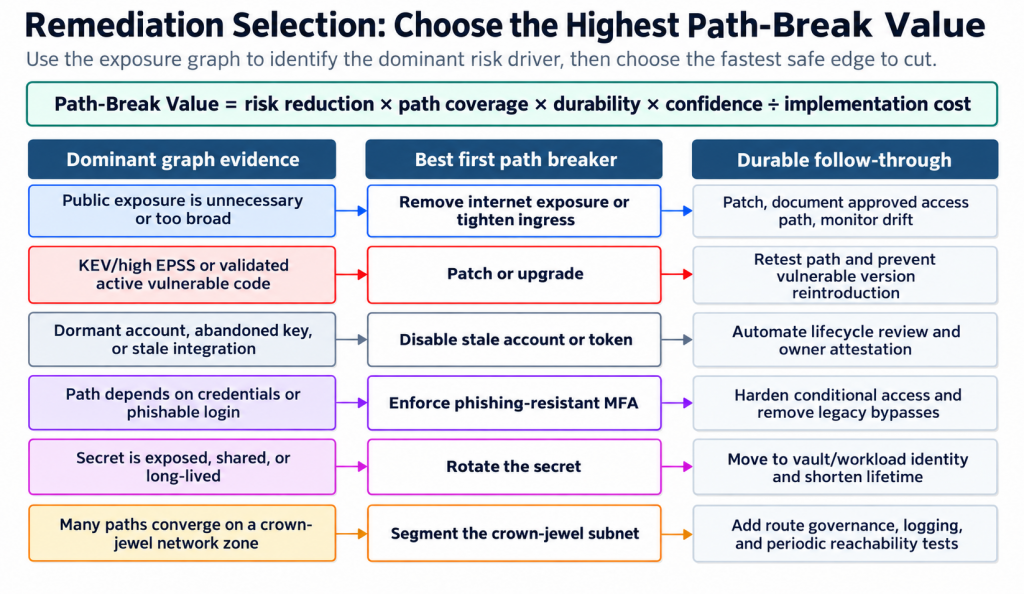
Figure 5: Remediation selection flow based on path-break value.

6.1 Remediation option decision matrix
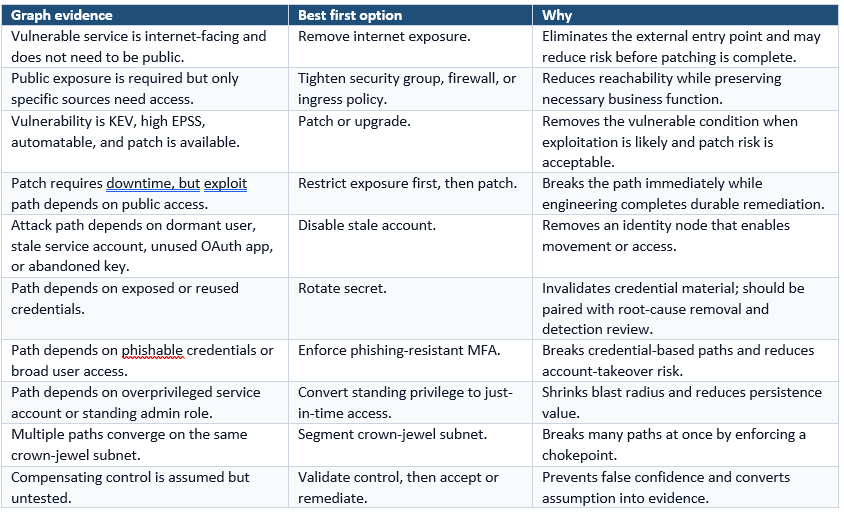
6.2 How to choose the best option
Patch
Choose patching first when the vulnerability itself is the primary risk driver, vulnerable code is active, exploitation likelihood is high, and the patch can be deployed within the required window. Patch is usually the most durable fix, but it may not be the fastest path breaker if testing or downtime delays deployment.
Remove internet exposure
Choose this when the graph shows that the internet is the entry point and public reachability is unnecessary or broader than required. This often has the highest immediate path-break value because it changes attacker reachability.
Disable a stale account
Choose this when compromise depends on an unused user, service account, vendor account, OAuth app, or abandoned key. Stale identities are often low-cost to disable and high-impact because they remove an entire edge from the graph.
Enforce phishing-resistant MFA
Choose this when the path depends on credential theft, interactive login, SaaS access, administrator access, or identity-provider compromise. This is especially important for identity, developer, production, and SaaS paths.
Rotate a secret
Choose this when the path depends on exposed, stale, shared, or overprivileged credentials. Rotation must be paired with source removal, vaulting, shorter lifetimes, detection, and least privilege; otherwise the secret may leak again.
Tighten a security group
Choose this when the path depends on overly broad ingress or east-west access. Restricting a security group can be faster than patching and can reduce multiple paths at once.
Segment a crown-jewel subnet
Choose this when many attack paths converge on a high-value environment. Segmentation is more complex than a single rule change, but it is durable and reduces systemic risk.
Convert standing privilege to just-in-time access
Choose this when privilege is the path. JIT access reduces blast radius, limits the value of stolen credentials, and makes privileged activity easier to approve, monitor, and revoke.
7. End-to-End Example: Customer API to Regulated Data
Assume the exposure graph identifies this path: Internet -> public customer API -> vulnerable framework component -> application service account -> customer database -> regulated PII. The scanner marks the framework vulnerability as medium. A severity-only backlog may place it behind several critical findings on isolated assets. The exposure graph changes the ranking because it adds reachability, identity, data sensitivity, and control evidence.
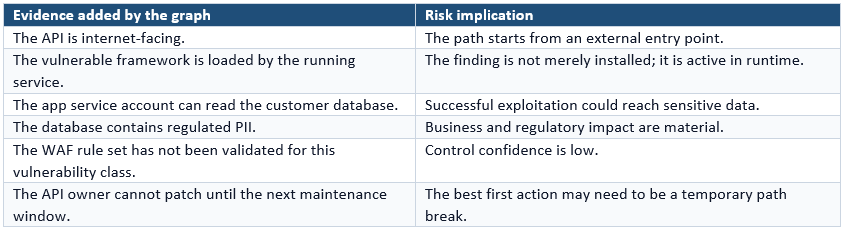
7.1 Compare remediation options
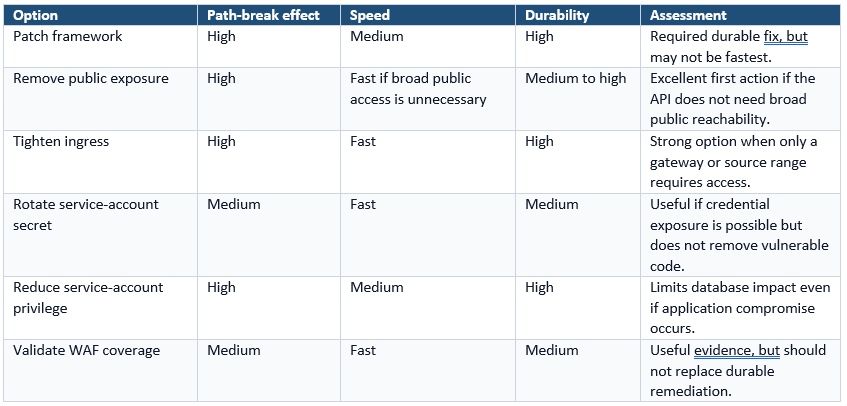
7.2 Recommended sequence
1. Restrict ingress to the required gateway, source ranges, or private access path.
2. Reduce the application service account to the least database privileges required by the business function.
3. Validate that the risky request path is blocked or unreachable from unauthorized sources.
4. Patch or upgrade the vulnerable framework during the approved maintenance window.
5. Retest the path and update graph evidence so the system risk score decreases for the right reason.

8. Operating Metrics and Governance
The strongest executive metric is time-to-break-path because it measures whether the organization can disrupt credible routes to business impact faster than adversaries can chain them. Other metrics should show graph coverage, exposure reduction, validation quality, and recurring root causes.
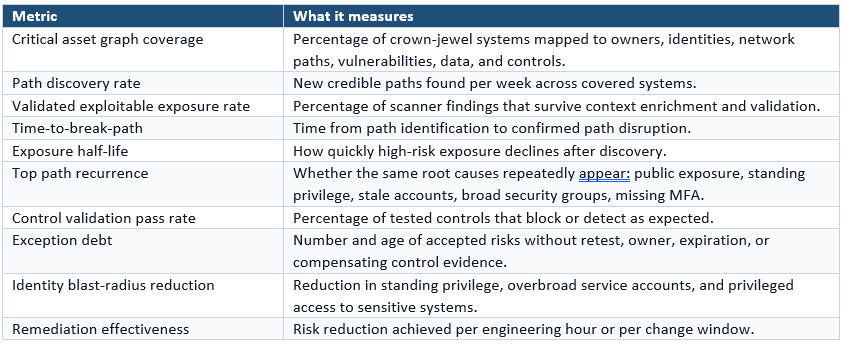
8.1 Governance controls
- Require every critical or high path to have a named business owner, technical owner, and security owner.
- Require each remediation decision to identify the path edge or node being broken.
- Require exceptions to include owner, expiration date, compensating controls, validation evidence, and retest plan.
- Use change windows for durable fixes, but allow emergency path breaks when business-impact risk is high.
- Track recurring root causes and fund systemic fixes, not only one-off tickets.
9. 30-60-90 Day Implementation Roadmap
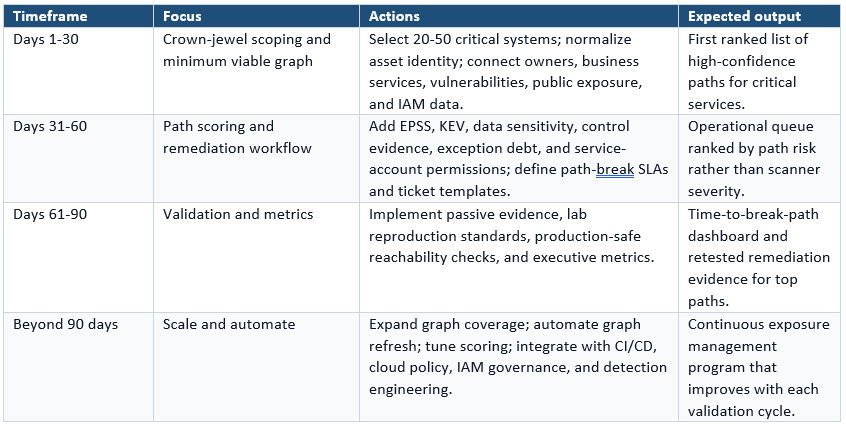

10. Sources and Further Reading
[1] Oracle A-Team: Oracle CISO Perspective: Modern Vulnerability Management in the Age of Frontier Cyber Models — Reference article expanded by this document.
[2] NVD: Vulnerability Metrics — Context for CVSS as a severity framework rather than a complete enterprise risk measure.
[3] CISA: Known Exploited Vulnerabilities Catalog — Authoritative exploited-in-the-wild signal for prioritization.
[4] FIRST: Exploit Prediction Scoring System — Probability signal estimating exploitation likelihood for published CVEs.
[5] MITRE ATT&CK: Enterprise Matrix — Common language for adversary tactics and techniques across enterprise platforms.
[6] NIST SP 800-40 Rev. 4: Guide to Enterprise Patch Management Planning — Patch management guidance for preventive maintenance and enterprise planning.
[7] OWASP CycloneDX — SBOM and supply-chain metadata context relevant to component-level exposure mapping.
[8] CycloneDX VEX capability — Vulnerability exploitability exchange context for whether a vulnerable component is exploitable in a product or environment.