

Overview
Oracle Database@Multicloud brings Oracle database services into the cloud where customers run their applications. For Exadata Database Service on Dedicated Infrastructure (ExaDB-D) and Exascale Infrastructure (ExaDB-XS), adjusting compute capacity to match workload demand helps optimize resource consumption and cost.
The Oracle Dynamic Scaling utility (ODyS) automates these adjustments through scheduled and load-based scaling. Customers can allocate more compute during business hours and reduce capacity overnight, or let ODyS respond to changes in CPU load.
As illustrated below, an active schedule takes priority: ODyS applies the configured OCPU or ECPU allocation for that period. When no schedule applies, it evaluates CPU load against configured thresholds to scale up, remain at the current allocation, or scale down after the applicable grace period. Scaling stays within configured minimum and maximum limits.
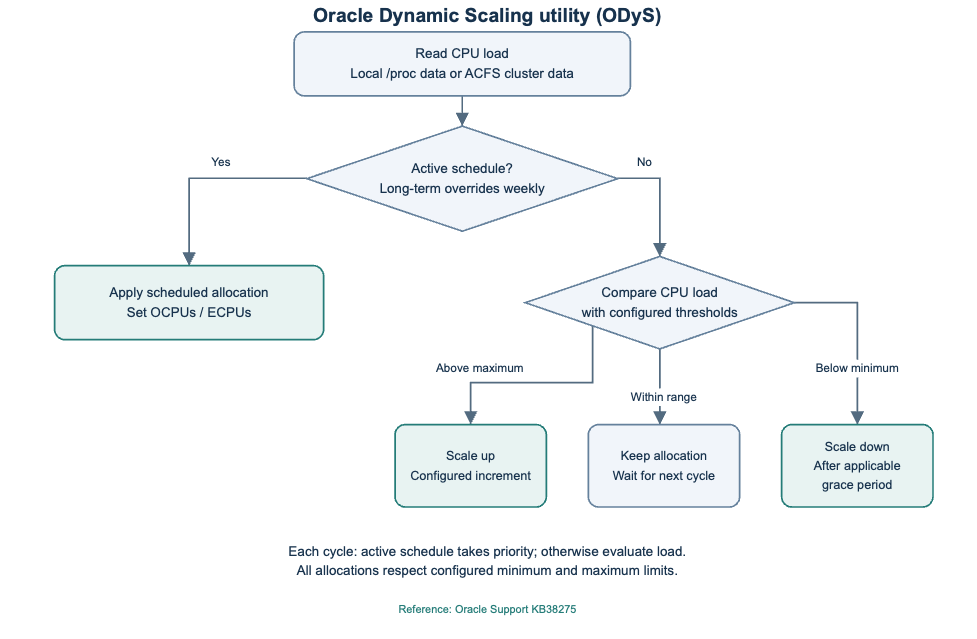
For detailed information about dynamic scaling—including supported platforms, installation, authentication, scheduling, and configuration—refer to Oracle Support Knowledge Article KB38275, Oracle Dynamic Scaling utility (ODyS) – Scale-up and Scale-down automation utility for OCI DB System (ExaDB-D/ExaDB-C@C/ExaDB-XS).
To perform these operations, ODyS must authenticate to OCI. It provides two integration paths:
- Direct REST API: Signs requests using OCI API key credentials, requiring access to a private key on the host running ODyS.
- OCI CLI: Delegates operations to the OCI CLI, allowing authentication through its configured profile or supported principal-based methods.
On OCI, instance principals provide a way to authenticate without storing user API keys on the compute instance. However, this mechanism does not directly extend to virtual machines running in AWS, Azure, or Google Cloud. Although the OCI CLI can run in those environments, authentication requires a suitable alternative. For organizations that restrict storing long-lived API keys on virtual machines, which is majority of the mature enterprise customers, this creates a challenge: how can a scaling utility running in another cloud securely invoke OCI APIs?
OCI Workload Identity Federation (WIF) provides a foundation for addressing this challenge. It allows a workload to exchange a trusted external identity token for a short-lived OCI security token, which can then authenticate OCI API requests within the permissions granted through OCI IAM. See Oracle’s JWT-to-OCI token exchange documentation.
In this blog, we build on my previous blog on WIF Workload Identity Federation overview to show how to integrate WIF with ODyS for a multicloud deployment, avoiding the storage of long-lived OCI user API keys on the scaling host.
Architecture
Oracle Database@Multicloud enables customers to run Oracle database services on Oracle Exadata infrastructure deployed within AWS, Microsoft Azure, and Google Cloud data centers. Applications connect to Oracle Database@AWS, Oracle Database@Azure, or Oracle Database@Google Cloud through the networking integration available in their respective cloud. The database deployment resides alongside the application cloud, while the OCI control plane provides Oracle database infrastructure management.
In the proposed architecture, the Oracle Dynamic Scaling utility (ODyS) runs on a compute instance in the same hyperscaler as the target database deployment in Amazon EC2 or Azure virtual machine, or a Google Compute Engine instance. It evaluates configured schedules or database workload telemetry, determines the required compute allocation, and submits scaling requests to the OCI Database API.
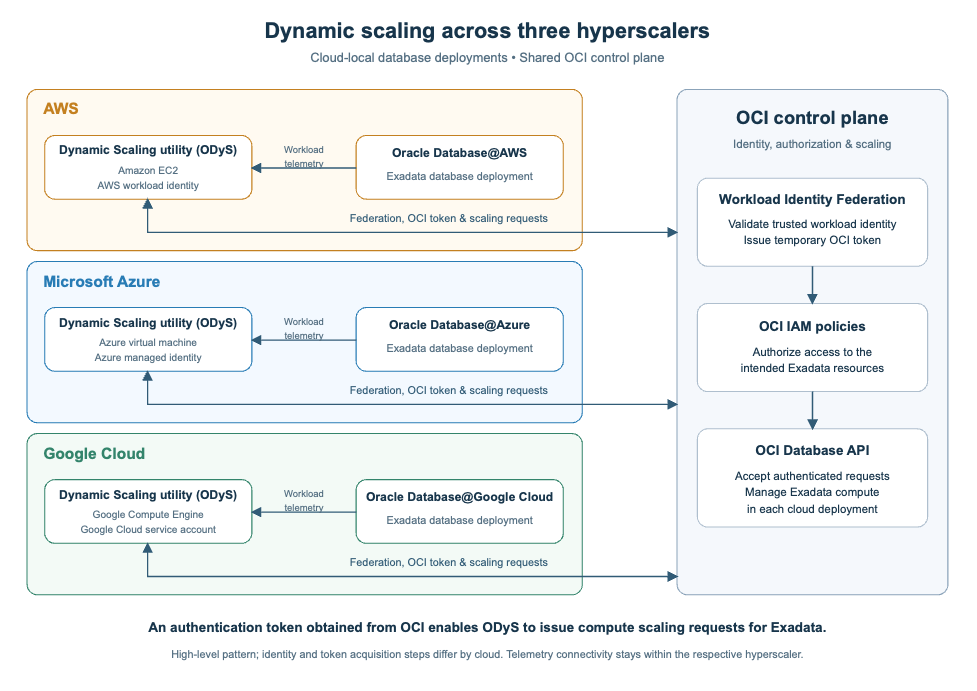
OCI Workload Identity Federation connects the workload’s identity in its application cloud with the OCI permissions needed to perform these DB operations. Each cloud requires its own identity configuration and token acquisition steps. The shared architectural pattern is to establish trust with OCI, obtain temporary OCI credentials, and use those credentials to authenticate scaling requests. OCI IAM policies determine which database resources the utility can manage.
Connectivity within the hyperscaler provides access to database workload telemetry, while an authentication token obtained from the OCI control plane enables the utility to issue compute scaling requests for Exadata.
Conclusion
Oracle Dynamic Scaling utility (ODyS) helps Oracle Database@Multicloud customers align database compute capacity with workload demand through scheduled and load-based scaling. Running the utility in the application cloud allows customers to keep their automation close to the database deployment while using the OCI control plane to manage compute allocation.
OCI Workload Identity Federation provides the identity foundation for this architecture. A workload uses its identity in the application cloud to obtain temporary OCI credentials, while OCI IAM policies control which database resources it can manage. This approach avoids storing long-lived OCI user API keys on the scaling host. Reliable access to database workload telemetry and the required control-plane endpoints completes the architecture.
In upcoming blogs, I will cover the implementation details for AWS and Microsoft Azure in separate posts, including the cloud-specific identity setup, federation with OCI, and ODyS configuration.
Resources
- Oracle Support KB38275 — Oracle Dynamic Scaling utility (ODyS): Supported platforms, installation, authentication, scheduling, and configuration.
- Workload Identity Federation — A-Team blog: WIF concepts and OCI identity propagation trust configuration.
- OCI Workload Identity Federation using Ephemeral RPST — A-Team blog: Resource principal federation and claim-based authorization.