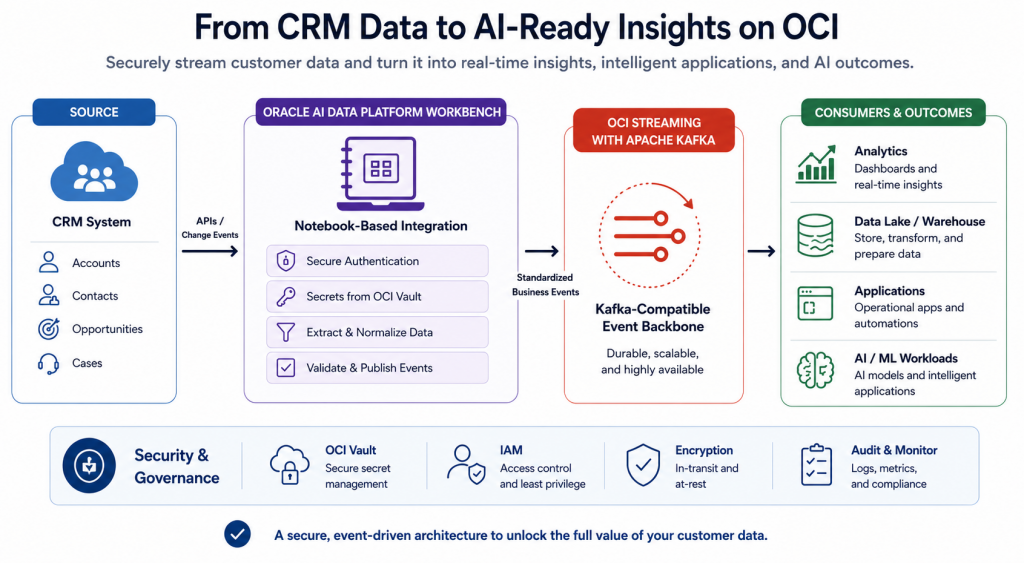
Customer data becomes more valuable when teams can move it quickly from the systems where work happens into the platforms where analytics, automation, and AI can act on it. Oracle Cloud Infrastructure (OCI) provides the streaming, security, and data platform services needed to operationalize that data at cloud scale.
Oracle AI Data Platform Workbench gives teams a practical environment for validating this kind of integration. Using a notebook-driven workflow, organizations can securely extract Salesforce data, transform it into a consistent change-event format, and publish it to OCI Streaming with Apache Kafka for downstream analytics, applications, and AI workloads.
This approach is useful because it is more than a one off data movement example. It demonstrates a repeatable reference pattern for turning operational CRM activity into reusable enterprise events.
From CRM Data to Enterprise Events
Many organizations want faster access to Salesforce data for reporting, operational intelligence, automation, and AI initiatives. Traditional batch integrations can delay insights and create point-to-point dependencies between systems.
A streaming-based architecture helps solve that problem by allowing Salesforce activity to be published as business events that other systems can consume independently.
The integration flow is straightforward:
- Authenticate securely to Salesforce.
- Retrieve Salesforce business records through APIs.
- Resolve sensitive credentials through OCI Vault.
- Normalize CRM records into a consistent change event model.
- Publish those events to OCI Streaming with Apache Kafka.
At a high level, the architecture looks like this:
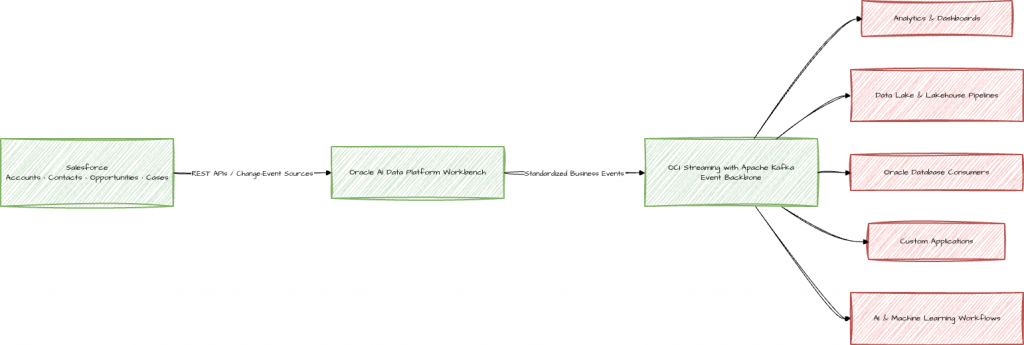
This pattern avoids locking the integration to a single downstream consumer. Data can be published once and reused by multiple teams and applications.
Supporting Snapshot and Incremental Data Flows
A practical CRM integration usually needs to support two different data movement patterns.
The first is a snapshot flow, which retrieves a recent set of Salesforce records and publishes them as events. This is useful for proving the end to end path, validating schemas, testing connectivity, and seeding downstream consumers with an initial view of the data.
The second is an incremental flow, which retrieves records changed after a selected point in time. This helps teams reduce processing overhead while keeping downstream systems synchronized with current CRM activity.
Together, these two patterns provide a realistic starting point for customer implementations. Teams can begin with a controlled snapshot, validate that events are arriving in OCI Streaming with Apache Kafka, and then move toward incremental updates as requirements mature.
Why Streaming Matters
OCI Streaming with Apache Kafka provides a durable event backbone for customer data. Instead of building a separate integration for every downstream application, organizations can publish business events to a stream and allow multiple consumers to process those events independently.
This architecture supports a wide range of use cases:
- Near real time analytics on sales, service, and customer activity
- Operational dashboards fed by fresh CRM changes
- Data lake and lakehouse ingestion patterns
- Application integrations that need timely CRM updates
The result is a more flexible data architecture. Producers and consumers are decoupled, new downstream use cases can be added more easily, and teams can reuse the same event stream across multiple business initiatives.
A Consistent Event Model
One of the most important parts of the pattern is the event contract. Salesforce objects such as Accounts, Contacts, Opportunities, and Cases have different fields and business meanings, but downstream systems benefit from receiving them through a consistent structure.
Each published event follows a simple model that includes:
- A unique event identifier
- The business entity type
- The change type
- A commit timestamp
- The source record identifier
This structure gives downstream systems enough information to route, monitor, replay, and process events while preserving the business context of the original Salesforce record.
The pipeline is resilient for known, contrac -defined entities, but a new entity such as Segment requires an explicit schema and extractor update, it will not flow through automatically.
A Portable Workbench Experience
Oracle AI Data Platform Workbench provides a low friction environment for exploring and validating data integration workflows. The notebook is designed to be self-contained and portable, which makes it easier to demonstrate, share, and adapt across environments.
That portability is useful for customer workshops and proof of value projects. Teams can validate the end to end flow, inspect the transformation logic, adjust configuration for their own tenancy, and understand how the pattern could evolve into a production deployment.
Conclusion
Salesforce data becomes more powerful when it can be converted into secure, reusable, and timely enterprise events.
By combining Oracle AI Data Platform Workbench, OCI Vault, and OCI Streaming with Apache Kafka, organizations can create a practical bridge from CRM activity to analytics, automation, and AI ready customer intelligence. The result is a clear path from notebook-based validation to scalable event driven architecture on Oracle Cloud.
References
Download notebook file from here.