
TL;DR
Oracle Fusion Applications security coordinates role-based access control, function security, data security, privacy, access provisioning, identity management, segregation of duties, and enforcement across the application life cycle. Oracle’s SaaS security posture also emphasizes isolated design, secure data isolation, centralized access controls, compliance readiness, and 24/7 cloud operations. The real implementation challenge is turning that baseline into a complete operating model across ERP, SCM, HCM, and CX. Security should be designed as a layered architecture, not a single control. Security is not separate from AI readiness; it is the control layer that makes AI data trustworthy, access predictable, and operations governable.
Introduction
Security in Oracle Fusion Cloud Applications is an implementation architecture decision, not an administration task. It defines how the program will handle identity, access, data scoping, auditability, extensions, integrations, and the enterprise perimeter. If those decisions are not explicit in the security strategy, the design is not ready to scale. Oracle’s cloud foundation provides the right baseline through isolation, encryption, controls, and visibility, but the implementation still has to turn that baseline into a governed enterprise operating model.
A strong Fusion implementation is driven by architectural decisions, not just system capabilities. Security affects identity, sign-in, authorization, data scoping, API access, monitoring, audit evidence, and the boundary between Fusion SaaS and Oracle Cloud Infrastructure (“OCI”).
Security is a prerequisite for AI-ready deployments because AI can only be trusted when data access is governed, sensitive information is protected, integrations are controlled, and usage is auditable across the full application lifecycle.
Scope
This framework applies whether the implementation covers ERP, SCM, HCM, CX, a single pillar, or multiple pillars together. It should also anticipate future expansion, because one pillar quickly affects the others. The implementation pattern is continuous, not linear: identity shapes access, access shapes data visibility, and data and audit requirements shape governance.
Security classification
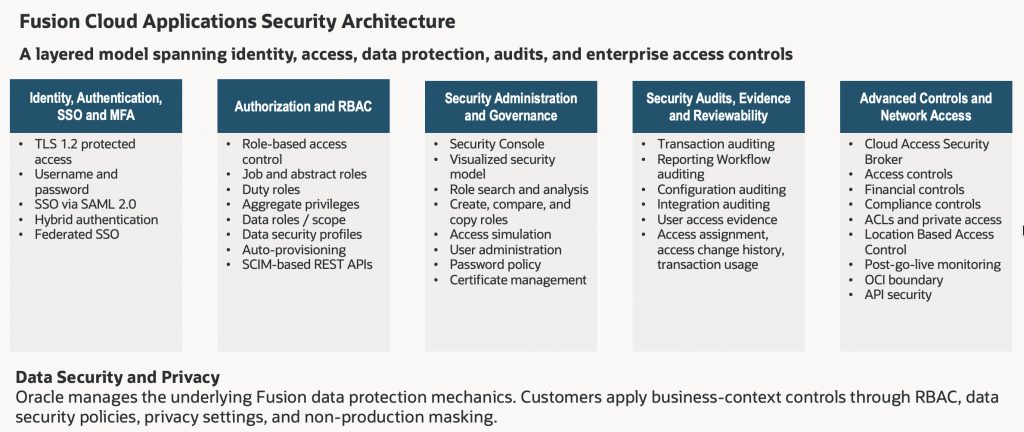
A useful way to think about Fusion security is to classify it into architectural layers. That keeps the design simple and prevents the conversation from collapsing into a feature list.
| Security layer | Architectural question | What the customer configures / governs |
|---|---|---|
| Cloud security foundation | Is the platform isolated and protected by design? | Tenant posture, environment connectivity, external access boundaries |
| Identity and authentication | Who is allowed in, and how is that identity verified? | Identity provider, SSO, MFA factors, user lifecycle |
| Authorization and RBAC | What can the user do after sign-in? | Job roles, duty roles, aggregate privileges, data roles |
| Data security and privacy | What data can the user actually see or use? | Data security policies, security profiles, data access sets, masking, privacy settings |
| Security administration | How is the model operated and reviewed? | Security Console, role analysis, user administration, certificate management |
| Security audits and evidence | Can the enterprise prove who did what with which access? | Audit policies, audit scope, reporting, review routines |
| Compliance and audit readiness | Can the enterprise prove control? | Logging, retention, evidence, reviews |
| Cloud operations and monitoring | Is security continuously managed? | Monitoring, response, post-go-live review |
| Advanced security options | What extra controls are needed for higher risk? | Risk controls, continuous monitoring, OCI-side security services |
| Network and enterprise access controls | How do users and systems reach the service? | ACLs, private access, LBAC, VPN/FastConnect paths |
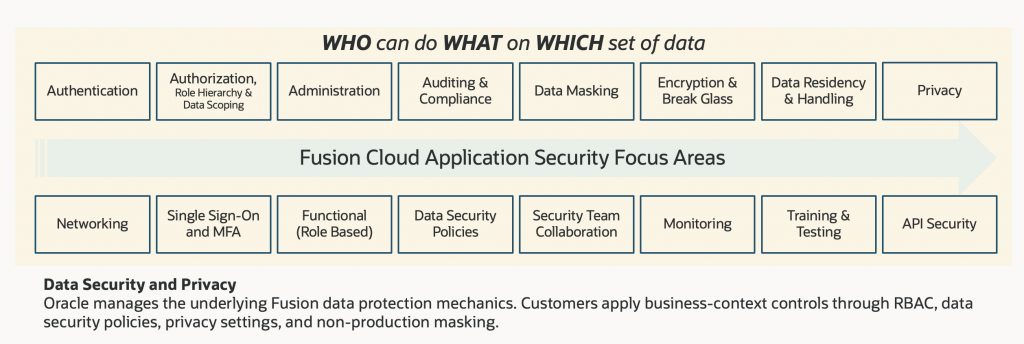
Oracle manages the underlying Fusion data protection mechanics. Customers define the business context and apply business controls through RBAC, data security policies, privacy settings, and non-production masking. That is the right ownership boundary for a SaaS security model: Oracle runs the service mechanics, and the enterprise configures the controls that make the model fit its business.
Security-first cloud foundation
Oracle’s SaaS security posture starts with a security-first, isolated design that separates customer (your) data from other customers to reduce risk while enabling scalability. OCI reinforces the same idea with customer isolation, encryption, security controls, and visibility. That means the platform is not just hosted securely; it is engineered around security boundaries.
From a security architecture perspective, this is a strong baseline. Data protected at rest, privileged access tied to identity, internal access controlled and reviewed, and access activity made visible are exactly the kinds of properties a security architect wants from the foundation. The platform should reduce exposure before the implementation team starts configuring roles.
Identity, authentication, and SSO
Identity is the first operational control point. It answers a simple question: who is this user, and should they be here at all?
In a Fusion implementation, identity should be centralized. Sign-on should be federated where possible. Access should follow the user through onboarding, role change, and offboarding. Oracle’s cloud security architecture explicitly calls out centralized identity management and federated SSO as part of global access controls. That is the right operating model for a multi-cloud enterprise.
MFA as part of the identity baseline
MFA belongs in the identity layer, not as an afterthought. For Fusion environments, MFA is a mandatory security control for both production and non-production once enforced, and Oracle says it cannot be disabled after enforcement. For newly provisioned environment families, MFA is enforced by default. Available factors include Email, SMS, Oracle Mobile Authenticator passcode, Oracle Mobile Authenticator notification, FIDO passkey authenticator, and bypass code. Federated users who sign in through SSO continue to follow their identity provider’s MFA experience. That is the architectural point: authentication is part of the access lifecycle, not a separate convenience feature.
If identity is weak, every other control becomes harder to trust. If identity is strong, the rest of the architecture becomes much easier to govern.
Authorization and Role-Based Access Control (RBAC)
RBAC is one of the main ways security becomes usable in Fusion. It turns business responsibility into RBAC is one of the main ways security becomes usable in Fusion. It turns business responsibility into application access.
Done well, it keeps access understandable. Done poorly, it creates role sprawl and confusion.
The key point is that RBAC is not just role assignment. It is role composition, privilege inheritance, and access propagation. Users receive roles, roles inherit other roles, and the effective access is the result of that hierarchy. The role name is only the starting point. The real architecture is in what the role contains, what it inherits, and what data it can reach. Oracle’s role model is hierarchical by design: users gain access to functions and data through roles, roles are grouped hierarchically, and the user’s access is determined by the combined set of active roles.
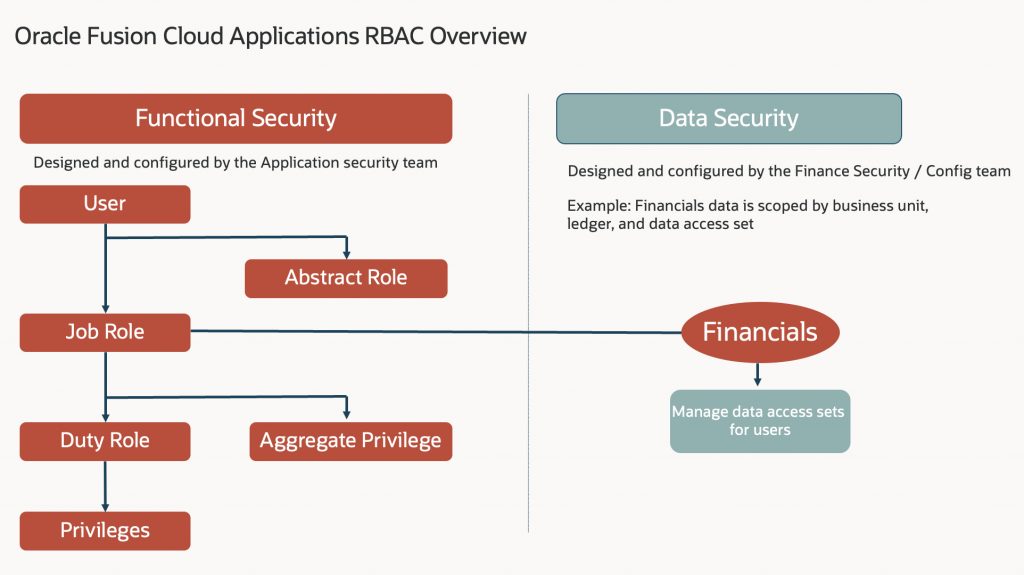
| Role element | What it means | Design implication | Example |
|---|---|---|---|
| Job role | Broad business responsibility | Assign directly when the job is stable | Payroll Manager; Financial Manager |
| Abstract role | Enterprise-level access not tied to a job | Use for common access and self-service | Employee; Contingent Worker |
| Duty role | Task-level building block | Inherit into job and abstract roles | Manage Payroll Definitions; Maintain Suppliers |
| Aggregate privilege | Function security plus data security in one package | Use when access and data scope belong together | View and manage journals for a business unit; Manage worker data with scoped access |
| Data role | Role plus scoped data security | Use to limit access by ledger, business unit, or profile | Financial Manager for Business Unit A; Manager with access only to direct reports |
The practical rule is simple: standardize first, tailor only when the business truly needs it. Oracle-delivered roles are a strong starting point, but they are not the final design. The implementation team still has to decide whether a role should be used as delivered, copied and trimmed, or rebuilt because the enterprise job is not represented well enough.
The Application Implementation Consultant role is the enterprise-wide setup role. It collaborates with specific application administrators to implement consistent enterprise application setup, architecture, information, rules, and access across HCM, SCM, ERP, and CX, and it has access to all setup tasks across all products. That makes it a powerful implementation role that should be understood as a broad setup function rather than a routine user role.
Least privilege matters here. So does segregation of duties. A person who prepares work should not automatically be the person who approves or posts it. Security works best when those boundaries are designed early, not discovered during audit preparation. Oracle’s security model explicitly treats separation of duties as part of the security approach.
Data security, privacy, and PII
Access to the application is not the same as access to the data.
That distinction matters in every Fusion implementation. Two users may have the same role name and still see different records because data is scoped separately from role assignment. That is expected. It is part of the design.
This is where the architecture becomes more specific. Data scoping is not generic security language. It is the mechanism that limits visibility by business unit, ledger, security profile, security context, or other domain-specific criteria. Oracle’s data-access model is explicit that users, roles, and data are linked through a three-way relationship that answers who can do what on which data. In Financials, that means access can be scoped through business units and data access sets, including ledgers and portions of ledgers represented by primary balancing segment values. In SCM, access can be scoped by inventory organization, cost organization, manufacturing plant, and reference data set. In HCM, security profiles identify instances of secured objects such as people, payrolls, organizations, and positions. In Sales, access is constrained by resource hierarchy, sales team membership, ownership, and territory hierarchy.
| Domain | Typical data scope mechanism | Example of what gets restricted |
|---|---|---|
| Financials | Business unit, data access set, ledger, primary balancing segment | Journal and ledger access for a specific business unit or ledger |
| SCM | Inventory organization, cost organization, manufacturing plant, reference data set | Access to operations data in a specific plant or inventory organization |
| HCM | Security profiles and HCM data roles | Worker, payroll, organization, or position visibility |
| Sales / CX | Resource hierarchy, team membership, territory hierarchy | Opportunity and lead visibility by team, territory, or ownership |
The harder part is classification. A person’s name may be PII without being sensitive. Medical information may be sensitive even when it does not identify a person. Salary ranges may be sensitive even though they are not personal data. Some data only becomes sensitive when combined with other data. Oracle’s privacy guidance is explicit that private, personally identifiable, and sensitive information are not the same thing.
For Fusion SaaS, Oracle manages the underlying security classification, masking and protection mechanics internally. Customers define the business context, decide what needs protection, and enable the controls Oracle provides. That includes RBAC, data security policies, privacy controls, location-based access control, and non-production data masking for test and development environments. Oracle’s masking process uses Oracle-provided templates and permanently obscures sensitive or PII data in non-production refreshes or standalone masking runs. In other words, the enterprise does not redesign Fusion’s internal protection engine; it enables and configures the controls around it.
That is the architectural lesson: do not let a role definition become the only protection layer. Data needs its own treatment. The best security teams classify information by business context and sensitivity, then apply the right control. For extension fields, interfaces, and custom attributes, the security team should review implementation run-books and playbooks to verify where masking, role checks, and interface protections are applied, because those areas are usually where the standard application model stops and customer responsibility begins.
Security Console and administration
A security architecture is only useful if it can be operated.
The Security Console is the operational control point for Fusion security. It is where the role model is reviewed, maintained, and governed across users, roles, hierarchies, and certificates. For a security architect, its value is not in the individual screens, but in the fact that it makes role design, access review, and entitlement governance executable.
At an architectural level, the Security Console supports the ongoing lifecycle of security: defining and adjusting roles, reviewing how access is inherited, checking who has what access, analyzing role growth, and maintaining the controls that keep the model stable after go-live. In practice, it is the place where the intended security design is validated against the live access model. Refer to Oracle Docs for details.
| Feature | Description | Example |
|---|---|---|
| Roles | Create job, abstract, and duty roles; edit custom roles; copy roles; compare roles; visualize role hierarchies and assignments to users; review Navigator menu items available to roles or users; identify roles that grant access to Navigator menu items and the privileges required for that access. | Compare a custom Financial Manager role with a delivered role to see how access is inherited. |
| Users | Create user accounts; review, edit, lock, or delete existing user accounts; assign roles to user accounts; reset users’ passwords. | Create a new user account, assign the required roles, and reset the password if needed. |
| Analytics | Review statistics of role categories, the roles belonging to each category, and the components of each role; view the data security policies, roles, and users associated with each data resource. | Review which roles and users are associated with a sensitive data resource. |
| Certificates | Generate, export, or import PGP or X.509 certificates; generate signing requests for X.509 certificates. These certificates establish encryption keys for data exchanged between Oracle Cloud applications and other applications. | Import an X.509 certificate for secure data exchange with an external system. |
| Administration | Establish rules for the generation of user names; set password policies; create standards for role definition, copying, and visualization; review the status of role-copy operations; define templates for notifications of user account events such as password expiration. | Set a password policy and define a notification template for password expiration. |
Security Audits and Evidence
This is the layer that answers the question security architects are often asked most directly: who did what, while having which access?
A strong security design separates three things: access assignment, access change history, and transaction usage. Those are different evidence layers, and they should not be treated as the same thing. Oracle’s audit model is built to support that separation by letting teams define which business objects and attributes to audit, then storing the resulting changes for later reporting. Auditing is used to monitor user activity and configuration, security, and data changes, and the configuration must explicitly select the objects and attributes to be tracked.
| Audit layer | What it answers | Typical evidence |
|---|---|---|
| Access assignment | Who has what access? | User role membership, effective access reports |
| Access change history | When did access change, and who changed it? | Audit reports, role and privilege change logs |
| Usage | What did the user do, and when? | Business object auditing, platform auditing, REST audit history |
The architectural point is simple. Security controls who can act. Audit proves what actually happened with that access. Governance becomes defensible only when those two views can be correlated.
That is why a security strategy should not stop at provisioning rules. It should also define how the team will prove access, prove changes to access, and prove usage. That is how audit readiness becomes real instead of assumed. Oracle’s audit setup model makes that explicit: select the business objects, select the attributes, then enable auditing so the changes are recorded for later review.
Data residency, compliance, and audit readiness
Security architecture also has to survive real-world scrutiny.
For global enterprises, that means data residency, compliance obligations, audit evidence, and logging all need to be part of the design. Oracle’s SaaS security posture explicitly calls out secure data isolation, data residency and compliance support, and 24/7 cloud operations. OCI reinforces the same model with customer isolation, encryption, security controls, and visibility.
This is where many implementations become too technical and not strategic enough.
Cloud operations and monitoring
Compliance is not just a separate work-stream. It is part of the security architecture. If the model cannot support audit questions, it is not complete.
Security does not end when the configuration is done.
A mature design includes operations: monitoring, review, response, and regular checks. Access must be tracked. Breach readiness must be understood. Security issues must be handled as operational realities, not rare exceptions. I recommend global operations, proactive monitoring, high availability, and visibility as part of the security baseline. It also makes clear that platform access and monitoring are part of the service model.
A project ends at go-live. A security model lives on.
Advanced security options
Some environments need more than the baseline controls.
The key is to use advanced controls intentionally. Not every implementation needs every advanced control on day one. The right sequence is standard first, advanced second. That keeps the model practical. It also avoids over-designing security before the business understands its real risk profile.
This is also where the SaaS-versus-OCI boundary matters. Fusion SaaS security controls are not the same thing as OCI security controls. OCI covers the underlying cloud infrastructure, customer isolation, encryption, security controls, and visibility. Fusion cloud applications adds the application-layer model of roles, data roles, Security Console administration, and domain-specific data scoping. When extensions or integrations are built or deployed on OCI, the team has to secure both sides correctly.
API security belongs here too. REST access, service accounts, and integration identities need the same architectural discipline as users. The security model should define who can call the API, what the identity or token can do, how that access is scoped, and how it is reviewed when an integration spans Fusion SaaS and OCI.
Network and enterprise access controls
Fusion access is not limited to identity and roles. Network access can also be controlled through access control lists, private on-premises connectivity, and location-based access control. In practice, that means security architecture must account for who can sign in, where they are signing in from, and whether the environment should be reachable through the public internet or only through approved private paths. These controls are especially important when Fusion is connected to OCI-hosted extensions or enterprise networks, because access design has to stay consistent across the full path to the application.
Users can access Fusion Applications from the internet with valid credentials, but Oracle also supports ACLs for selected public IPs or VCNs, private access from on-premises networks, and LBAC for access based on roles and compute IP addresses. These options are not mutually exclusive. LBAC is configured in the Fusion Applications Security Console by an IT Security Manager, which makes it an architectural control rather than a network-only setting.
Governance and operating model
Security only works when it is governed.
That means access reviews, temporary access removal, role maintenance, data classification updates, and control ownership all need to be part of the operating model. A security architect reviewing a program security strategy should expect to see decisions for identity and access management, RBAC, segregation of duties, secure extensions and integrations, custom job roles, and configuration and transaction controls. If those areas are missing, the strategy is not mature enough. The master framework’s transformation path applies here too: Adopt → Configure → Extend → Automate. Security should follow the same progression and avoid jumping straight to complexity.
A strong governance model keeps the design from drifting. It also makes the security story easier to explain to auditors, administrators, and business leaders.
Why it works
This architecture works because it follows how real Fusion implementations succeed.
The cloud foundation provides isolation. Identity centralizes access. RBAC turns business responsibility into manageable roles. Data security protects the records themselves. The Security Console keeps the model operable. Audit evidence makes the model defensible. Governance keeps it alive. Advanced controls and perimeter controls strengthen it when needed.
This architecture also supports AI-ready deployments because it creates the control foundation AI depends on: trusted data, scoped access, secure integrations, reviewable activity, and consistent governance across ERP, SCM, HCM, and CX.
That is the difference between a security setup and a security architecture.
Closing summary
Security in Oracle Fusion Cloud Applications should be designed as a layered architecture, not a single control. The strongest implementations treat secure cloud foundation, identity, authentication, authorization, data protection, operations, compliance, auditing, and governance as one connected system. RBAC is important, but it is only one part of the model.
The security architect’s job is to make sure the strategy is more than a list of controls. It should explain how role hierarchy, data scoping, Security Audits and Evidence, SaaS-versus-OCI boundaries, API security, Security Console operations, and network controls work together. When security is designed this way, it supports trust, scale, and change across ERP, SCM, HCM, and CX.