
Introduction
This blog discusses the new and enhanced prebuilt OIC integrations available between Order Management (OM) and Global Trade management (GTM). OM and GTM are key components in Oracle’s Supply Chain and Manufacturing (SCM) applications suite. The new prebuilt integrations provide rich out-of-the-box integration between OM Order fulfilment orchestration and Logistics GTM application to ensure high efficiency through automation of the trade compliance transactions which in today’s world forms a critical piece of the global supply chain management.
In our previous blog we learnt about the enhancements in prebuilt integrations between OM and Oracle Transportation Management (OTM). The enhancements included Shipsets, delivery through the OIC Integration Store and the OIC Project constructs.
Refer here for the OM OTM Blog – https://www.ateam-oracle.com/post/om-otm-prebuilts-with-shipsets
This blog is a continution in the series of enhanced integration capabilities between Order Managament and the Logistics applications.
Where can we find the prebuilt integration
The new OM GTM prebuilt integration Project is available as a Recipe in the OIC Integration Store. Just login to your Integration cloud instance and ‘Browse store’ from the home page and search by ‘GTM’ , ‘Order Management’ or other relevant keywords.


A ‘Get’ will import the recipe and will then be available as a Project as shown below.
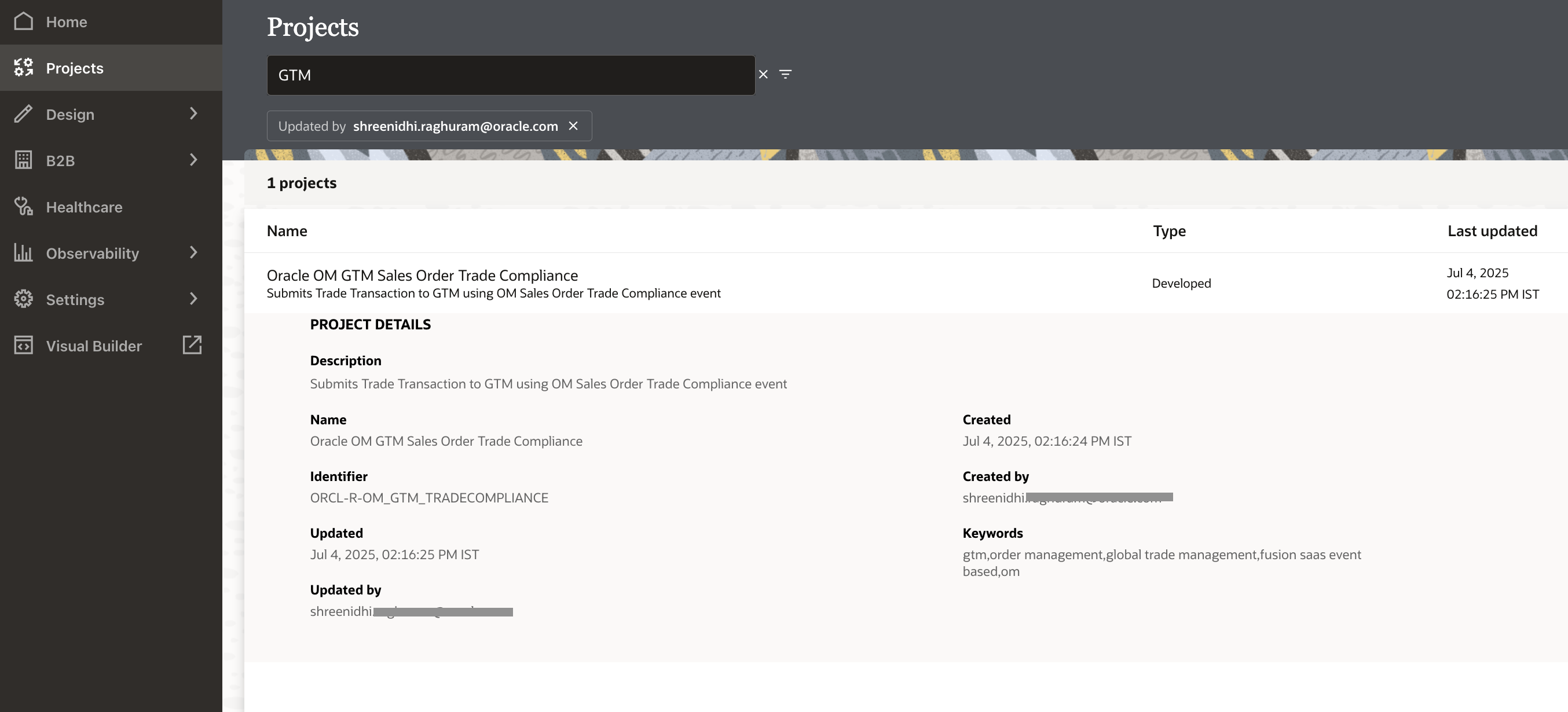
The recipe is structured as an OIC Project consisting of integrations, connections and lookups ready to be configured. The user can configure endpoints and credentials on the SCM connection (for OM) and Logistics connection (for GTM), and activate the integration.

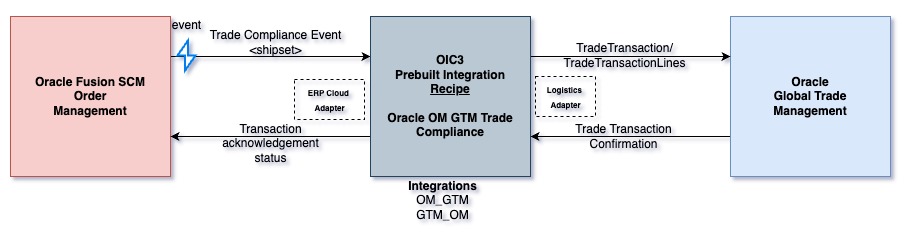
With the integrations activated, the OM trigger connection in OM_GTM flow subscribes to and listens for Trade compliance events from OM. The prebuilt integration transforms them into GTM Transmissions of type GTM TradeTransactions for fulfilment in GTM. The GTM_OM integration flow receives trade transaction acknowledgement and confirmation from GTM, which are then mapped and updated in OM Order for a 360 degree view of order fulfilment. This integration design is logically shown in the below diagram.
Shipset, Kit and ATO orders support in OM GTM prebuilt Integration recipe
- Shipset Orders – A Shipment set (also known as Shipset) is a set of order lines that Order Management ships together as one group. The shipset grouping provides greater efficiency due to reduced processing for fulfilment.
- Kit Orders – Kit orders refer to orders including kits which are a pre-defined collections of items that are ordered together as a single unit. For example a pre-configured desktop computer system.
- ATO Orders – ATO (Assemble-to-Order) refers to orders assembled from pre-existing components after a customer order is received. Typically all the components of an ATO order are fulfilled and shipped together. For example custom automobiles, made to order furniture.
OM GTM prebuilt integration recipe now provides new features.
The OM GTM recipe now provides out-of-the-box support for Shipset orders. The OIC integration maps a shipset order to a single GTM trade transaction and fulfilment lines within the shipset are represented as trade transaction lines. Consider an order with 100 lines without shipset. During fulfilment such an order would generate 100 events. Whereas with the 100 lines grouped under a single shipset, there will be just one event between OM and GTM to be processed reducing the stress on integration layer as well as in OM and GTM.
Similarly, Kit and ATO type composite orders are made up of a hierarchy of items in an order and are typically shipped and fulfilled as a group (of hierarchical items). The OM GTM recipe now also provided mappings from OM to GTM for such composite orders enabling customers to implement highly efficient order orchestration processes.
Standard Orders – Note that the OM GTM integration continues to support and process standard OM orders which are fulfilled as individual fulfilment lines without any shipsets or product groupings.
The OIC prebuilt integration maps the OM Order lines/fulfilment lines to GTM trade transaction and trade transaction lines. Below diagrams schematically show the structure of OM orders for scenarios with shipsets and without shipsets and how they are mapped during GTM transmission. The Shipset Name attribute of OM fulfilment lines is used to group the trade transaction lines for trade compliance checks. In short all order lines belonging to the same shipset are grouped together as trade transaction lines within a single trade transaction.
Order Without Shipset

The OM Order fulfilment lines are grouped together in shipment sets (shipsets <>) which provides better operational efficiency for shipping and downstream fulfilment processing.
Shipset Order
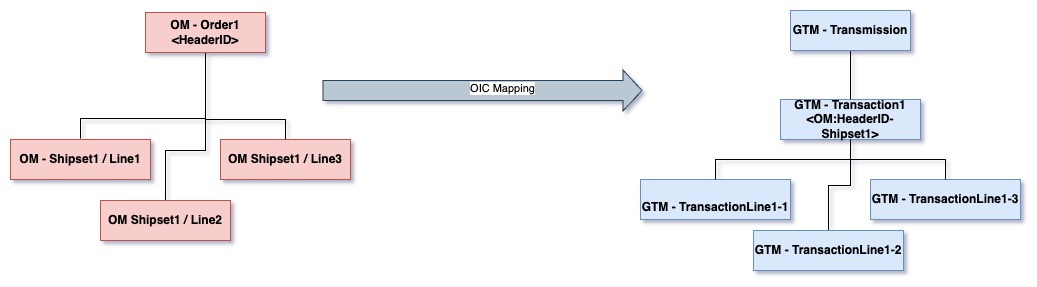
Similar integration support is inbuilt for Kit and ATO type orders coming in from OM into GTM for Trade compliance processing. The Root Parent Fulfillmernt Line Identifier is used to group the order fulfilment lines within a single GTM trade transaction.
Customers are advised to download the latest OM-GTM prebuilt integrations from the OIC Integration Store accessible from the OIC Home page. This latest version supersedes the integrations available from below sources
Conclusion
We learnt about the latest OM GTM prebuilt integrations in this blog , which are now available in the OIC Integration Store as Oracle-built recipes and support the high efficiency shipset feature and mappings for Kit and ATO orders.
Finally, I would like to acknowledge my colleagues from product development for their valuable suggestions and feedback for bringing out this blog.
OM Development – Shrikant Nene, Nikhil Kala
GTM Development – Ashok Kalidindi, Mythili Putchakayala