
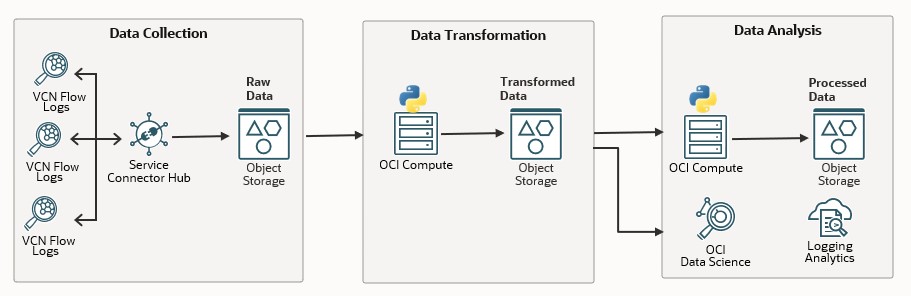
In Part 2 of this blog series, I provided detailed guidance on enabling OCI Flow Logs for all subnets and streaming them to an OCI Object Storage bucket using the Service Connector Hub. In this post, we will focus on Data Transformation – Understanding the Flow Log content and how to enrich the data to provide more valuable insights.
Reviewing Flow Log Data
Let’s quickly review the data collected in flow logs. Below is a sample flow log entry:
{
   "data":{
      "action":"ACCEPT",
      "bytesOut":68,
      "destinationAddress":"18.162.xx.130",
      "destinationPort":0,
      "endTime":1725632768,
      "flowid":"fe75a27e",
      "packets":1,
      "protocol":1,
      "protocolName":"ICMP",
      "sourceAddress":"10.100.xx.197",
      "sourcePort":0,
      "startTime":1725632768,
      "status":"OK",
      "version":"2"
   },
   "id":"69254429",
   "oracle":{
      "compartmentid":"ocid1.compartment.oc1..aaaaaaaalxxxxxxxxzdd675wragmtj3gcxm7h4a7gbxxxx",
      "ingestedtime":"2024-09-06T14:33:30.385Z",
      "instanceOcid":"ocid1.instance.oc1.iad.anuwcljtc3adhhqcc72hxxxhgveroiuyyylbhlbfqqca",
      "loggroupid":"ocid1.loggroup.oc1.iad.amaaaaaac3adhhqaxgrxxgkuvd4k7ozza2oktb74fq",
      "logid":"ocid1.log.oc1.iad.amaaaaaac3adhhqae23fuithxguwc2e3pjdcpa",
      "publicIpv4":"132.145.xx.xx",
      "tenantid":"ocid1.tenancy.oc1..aaaaaaaaa3qmjxr43xxjw22ermohbw2vbxyhczksgjir7xdq",
      "vcnOcid":"ocid1.vcn.oc1.iad.amaaaaaac3adhhqalypdumgaixxvi5nf4jgufy3foon6eq",
      "vniccompartmentocid":"ocid1.compartment.oc1..aaaaaaaalqjxxzdd675wragmtj3gcxm7h4a7gbxoqlq",
      "vnicocid":"ocid1.vnic.oc1.iad.abuwcljt42mwciwcwvxpjydidjgnrwtoxpl7kxuialq",
      "vnicsubnetocid":"ocid1.subnet.oc1.iad.aaaaaaaajo77xxxrxxe4hi5h6hq"
   },
   "source":"-",
   "specversion":"1.0",
   "time":"2024-09-06T14:26:08.000Z",
   "type":"com.oraclecloud.vcn.flowlogs.DataEvent"
}
This data provides insights into the traffic details, such as whether it was accepted or denied, data transferred, source and destination addresses, and information about the resource in OCI. While this data is helpful, enriching it with additional details like traffic direction (whether the traffic is east-west or north-south) and mapping it to associated security lists offers more valuable insights to optimize security list rules.
Enriching the Data
To achieve this, we created a Python utility that processes the flow logs from the source bucket, parses them and enriches them with additional details.
Python Script to Enrich data
import oci
import gzip
import json
import os
import ipaddress
import threading
from datetime import datetime, timedelta
from concurrent.futures import ThreadPoolExecutor, as_completed
import tempfile


# OCI configuration
config = oci.config.from_file("~/.oci/config")  # Modify if your config file is located elsewhere
object_storage_client = oci.object_storage.ObjectStorageClient(config)
virtual_network_client = oci.core.VirtualNetworkClient(config)
subnet_cache = {}
security_list_cache = {}
namespace = "namespace"  # OCI Object Storage namespace
bucket_name = "Flow-Logs"  # Replace with your bucket name
parsed_data_bucket_name = "enriched-flow-logs" # Replace with your bucket name
# Time filter (e.g., last 30 days)
time_threshold = datetime.utcnow() - timedelta(days=30)

# Private IP ranges
PRIVATE_IP_RANGES = [
    ipaddress.ip_network("10.0.0.0/8"),
    ipaddress.ip_network("172.16.0.0/12"),
    ipaddress.ip_network("192.168.0.0/16")
]

# Lock for thread-safe operations
lock = threading.Lock()

# List all objects in the bucket and group them by folders
def list_log_files(client, namespace, bucket_name):
    objects = []
    list_objects_response = client.list_objects(namespace, bucket_name)
    for obj in list_objects_response.data.objects:
        if not obj.name.endswith("/"):  # Exclude folders
            objects.append(obj)
    return objects

# Download and extract .log.gz files
def download_and_extract_file(client, namespace, bucket_name, object_name):
    file_stream = client.get_object(namespace, bucket_name, object_name).data.raw
    local_file_name = os.path.join(r'C:\downloads', object_name.split('/')[-1]) # update with valid local path

    with open(local_file_name, 'wb') as f:
        f.write(file_stream.read())

    # Extract the .log.gz file
    if local_file_name.endswith('.gz'):
        with gzip.open(local_file_name, 'rb') as f_in:
            extracted_file = local_file_name.replace('.gz', '')
            with open(extracted_file, 'wb') as f_out:
                f_out.write(f_in.read())
        os.remove(local_file_name)  # Remove the original .gz file
        return extracted_file
    return local_file_name

# Determine if an IP is internal or external
def is_internal_ip(ip):
    try:
        ip_obj = ipaddress.ip_address(ip)
        for net in PRIVATE_IP_RANGES:
            if ip_obj in net:
                return "internal"
        return "external"
    except ValueError:
        return "invalid"

def get_subnet_cidr(subnet_ocid):
    if subnet_ocid in subnet_cache:
        return subnet_cache[subnet_ocid]
    try:
        subnet_response = virtual_network_client.get_subnet(subnet_ocid)
        subnet_cidr = subnet_response.data.cidr_block
        subnet_security_list = subnet_response.data.security_list_ids
        subnet_cache[subnet_ocid] = (subnet_cidr, subnet_security_list)
        return subnet_cidr, subnet_security_list
    except oci.exceptions.ServiceError as e:
        print(f"Failed to get subnet CIDR: {e}")
        return None

# Check if the IP is part of the subnet CIDR
def is_ip_in_subnet(ip, cidr):
    try:
        ip_obj = ipaddress.ip_address(ip)
        subnet = ipaddress.ip_network(cidr)
        return ip_obj in subnet
    except ValueError:
        return False

def extract_ingress_rule_attributes(rule):
    return {
        "description": rule.description,
        "icmp_options": vars(rule.icmp_options) if rule.icmp_options else None,  # Convert icmp_options to a dict
        "is_stateless": rule.is_stateless,
        "protocol": rule.protocol,
        "source": rule.source,
        "source_type": rule.source_type,
        "tcp_options": {
            "destination_port_range": {
                "max": rule.tcp_options.destination_port_range.max if rule.tcp_options and rule.tcp_options.destination_port_range else None,
                "min": rule.tcp_options.destination_port_range.min if rule.tcp_options and rule.tcp_options.destination_port_range else None
            },
            "source_port_range": {
                "max": rule.tcp_options.source_port_range.max if rule.tcp_options and rule.tcp_options.source_port_range else None,
                "min": rule.tcp_options.source_port_range.min if rule.tcp_options and rule.tcp_options.source_port_range else None
            }
        } if rule.tcp_options else None,
        "udp_options": {
            "destination_port_range": {
                "max": rule.udp_options.destination_port_range.max if rule.udp_options and rule.udp_options.destination_port_range else None,
                "min": rule.udp_options.destination_port_range.min if rule.udp_options and rule.udp_options.destination_port_range else None
            },
            "source_port_range": {
                "max": rule.udp_options.source_port_range.max if rule.udp_options and rule.udp_options.source_port_range else None,
                "min": rule.udp_options.source_port_range.min if rule.udp_options and rule.udp_options.source_port_range else None
            }
        } if rule.udp_options else None
    }

def extract_egress_rule_attributes(rule):
    return {
        "description": rule.description,
        "icmp_options": vars(rule.icmp_options) if rule.icmp_options else None,  # Convert icmp_options to a dict
        "is_stateless": rule.is_stateless,
        "protocol": rule.protocol,
        "destination": rule.destination,
        "destination_type": rule.destination_type,
        "tcp_options": {
            "destination_port_range": {
                "max": rule.tcp_options.destination_port_range.max if rule.tcp_options and rule.tcp_options.destination_port_range else None,
                "min": rule.tcp_options.destination_port_range.min if rule.tcp_options and rule.tcp_options.destination_port_range else None
            },
            "source_port_range": {
                "max": rule.tcp_options.source_port_range.max if rule.tcp_options and rule.tcp_options.source_port_range else None,
                "min": rule.tcp_options.source_port_range.min if rule.tcp_options and rule.tcp_options.source_port_range else None
            }
        } if rule.tcp_options else None,
        "udp_options": {
            "destination_port_range": {
                "max": rule.udp_options.destination_port_range.max if rule.udp_options and rule.udp_options.destination_port_range else None,
                "min": rule.udp_options.destination_port_range.min if rule.udp_options and rule.udp_options.destination_port_range else None
            },
            "source_port_range": {
                "max": rule.udp_options.source_port_range.max if rule.udp_options and rule.udp_options.source_port_range else None,
                "min": rule.udp_options.source_port_range.min if rule.udp_options and rule.udp_options.source_port_range else None
            }
        } if rule.udp_options else None
    }


def get_security_list_details(security_list_ids):
    if tuple(security_list_ids) in security_list_cache:
        return security_list_cache[tuple(security_list_ids)]
    security_list_details = []
    for security_list_id in security_list_ids:
        try:
            security_list_response = virtual_network_client.get_security_list(security_list_id)
            security_list_data = security_list_response.data
            ingress_rules = [extract_ingress_rule_attributes(rule) for rule in security_list_data.ingress_security_rules]
            egress_rules = [extract_egress_rule_attributes(rule) for rule in security_list_data.egress_security_rules]
            security_list_details.append({
                "display_name": security_list_data.display_name,
                "security_list_ocid": security_list_data.id,
                "ingress_security_rules": ingress_rules,
                "egress_security_rules": egress_rules
            })
        except oci.exceptions.ServiceError as e:
            print(f"Failed to get security list: {e}")
            continue
    security_list_cache[tuple(security_list_ids)] = security_list_details
    return security_list_details

# Parse the JSON data and filter based on action 'ACCEPT'
def parse_log_file(file_name):
    result_list = []
    with open(file_name, 'r') as f:
        for line in f:
            try:
                log_entry = json.loads(line)
                # Filter based on ingestedtime (last 30 days)
                ingested_time = log_entry['oracle']['ingestedtime']
                try:
                    ingested_datetime = datetime.strptime(ingested_time, "%Y-%m-%dT%H:%M:%S.%fZ")
                except ValueError:
                    # If the above fails, try without microseconds
                    ingested_datetime = datetime.strptime(ingested_time, "%Y-%m-%dT%H:%M:%SZ")

                if ingested_datetime < time_threshold:
                    continue

                # Filter for 'ACCEPT' action only
                if log_entry['data'].get('action') == 'ACCEPT':
                    # Extract variables
                    destination_address = log_entry['data'].get('destinationAddress', 'N/A')
                    destination_port = log_entry['data'].get('destinationPort', 'N/A')
                    protocol = log_entry['data'].get('protocol', 'N/A')
                    protocol_name = log_entry['data'].get('protocolName', 'N/A')
                    source_address = log_entry['data'].get('sourceAddress', 'N/A')
                    vnic_subnet_ocid = log_entry['oracle'].get('vnicsubnetocid', 'N/A')
                    oracle_data = log_entry.get('oracle', {})

                    # Determine if the sourceAddress and destinationAddress are internal or external
                    internal_or_external_source = is_internal_ip(source_address)
                    internal_or_external_destination = is_internal_ip(destination_address)

                    # Check if sourceAddress or destinationAddress matches subnet CIDR
                    traffic_direction = "N/A"
                    traffic_type = "external traffic"
                    security_list_details = []
                    if vnic_subnet_ocid != 'N/A':
                        subnet_cidr, subnet_security_list = get_subnet_cidr(vnic_subnet_ocid)

                        # Fetch security list details for all security lists in the subnet
                        if subnet_security_list:
                            security_list_details = get_security_list_details(subnet_security_list)

                        # Determine traffic direction (egress, ingress) based on source or destination match
                        if subnet_cidr:
                            if is_ip_in_subnet(source_address, subnet_cidr):
                                traffic_direction = "egress"
                            elif is_ip_in_subnet(destination_address, subnet_cidr):
                                traffic_direction = "ingress"

                        # Check if both source and destination addresses are internal
                        if internal_or_external_source == "internal" and internal_or_external_destination == "internal":
                            traffic_type = "internal traffic"

                    # Add extracted data to the result list, including security list details
                    result_list.append({
                        "destinationAddress": destination_address,
                        "destinationPort": destination_port,
                        "protocol": protocol,
                        "protocolName": protocol_name,
                        "sourceAddress": source_address,
                        "internal_or_external_source": internal_or_external_source,
                        "internal_or_external_destination": internal_or_external_destination,
                        "traffic_direction": traffic_direction,
                        "traffic_type": traffic_type,
                        "security_lists": security_list_details,  # Contains details of all security lists
                        "oracle": oracle_data
                    })
            except json.JSONDecodeError:
                print(f"Skipping invalid JSON: {line}")

    return result_list

# Write the result to JSON and Excel
def write_output_to_files(output_data, log_file_name):
    # Use the lock to ensure thread-safe file writing
    with lock:
        # Write to JSON file
        json_output_file = f'C:\\Downlods\\parsed_data\\{log_file_name}_output.json' # update the folder to a valid path
        with open(json_output_file, 'w') as json_file:
            json.dump(output_data, json_file, indent=4)

def upload_to_object_storage(file_path, bucket_name, object_name):
    with open(file_path, 'rb') as f:
        object_storage_client.put_object(
            namespace,
            bucket_name,
            object_name,
            f
        )

def write_output_to_bucket(parsed_data, bucket_name, thread_id):
    output_file_name = f"parsed_data_{thread_id}_{datetime.utcnow().strftime('%Y%m%d%H%M%S')}.json"
    temp_file_path = os.path.join(tempfile.gettempdir(), output_file_name)

    # Write to a temporary file first
    with open(temp_file_path, 'w') as f:
        json.dump(parsed_data, f, indent=4)

    # Upload to Object Storage
    upload_to_object_storage(temp_file_path, bucket_name, output_file_name)

    # Clean up the temporary file
    os.remove(temp_file_path)

# Process a single log file
def process_single_log_file(client, namespace, bucket_name, obj_name, thread_id):
    log_file_name = obj_name.split('/')[-1].replace('.gz', '')  # Extract log file name
    extracted_file = download_and_extract_file(client, namespace, bucket_name, obj_name)
    parsed_data = parse_log_file(extracted_file)

    # Write each thread's output to a separate file
    write_output_to_bucket(parsed_data, parsed_data_bucket_name, thread_id)

    os.remove(extracted_file)  # Clean up extracted files
    return parsed_data

def process_flow_logs_in_parallel():
    objects = list_log_files(object_storage_client, namespace, bucket_name)
    extracted_data = []

    # Use ThreadPoolExecutor for parallel processing of files
    with ThreadPoolExecutor(max_workers=10) as executor:
        futures = {
            executor.submit(process_single_log_file, object_storage_client, namespace, bucket_name, obj.name, idx): obj
            for idx, obj in enumerate(objects) if obj.name.endswith('.log.gz')
        }

        for future in as_completed(futures):
            try:
                data = future.result()
                extracted_data.extend(data)
            except Exception as e:
                print(f"Error processing file: {e}")

if __name__ == "__main__":
    process_flow_logs_in_parallel()
Here’s a sample log after enrichment
{
        "destinationAddress": "15.228.xx.47",
        "destinationPort": 0,
        "protocol": 1,
        "protocolName": "ICMP",
        "sourceAddress": "192.168.1.xx",
        "internal_or_external_source": "internal",
        "internal_or_external_destination": "external",
        "traffic_direction": "egress",
        "traffic_type": "external traffic",
        "security_lists": [
            {
                "display_name": "Default Security List for WAF VCN",
                "security_list_ocid": "ocid1.securitylist.oc1.iad.xxxxxxxxx",
                "ingress_security_rules": [
                    {
                        "description": null,
                        "icmp_options": null,
                        "is_stateless": false,
                        "protocol": "6",
                        "source": "0.0.0.0/0",
                        "source_type": "CIDR_BLOCK",
                        "tcp_options": {
                            "destination_port_range": {
                                "max": 22,
                                "min": 22
                            },
                            "source_port_range": {
                                "max": null,
                                "min": null
                            }
                        },
                        "udp_options": null
                    },
                    {
                        "description": null,
                        "icmp_options": null,
                        "is_stateless": false,
                        "protocol": "1",
                        "source": "0.0.0.0/0",
                        "source_type": "CIDR_BLOCK",
                        "tcp_options": null,
                        "udp_options": null
                    },
                    {
                        "description": null,
                        "icmp_options": {
                            "swagger_types": {
                                "code": "int",
                                "type": "int"
                            },
                            "attribute_map": {
                                "code": "code",
                                "type": "type"
                            },
                            "_code": null,
                            "_type": 3
                        },
                        "is_stateless": false,
                        "protocol": "1",
                        "source": "192.168.0.0/16",
                        "source_type": "CIDR_BLOCK",
                        "tcp_options": null,
                        "udp_options": null
                    },
                    {
                        "description": null,
                        "icmp_options": null,
                        "is_stateless": false,
                        "protocol": "6",
                        "source": "0.0.0.0/0",
                        "source_type": "CIDR_BLOCK",
                        "tcp_options": {
                            "destination_port_range": {
                                "max": 80,
                                "min": 80
                            },
                            "source_port_range": {
                                "max": null,
                                "min": null
                            }
                        },
                        "udp_options": null
                    },
                    {
                        "description": null,
                        "icmp_options": null,
                        "is_stateless": false,
                        "protocol": "6",
                        "source": "192.168.1.0/24",
                        "source_type": "CIDR_BLOCK",
                        "tcp_options": {
                            "destination_port_range": {
                                "max": 80,
                                "min": 80
                            },
                            "source_port_range": {
                                "max": null,
                                "min": null
                            }
                        },
                        "udp_options": null
                    }
                ],
                "egress_security_rules": [
                    {
                        "description": null,
                        "icmp_options": null,
                        "is_stateless": false,
                        "protocol": "all",
                        "destination": "0.0.0.0/0",
                        "destination_type": "CIDR_BLOCK",
                        "tcp_options": null,
                        "udp_options": null
                    }
                ]
            }
        ],
        "oracle": {
            "compartmentid": "ocid1.tenancy.oc1..xxxxxxxxxx",
            "filterOcid": "DEFAULT_CAPTURE_FILTER",
            "ingestedtime": "2024-xx-26T06:52:44.070Z",
            "instanceOcid": "VNICaaS:ocid1.vnic.oc1.iad.xxxxxxxxx",
            "loggroupid": "ocid1.loggroup.oc1.iad.xxxxx",
            "logid": "ocid1.log.oc1.iad.xxxx",
            "managed": "true",
            "publicIpv4": "129.80.90.233",
            "resourceId": "ocid1.loadbalancer.oc1.iad.xxxxxxx",
            "resourceType": "loadbalancer",
            "tenantid": "ocid1.tenancy.oc1..xxxxxxx",
            "vcnOcid": "ocid1.vcn.oc1.iad.xxxxx",
            "vniccompartmentocid": "ocid1.compartment.oc1..xxxxxx",
            "vnicocid": "ocid1.vnic.oc1.iad.xxxxxx",
            "vnicsubnetocid": "ocid1.subnet.oc1.iad.xxxxx"
        }
    }
-
internal_or_external_source: Indicates whether the source IP is internal (private) or external (public).
-
internal_or_external_destination: Indicates whether the destination IP is internal (private) or external (public).
-
traffic_direction: Specifies whether the traffic is egress or ingress from the network.
-
traffic_type: External meaning it’s North-south traffic and Internal meaning it’s East-West traffic.
-
security_lists: Provides details of the security lists that govern the traffic, including ingress and egress rules.
Focus on TCP and UDP Traffic
For the scope of this blog post series, we will focus only on TCP and UDP traffic, which are most commonly used by customers. In the next post, we will dive into analyzing the enriched data and explore how it can be leveraged to further optimize security lists.