
Overview
The regulatory landscape in the financial services sector is highly complex, driven by the need to protect consumers, maintain market stability, and mitigate systemic risk. It involves a mix of international, national, and industry-specific rules covering everything from capital adequacy to data privacy. Couple these with emerging guidelines from various other governing bodies, and a rapidly unfolding threat landscape and things can get quite complicated. Financial institutions must stay abreast of evolving regulations and maintain robust compliance programs to navigate this environment successfully. Failure to do so can result in financial penalties, reputational damage, and legal repercussions.
Financial Sector Regulation
The sector is one of the most heavily regulated industries, subject to a myriad of global, national, and regional regulations. Emerging data privacy regulations such as the EU’s General Data Protection Regulation (GDPR), or the US’s Grahm Leech-Bliley (GLBA) Sarbanes-Oxley Act (SOX), and the Federal Financial Institutions Examination Council (FFIEC) guidelines require strict controls over data access, storage, handling, and security.
Key regulatory and compliance considerations for Financial Sector Institutions include:
Data Sovereignty, Jurisdictional, Cross-border Regulations
- Financial institutions operating internationally must comply with both local and global regulations, which can sometimes conflict. Navigating these regulations requires careful coordination across jurisdictions, especially for institutions offering cross-border services such as investment management, banking, and insurance.
- Additionally, some financial institutions are required to adhere to regulations that require them to keep data within specific geographical borders.
Data Privacy and Protection
- As financial institutions handle vast amounts of personal and sensitive financial data, complying with data protection laws such as GDPR (EU), CCPA (California), and others becomes crucial. This includes adopting stringent cybersecurity protocols, ensuring that customers’ privacy rights are respected, and data lineage is understood.
Consumer Protection
- Ensuring fair treatment of consumers is central to financial regulation. Institutions must have transparent practices, avoid predatory lending, and manage conflicts of interest.
Risk Management
- Financial institutions are expected to have strong risk management frameworks in place, covering liquidity risk, credit risk, market risk, operational risk, and cybersecurity risk.
In addition to existing regulation the sector responds to changes in the business, fraud, and cyber landscape as well as alignment with emerging technologies and an ever-changing risk landscape, which only add to the list of risks to manage. Some examples include:
Cybersecurity Regulations
- As financial institutions increasingly move toward digital and cloud-based infrastructures, the regulatory focus on cybersecurity has grown. Regulations such as the EU Network and Information Systems Directive (NIS Directive) and the New York Department of Financial Services (NYDFS) Cybersecurity Regulation require financial firms to implement robust cybersecurity measures and report breaches.
- Financial services firms must regularly assess their cybersecurity posture, protect data, and ensure continuity of operations in case of a breach.
Emerging Technologies
- Emerging and developing technologies continually transform the industry, ways of life, and often lead to additional risk and possible new regulation.
- Current examples include artificial intelligence (AI) and quantum computing, and while there may only be executive orders in the US governing these advancements, European regulation is already governing how risk related to these emerging technologies be managed.
Digital Assets & Cryptocurrencies
- As cryptocurrencies and digital assets become more mainstream, regulators are increasingly focused on ensuring that these assets comply with traditional financial regulations.
- Key regulatory frameworks under development or in discussion include the EU’s MiCA (Markets in Crypto-Assets) Regulation and the U.S. SEC’s stance on cryptocurrency classification. These frameworks aim to address issues related to the issuance, trading, and use of digital assets, while ensuring consumer protection and preventing illicit activity.
Environmental, Social, and Governance (ESG) Regulations
- ESG regulations are becoming increasingly important in the financial sector, with growing pressure on financial institutions to disclose their environmental and social impact, manage climate-related risks, and incorporate sustainability into their investment strategies.
- In the EU, the EU Sustainable Finance Disclosure Regulation (SFDR) and EU Taxonomy aim to ensure that financial institutions disclose their ESG-related activities and risks transparently.
See the appendix for a comprehensive list of FSI regulating bodies and frameworks.
A Complicated Landscape – Simplified
How then, with all this swirling around, are we maintain compliance? The answer to that question might be easier than you think. While the regulatory landscape may be vast, many are governed consistently and point to unified frameworks that help organizations implement robust, risk-based programs. For example while the Federal Reserve Board (FRB), the Office or the Comptroller of the Currently (OCC), Federal Deposit Insurance Corporation (FDIC), and the Consumer Financial Protection Bureau (CFPB) all address different aspect of the Financial sector, but they all leverage guidance from the Federal Financial Institutions Examination Council (FFIEC), a U.S. government agency that standardizes how financial institutions are regulated and examined.
The FFIEC develops uniform standards, report forms, and principles for examining financial institutions, recommends ways to make sure financial institutions are supervised consistently at a federal level, and have consistent means to identify and manage risk related cybersecurity and emerging technologies like cloud. The FFIEC Information Technology Examination Handbook is a set of guidlines for financial institurions in the United States to manage their IT and security risks. The handbook is made up of multiple booklets, each covering a different topic, including architecture, infrastructure, operations, development, acquisition, maintenance, and information security.
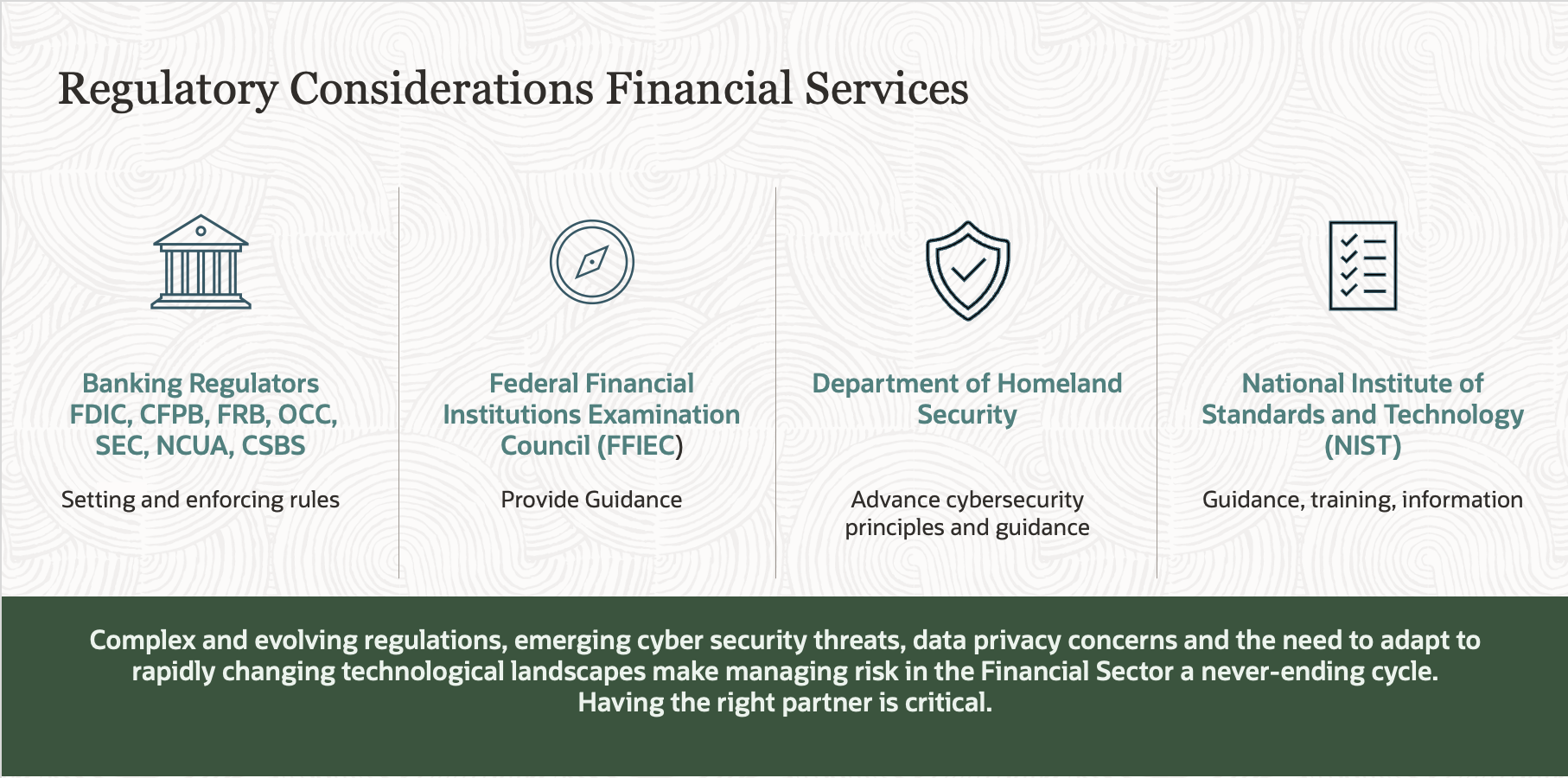
While at first glance this may seem more complicated, the FFIEC references NIST 800-53, a publication by the National Institute of Standards and Technology (NIST) that provides a comprehensive catalog of security and privacy controls for information systems, essentially acting as a standard for organizations to evaluate their risk posture and ensure compliance with federal regulations, particularly regarding the protection of sensitive information. Additionally, the FFIEC has developed the Cybersecurity Assessment Tool (CAT) to help financial institutions assess their cybersecurity readiness by asset.
For most organizations staying compliant really comes down to maintaining good information and technology hygiene and investing in relationships with partners who are rooted in building solutions with strong security foundations that align to and support regulation.
Oracle is the Right Partner
Oracle is well-suited for financial sector companies due to its comprehensive suite of solutions, robust security, scalability, and ability to handle complex regulatory and operational requirements. Here are key reasons why Oracle is a strong choice for the financial industry:
Comprehensive Financial Solutions
Oracle provides a broad range of tools designed specifically for financial services, including core banking, risk management, fraud detection, regulatory compliance, and financial reporting. These solutions are customizable and can integrate with existing infrastructure, allowing financial institutions to streamline their operations while maintaining flexibility.
Advanced Analytics and AI
Oracle leverages artificial intelligence (AI) and machine learning (ML) to provide deep insights into customer behavior, market trends, and emerging risks. These capabilities help financial companies make data-driven decisions, optimize portfolios, and predict market shifts, which is critical for both regulatory compliance and strategic planning.
Cloud and Scalability
Oracle’s cloud offerings, including Oracle Cloud Infrastructure (OCI), enable financial firms to scale resources efficiently, whether for processing large transaction volumes or supporting a growing customer base, where they want. The flexibility of Oracle’s cloud services ensures that institutions can adapt quickly to changing market conditions and regulatory requirements.
Security and Compliance
Oracle is renowned for its data security features, which include encryption, access controls, and compliance frameworks aligned with financial regulations (such as GDPR, SOX, and PCI DSS). These features ensure that financial data is protected, helping institutions meet strict regulatory standards.
Real-Time Processing
Oracle’s ability to handle real-time transactions and big data processing is critical in the financial sector, where timely and accurate data is essential. Whether it’s for payments, trading, or risk analysis, Oracle ensures that financial transactions and decisions are processed swiftly and accurately.
Regulatory Reporting
Oracle’s solutions simplify the often-complex task of regulatory reporting. It automates the generation of reports that adhere to global and local regulations, reducing manual effort and minimizing the risk of errors or compliance breaches.
Innovation and Integration
With continuous updates and innovations, Oracle stays ahead of technological trends, offering financial companies access to the latest tools and features. Oracle also offers seamless integration capabilities with third-party applications and systems, enabling financial institutions to build a tailored solution.
By combining these features, Oracle provides financial sector companies with the tools they need to stay competitive, secure, and compliant in an ever-changing regulatory environment.
Conclusion
Information technology risk is accelerating, and financial sector regulatory landscape is evolving with it.
Organizations need to maintain good information and technology hygiene and invest in relationships with partners who are rooted in building solutions with strong security foundations that align to and support emerging regulations and threats.
Oracle has always had a security first mindset, building security into the foundation of its products. Oracle offers a complete range of innovative services to support businesses end to end, meeting their security, compliance and availability needs while continuing to keep pace with the evolution of cyber threats and ever-changing compliance requirements.
Simple, effortless, integrated. – Oracle
Related Links
Oracle Trust Center https://www.google.com/url?sa=t&source=web&rct=j&opi=89978449&url=https://www.oracle.com/trust/&ved=2ahUKEwi0jefR6NqLAxX_l4kEHaSPCtEQFnoECA0QAQ&usg=AOvVaw22BbrzZt9-Y8gH51S-XuoV
FFIEC IT Examination Handbook https://www.google.com/url?sa=t&source=web&rct=j&opi=89978449&url=https://ithandbook.ffiec.gov/&ved=2ahUKEwjL0evt6NqLAxWbv4kEHc-tMw4QFnoECAgQAQ&usg=AOvVaw0L6TdIN7C_LCnI9_Y-7xry
National Institute of Standards and Technology (NIST) – 800-53 revision 5 https://csrc.nist.gov/pubs/sp/800/53/r5/upd1/final
Appendices
Key Financial Sector Regulators in the United States
In the United States, the financial services industry is regulated by a mix of federal and state agencies that are tasked with ensuring financial market stability, protecting consumers, enforcing fair competition, and preventing financial crimes. These regulatory bodies oversee various aspects of the industry, including banking, securities, insurance, and consumer protection. Below are the key financial sector regulators in the U.S.
| US Regulators |
Role |
Key Responsibilities |
Regulatory Oversight |
| The Federal Reserve System (Fed)
|
The Federal Reserve, often referred to simply as “the Fed,” is the central bank of the United States and plays a crucial role in regulating and supervising the U.S. financial system. Its responsibilities extend across monetary policy, financial stability, and the oversight of certain types of financial institutions. |
|
|
| The Securities and Exchange Commission (SEC)
|
The SEC is the primary regulatory body for the securities industry, responsible for overseeing the stock and bond markets, protecting investors, and maintaining fair, orderly, and efficient markets. |
|
|
| The Commodity Futures Trading Commission (CFTC)
|
The CFTC regulates commodity futures and options markets, including derivatives and swaps. It aims to ensure the integrity and transparency of derivatives markets, which are critical for risk management in industries such as agriculture, energy, and finance. |
|
|
| The Office of the Comptroller of the Currency (OCC)
|
The OCC is an independent bureau of the U.S. Department of the Treasury and is responsible for regulating and supervising national banks and federal savings associations.
|
|
|
| The Federal Deposit Insurance Corporation (FDIC) |
The FDIC is an independent agency that provides deposit insurance, supervises financial institutions, and acts as a receiver for failed banks.
|
|
|
| The Consumer Financial Protection Bureau (CFPB)
|
The CFPB is an independent agency that was created after the 2008 financial crisis under the Dodd-Frank Wall Street Reform and Consumer Protection Act. Its mission is to protect consumers in the financial services marketplace.
|
|
|
| The National Credit Union Administration (NCUA)
|
The NCUA regulates and supervises credit unions, ensuring that they operate in a safe and sound manner and providing deposit insurance to credit union members.
|
|
|
| The Financial Industry Regulatory Authority (FINRA)
|
FINRA is a self-regulatory organization (SRO) that regulates broker-dealers and their associated persons in the U.S. securities industry. It operates under the oversight of the SEC.
|
|
|
Global Regulatory Bodies
Key global and financial sector regulating bodies include:
- Basel Committee on Banking Supervision (BCBS)
-
- A global standard-setter for banking supervision that brings together central banks and regulatory authorities.
- Commodity Futures Trading Commission (CFTC)
-
- An independent authority that regulates commodity futures and options and other related derivatives markets.
- Dubai Financial Services Authority (DFSA)
-
- A financial regulatory agency that was created to regulate the Dubai International Finance Centre.
- Federal Deposit Insurance Corporation (FDIC)
-
- An independent agency that insures deposits and examines and supervises financial institutions for their safety and soundness.
- Financial Conduct Authority (FCA)
-
- A financial regulatory organization in the United Kingdom that aims to protect consumers, increase market integrity, and promote competition.
- Financial Stability Board (FSB)
-
- The FSB monitors and makes recommendations about the global financial system’s stability, working closely with national regulators to prevent systemic risks. It plays a critical role in global regulatory coordination, especially in areas like the regulation of systemically important financial institutions (SIFIs).
- Hong Kong Monetary Authority (HKMA)
-
- A governmental authority that maintains monetary and banking stability through policy development and regulation.
- International Organization of Securities Commissions (IOSCO)
-
- IOSCO sets global standards for securities regulation, promoting cooperation among securities regulators and offering guidelines to improve the functioning of financial markets.
- International Monetary Fund (IMF)
-
- The IMF provides oversight of the global financial system, particularly focusing on macroeconomic stability and providing financial assistance to countries facing crises.
Key Regulatory Frameworks & Authorities
The regulatory landscape in the financial services sector is complex, multi-faceted, and varies by region, but its overarching aim is to ensure financial stability, consumer protection, market integrity, and the prevention of financial crimes such as fraud and money laundering. Given the sensitive nature of financial transactions, extensive regulation is required to maintain trust in financial systems. Below is an overview of key regulations, agencies, and compliance frameworks that shape the regulatory environment in the financial services sector.
| Regulatory Framework |
Purpose |
Key Provision |
| Basel Accords (Basel I, II, III)
|
These are international regulatory frameworks established by the Basel Committee on Banking Supervision (BCBS) to enhance the stability of the global financial system. Basel regulations focus on risk management, particularly around capital adequacy, stress testing, and liquidity risk. |
Basel III: The most recent set of regulations, implemented after the 2008 financial crisis, requires banks to maintain higher capital reserves and liquidity ratios. It also mandates comprehensive stress tests and introduces the concept of the “counter-cyclical buffer” to protect against economic volatility.
|
| MiFID II (Markets in Financial Instruments Directive II)
|
MiFID II is a European Union directive that regulates financial markets in the EU. It aims to increase transparency, improve market efficiency, and enhance investor protection. MiFID II focuses on trading venues, financial products, investment services, and the conduct of firms, including stricter rules on high-frequency trading and reporting obligations.
|
It includes requirements around transparency of financial instruments, more detailed reporting on trading activity, and the protection of client assets. |
| Dodd-Frank Act (U.S.)
|
The Dodd-Frank Wall Street Reform and Consumer Protection Act was enacted in response to the 2008 financial crisis in the United States. Its aim is to reduce risks in the financial system, enhance consumer protection, and prevent the emergence of “too big to fail” financial institutions. |
It established the Consumer Financial Protection Bureau (CFPB), introduced regulations to curb speculative trading (Volcker Rule), and created the Financial Stability Oversight Council (FSOC) to monitor systemic risks in the financial system. |
| The Volcker Rule (U.S.)
|
Part of the Dodd-Frank Act, the Volcker Rule restricts banks from engaging in proprietary trading (trading for their own account) and from owning, investing, or sponsoring hedge funds or private equity funds. |
This rule is designed to reduce the risks of speculative trading by banks and to ensure that banks focus on traditional lending activities.
|
| The Securities and Exchange Commission (SEC) (U.S.)
|
The SEC regulates U.S. securities markets to protect investors and ensure the integrity of the financial markets. Its mission includes preventing fraud, enforcing securities laws, and promoting fair, orderly, and efficient markets.
|
It oversees rules around disclosure of financial information, insider trading, and the governance of publicly traded companies. It also regulates investment advisers, broker-dealers, and asset managers.
|
| Anti-Money Laundering (AML) Regulations & KYC (Know Your Customer) |
AML laws require financial institutions to detect and prevent money laundering and other financial crimes such as terrorism financing. KYC procedures are designed to verify the identity of clients and assess their risk profile. |
Financial institutions are required to conduct due diligence on customers, monitor transactions for suspicious activities, report large cash transactions, and maintain records to ensure compliance with these regulations.
|
| The Payment Services Directive 2 (PSD2) (EU)
|
PSD2 is a European Union directive aimed at enhancing the security of online payments, promoting innovation, and increasing competition in the financial services industry. It focuses on regulating payment services and e-money institutions. |
It introduces strong customer authentication (SCA) for digital payments, mandates open banking (access to payment account information), and enhances consumer protection against fraud in electronic transactions.
|
| The Financial Conduct Authority (FCA) (UK)
|
The FCA regulates the financial services industry in the UK to protect consumers, promote competition, and ensure the integrity of financial markets.
|
It oversees conduct of business regulations, market abuse, prudential standards for non-bank financial institutions, and financial consumer protection. The FCA also has a strong focus on ensuring that firms treat their customers fairly and maintain transparency. |
| GDPR (General Data Protection Regulation)
|
GDPR is a regulation in EU law that focuses on data protection and privacy for individuals within the European Union and the European Economic Area. While it is not specific to financial services, it applies to any firm that processes personal data of EU citizens. |
It mandates strict rules on consent, data usage, and the protection of personal data. Firms must implement data protection measures, provide transparency about data use, and allow individuals to request access or deletion of their personal data. |
Connect with us
Call +1.800.ORACLE1 or visit oracle.com. Outside North America, find your local office at: oracle.com/contact.


 blogs.oracle.com facebook.com/oracle twitter.com/oracle
Copyright © 2024, Oracle and/or its affiliates. This document is provided for information purposes only, and the contents hereof are subject to change without notice. This document is not warranted to be error-free, nor subject to any other warranties or conditions, whether expressed orally or implied in law, including implied warranties and conditions of merchantability or fitness for a particular purpose. We specifically disclaim any liability with respect to this document, and no contractual obligations are formed either directly or indirectly by this document. This document may not be reproduced or transmitted in any form or by any means, electronic or mechanical, for any purpose, without our prior written permission.
Oracle, Java, MySQL, and NetSuite are registered trademarks of Oracle and/or its affiliates. Other names may be trademarks of their respective owners.