
Faster discovery raises the stakes for every handoff that follows. Here’s where CISOs can make practical progress over the next three months.

A critical security advisory lands on Monday morning. By lunchtime, the security team has reviewed it. By Tuesday, teams are still working out which applications are affected. The service owner is waiting for a dependency check. Operations needs a change window. Someone needs to approve the downtime.
The finding moved quickly. The organization is still catching up.
That is a useful place to start the conversation about frontier AI. As advanced models make it easier to analyze software and investigate potential weaknesses, CISOs need to look closely at what happens after a finding arrives. How much time is lost before someone can make a decision and put protection in place?
The next 90 days are an opportunity to shorten that delay. Pick a manageable set of critical business services, bring their owners into the discussion, and work through the plan below. Start urgent remediation immediately; the milestones give the work structure, not a reason to wait.
Measure the time between “we know” and “we have reduced the risk.”
Days 1–30: Find out where you stand
Start with the services the business can least afford to lose. That might be payment processing, customer access, manufacturing operations, or a platform holding sensitive data. Ask the business owner what an outage would mean, then work backward through the applications, identities, infrastructure, and suppliers that keep the service running.
You do not need a perfect enterprise inventory before making progress. You do need enough visibility to answer practical questions about the services you have selected:
- Who owns the service, its remediation, and any decision to accept risk?
- Which software components and dependencies support it?
- Where could an attacker reach it, and what access would make a compromise worse?
- Who can authorize a change when the next scheduled window is too far away?
Include AI in this inventory. Look at employee tools, coding assistants, and agents connected to enterprise systems. Identify the data they can read, the actions they can take, and the person responsible for their use.
Then walk a recent advisory through the response process. Bring together security operations, engineering, service owners, and change management. Could they patch, mitigate, or isolate a serious exposure within 24 hours if the risk justified it? This is a readiness exercise, not a blanket patching deadline. Note where the process stalls and assign someone to fix each bottleneck.
By day 30, you should be able to show executives which services are in scope, where the most important exposures sit, and who has the authority to act. Make the unknowns visible too.
Days 31–60: Close the gaps that matter most
Now put that visibility to work. Prioritize findings by the harm they could cause in your environment. A severity score is useful, but it cannot tell the whole story. Reachability, sensitive data, privileged access, and business dependencies help explain why one issue needs attention before another.
Consider a vulnerable application that supports a critical customer service. While the team tests a patch, it may be possible to restrict the exposed interface or remove unnecessary privileges. Those steps can reduce risk sooner, provided the team verifies that they actually block the relevant path. Give temporary measures an owner and an expiry date so they do not quietly become permanent exceptions.
Pay close attention to identity. Stale accounts, excessive permissions, and poorly controlled service identities can turn a limited compromise into a much larger incident. Review them alongside network segmentation, application access, and recovery dependencies.
Use this month to make emergency changes safer and easier to execute. Check that teams have a test approach, a rollback plan, and someone available to make the decision. Where an unsupported system repeatedly prevents remediation, bring the modernization choice to the business owner with a clear explanation of the exposure.
Give defenders a practical way to use AI
Choose one bounded use case. For example, let an approved model help an analyst connect an advisory to software inventories, configurations, and identity information. Ask it to explain the affected service, the conditions that make the weakness reachable, and the evidence needed to validate a proposed mitigation.
Keep the workflow auditable. Limit access to the data it needs, protect sensitive information, record its work, and have qualified people check the output. Decisions that change production or accept risk should stay with the accountable owner.
By day 60, show which priority exposures have been reduced and how that was verified. Include the remaining blockers and any funding or business decisions needed to move them.
Days 61–90: Prove it works under pressure
The final month is about making these improvements part of everyday work. For the applications in scope, build security checks into development and deployment. Keep software bills of materials current, check code and configurations, and retain the evidence behind release decisions. Feed findings from security operations and testing back to engineering while the context is still fresh.
Then exercise recovery. Choose a scenario that puts your assumptions under strain: the identity service is unavailable, the primary environment is compromised, or a key supplier cannot respond. Involve business leaders and communications teams as well as technical responders.
A successful backup job is not proof that the business can recover. Restore a service, check the integrity of the data, and measure how long it takes. Confirm that dependencies come back in the right order and that the result meets the business’s agreed recovery objectives.
Cloud responsibilities belong in the exercise too. For each service, confirm what the provider operates and what your teams must configure, protect, patch, and recover. Make sure the provider’s advisory and escalation channels connect to your own response process.
Oracle’s published approach to vulnerability detection and response reinforces this point: AI-assisted discovery needs to be followed by timely action. For customer-managed deployments, customers remain responsible for planning, testing, and applying the security updates Oracle supplies. Build that work into the operating plan.
By day 90, you should have evidence of safer changes, reduced exposure, and tested recovery for the initial services. Use the lessons to expand the approach to the next group.
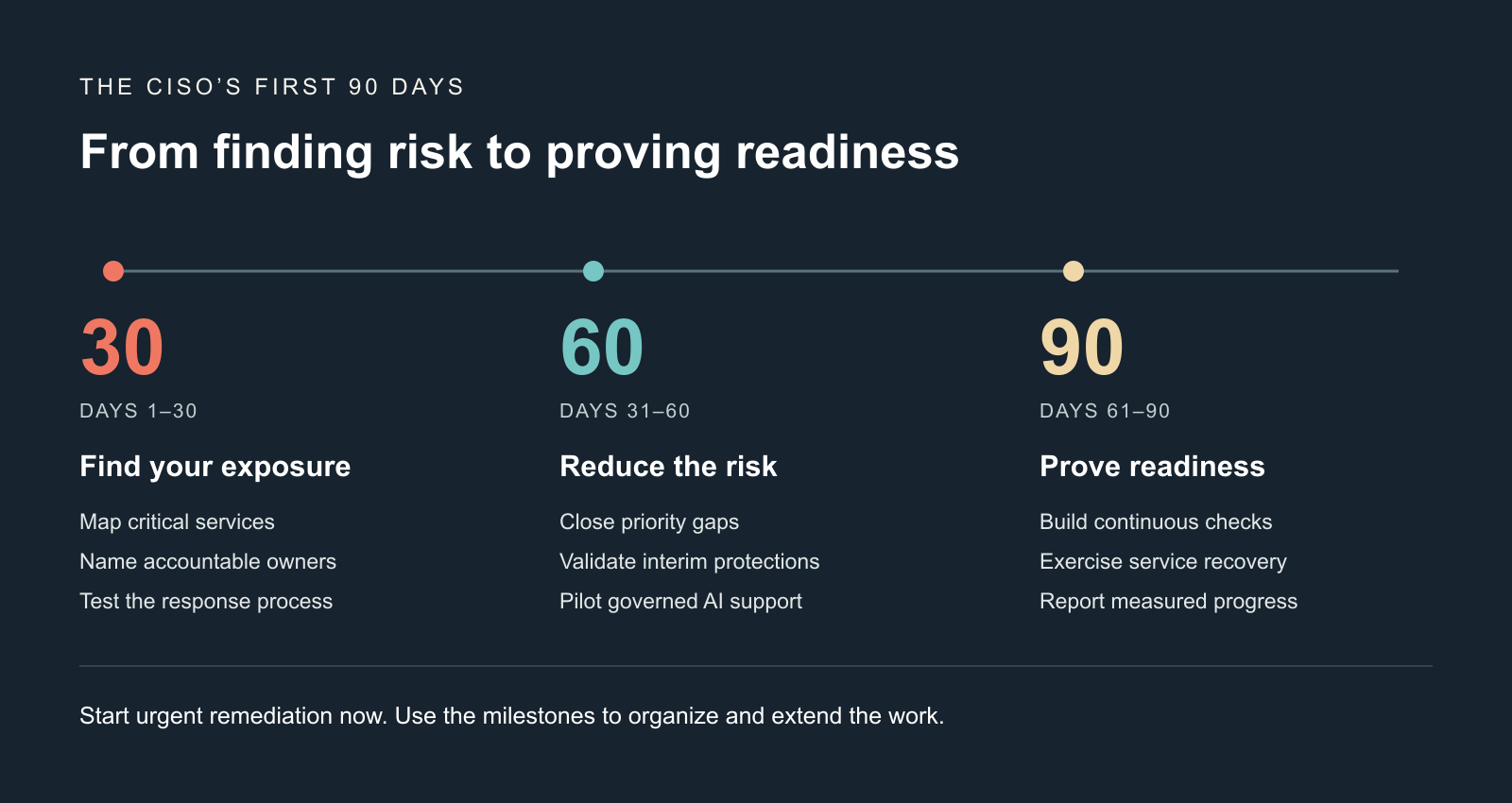
The first 90 days establish a repeatable approach, beginning with a manageable set of critical services.
Bring the board evidence it can use
Keep the executive dashboard short. Show how quickly the organization can identify affected services, put an owner in charge, and verify protection. Alongside those measures, report material exposures still open and recovery objectives actually demonstrated in an exercise.
Review urgent exposures and blocked decisions weekly. Look at readiness trends monthly. Give the board a quarterly view of what has improved, what remains exposed, and where investment is needed.
Ninety days will not resolve every legacy dependency or rebuild the entire security program. It is enough time to demonstrate that a critical finding can move through the organization without losing days between teams.
Start with one critical service this week. Ask its owner to walk you from a new advisory to a verified fix and a tested recovery. The places where that conversation gets difficult are where your 90-day plan should begin.
Resources
Accelerating Vulnerability Detection and Response at Oracle