
How engineering integration AI governance and decision ready metrics compress the time to reduce material cyber risk.
This is part 2 of a 2 part series that expands on the blog linked below and expands on items 5 and 6 with additional discussion on new CISO metrics from the Oracle CISO Perspective article on modern vulnerability management in the age of frontier cyber models that can be found here: https://www.ateam-oracle.com/oracle-ciso-perspective-modern-vulnerability-management-in-the-age-of-frontier-cyber-models
The link to part 1 is: https://www.ateam-oracle.com/ciso-perspectives-transitioning-from-vulnerability-management-to-exposure-intelligence
Please also see the blog from my colleague that discusses a 30-60-90 day CISO action plan for the Frontier AI era: https://www.ateam-oracle.com/ciso-perspectives-a-90-day-ciso-action-plan-for-the-frontier-ai-era

Figure 1. Exposure intelligence connects technical signals to the paths and decisions that determine business risk.
The core leadership decision is straightforward. Frontier cyber models reduce the time needed to find weaknesses, test preconditions, and reason across identities, cloud configurations, exposed services, and business systems. The defensive answer is not to create a larger backlog. It is to make remediation, governance, and executive measurement operate at the speed of credible exposure.
A modern program should optimize for the interruption of credible paths to material impact. That means bringing remediation closer to the teams that build and run services, governing AI cyber tools as privileged infrastructure, and measuring whether the organization is actually reducing exploitable exposure rather than merely processing tickets.
The Operating Model Has to Move at Engineering Speed
Item 5 from the Oracle CISO Perspective is a direct challenge to the quarterly cleanup mentality. When discovery and validation accelerate, vulnerability work cannot begin as a security finding and end as an unexplained engineering ticket. The work item has to arrive with the context required for a service owner to act: what is exposed, how it can be reached, what business capability is at stake, which control is uncertain, and which action breaks the path fastest.
This is not an argument to collapse security ownership into engineering or to make every engineer an exposure analyst. It is an argument to create a shared operating system. Security teams curate threat signals, path evidence, validation criteria, and risk decisions. Engineering teams own durable changes in code, infrastructure, and service design. Platform, identity, network, and SRE teams own the control planes that often provide the fastest interim path break.
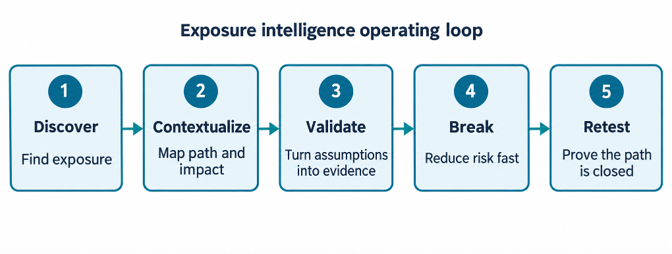
Figure 2. A closed operating loop turns new exposure signals into verified risk reduction.
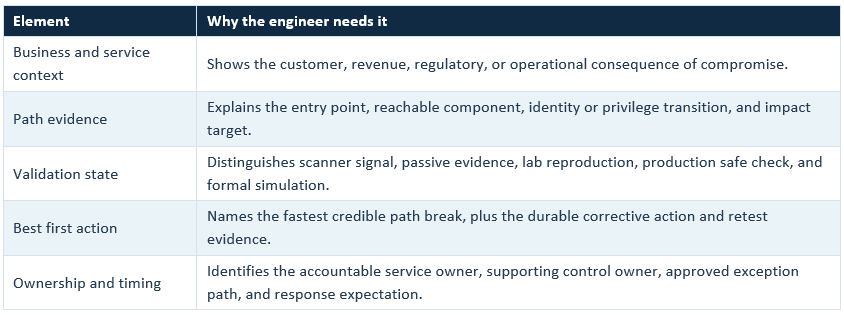
What a Decision Ready Remediation Item Contains
A finding becomes decision ready when an owner can understand the consequence and choose a safe action without reconstructing the analysis from five different tools. The following information should travel with the work item.
Treat Remediation as Product Work
The most effective programs treat repeated exposure patterns as product and platform problems, not a stream of exceptions. If public-by-default ingress, excessive service-account privilege, stale tokens, or missing dependency controls recur, the organization should fund the guardrail that prevents the class of issue. This is where secure-by-default libraries, infrastructure-as-code policy checks, dependency governance, secret scanning, SBOM and VEX workflows, CI testing, and service-owner service-level agreements become risk-reduction mechanisms rather than compliance artifacts.
- Define a path breaking definition of done. A ticket is complete only when the selected graph edge or vulnerable node has been changed and the retest evidence shows the path is no longer viable.
- Provide safe fast actions. Restricting unnecessary ingress, disabling a dormant identity, rotating a credential, reducing a role, or applying a conditional-access policy can often interrupt risk while a patch or redesign proceeds.
- Make exceptions expiring decisions. Every exception needs a named owner, expiration, compensating-control evidence, and a retest commitment. Otherwise the exception becomes hidden exposure debt.
- Measure the friction engineers encounter. If the same remediation takes weeks because dependency updates, change windows, or ownership routing are difficult, that is a platform investment signal.
A Practical Example
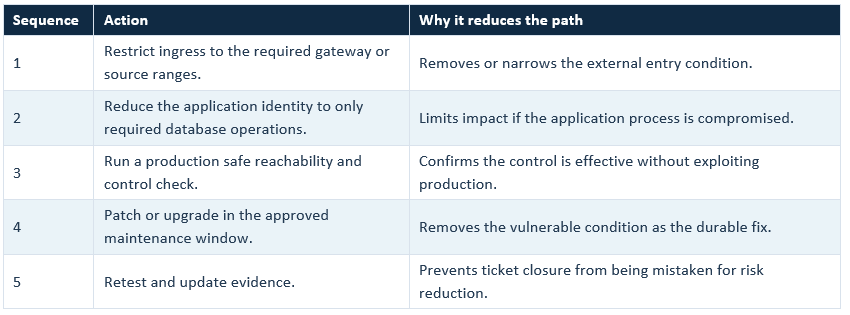
Consider a medium-severity framework flaw in a customer API. In a severity-only queue, it may sit behind critical issues on isolated test systems. Exposure intelligence changes the priority when the API is internet reachable, the affected component is active at runtime, the workload uses an over privileged service account, and the downstream database contains regulated data. The immediate goal is not to wait for the full patch lifecycle. It is to interrupt the reachable route to the database.
AI Cyber Tools Need Privileged Infrastructure Governance
Item 6 recognizes a critical distinction. A model that can reason across exploit chains, source code, cloud accounts, dependency manifests, and incident data is not a casual productivity tool. It is privileged security infrastructure. The more capable the model, the more important it is to define who can use it, which data it can access, what actions it may influence, and how its use is evidenced.
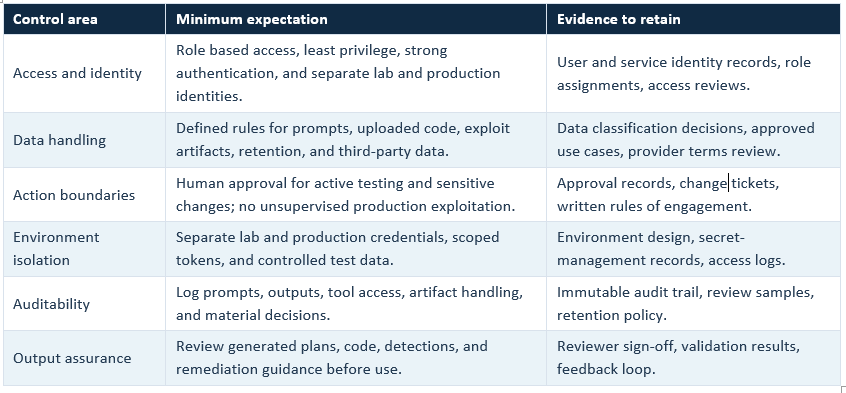
Governance should enable approved defensive use while preventing ambiguous authority. The policy boundary is especially important when an AI workflow touches production credentials, code repositories, build pipelines, customer information, or third-party targets. A useful control design separates what the model may analyze, what a human must approve, and what is prohibited entirely.
A Minimum Governance Baseline
Good governance also respects the difference between assistance and authority. A model can summarize an advisory, compare a patch, propose a safe validation plan, correlate logs, or draft detection ideas. Those are high-value uses. A model should not independently conduct active production exploitation, use unbounded credentials, or send sensitive data to an non reviewed destination. The program should make that boundary visible in policy, tooling, and audit evidence.
The CISO Metrics Should Change
The CISO does not need another dashboard that counts every vulnerability. Counts are operationally useful, but they are weak indicators of whether the organization can withstand machine-speed pressure. The executive scorecard should show whether critical exposure is understood, whether paths are being interrupted quickly, whether controls work when tested, and whether AI-enabled work remains accountable.
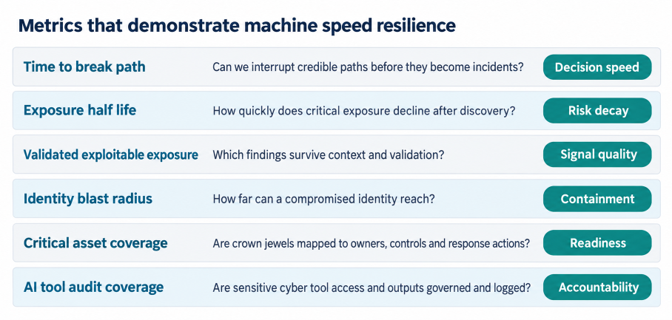
Figure 3. The metric set aligns executive questions with defensible operating outcomes.
The original article identifies six core measures: time-to-break-path, exposure half-life, validated exploitable findings, identity blast radius, critical asset coverage, and AI tool audit coverage. Section 8 of the supplied exposure-intelligence blog expands that frame with graph coverage, path discovery, control validation, exception debt, recurrence, and remediation effectiveness. Together, they form a balanced metric system: speed, signal, coverage, containment, control confidence, and accountability.
Build a Metric System Not a Metric Pile
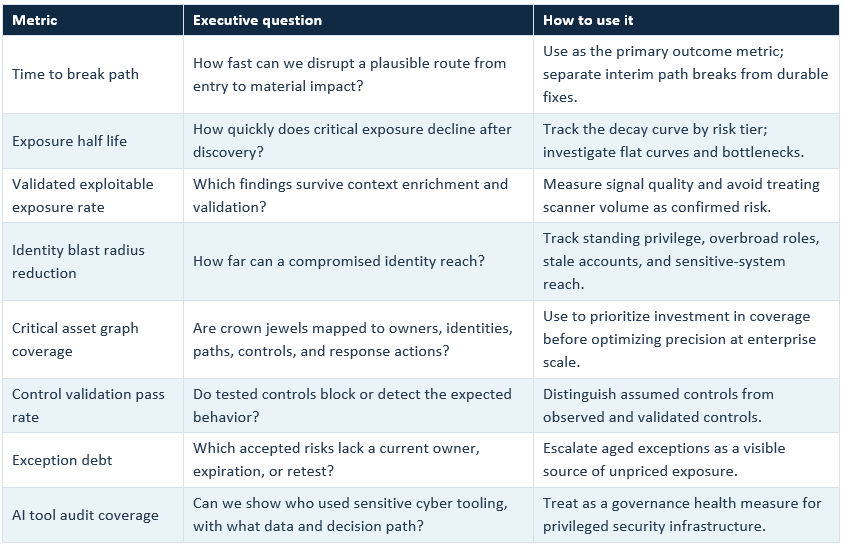
Metric Design Rules
- Define the clock. Time-to-break-path starts when a credible path is identified and stops only when evidence confirms the selected path is interrupted. Do not stop the clock at ticket assignment.
- Segment before averaging. A single enterprise average conceals the difference between an internet-facing route to regulated data and an isolated non-production host.
- Show confidence. Every dashboard should distinguish assumed, observed, validated, and retested control states so leaders can see where the score rests on inference.
- Pair speed with durability. A fast temporary ingress restriction can be excellent risk reduction, but the dashboard should also show whether the durable patch or redesign is complete.
- Use recurrence as a board-level learning signal. Repeated public exposure, privilege sprawl, stale identities, or missing MFA are systemic design conditions, not just a sequence of closed tickets.
Governance That Drives Decisions
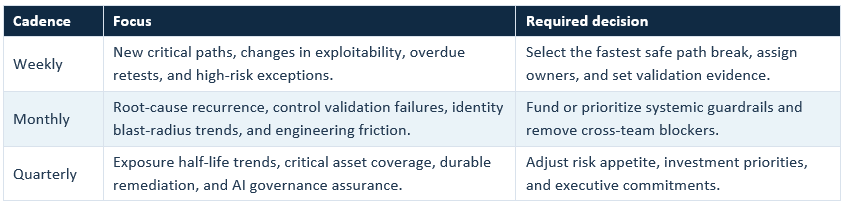
Metrics are useful only when they trigger an owner and a decision. A practical cadence is a short weekly working review for the top new or changed paths, a monthly cross-functional review for recurring root causes and exception debt, and a quarterly executive review for trend, investment, and critical asset coverage. The intent is not more meetings. It is to prevent evidence, authority, and remediation from becoming disconnected.
For each critical or high path, require a business owner, a technical owner, and a security owner. Require the remediation decision to name the graph edge or node being broken. Require exceptions to include a compensating control, expiration, evidence, and retest plan. This turns governance from a reporting overlay into the mechanism that makes path reduction repeatable.
What to Do Next
Begin with a small, high-confidence scope: roughly 20 to 50 crown-jewel systems and their direct dependencies. Map owners, public exposure, identities, vulnerable components, sensitive data, and controls. Generate a first ranked set of paths. For each one, select a path-breaking action, validate it safely, and record the evidence. Then use the resulting cycle time, recurrence, and coverage gaps to improve the engineering and governance system around it.
The winning program will not be the one that closes the most CVEs. It will be the one that identifies exploitable exposure, gives engineers the context and authority to act, governs the AI capabilities that accelerate the work, and proves that the paths to material business impact are being broken faster than adversaries can chain them.
Sources
Oracle A Team. Oracle CISO Perspective Modern Vulnerability Management in the Age of Frontier Cyber Models. May 15 2026. https://www.ateam-oracle.com/oracle-ciso-perspective-modern-vulnerability-management-in-the-age-of-frontier-cyber-models
Supplied document. Transitioning from Vulnerability Management to Exposure Intelligence Building Ranking and Breaking Attack Paths Before They Become Incidents. Section 8 Operating Metrics and Governance.