

Vijay Shanthappa
Sr. Manager, Advanced Services | Aviatrix
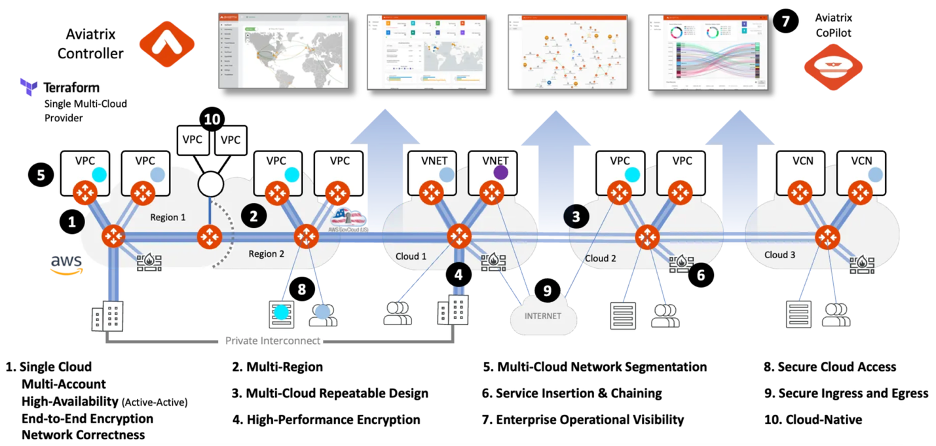
Aviatrix is a cloud networking and security platform that helps enterprises connect, protect, and manage applications across multiple clouds and on-premises environments. It provides a consistent management layer for automated connectivity, encrypted traffic, network segmentation, firewall service insertion, and centralized visibility, simplifying operations across different cloud providers. Its built-in security controls restrict which workloads can communicate and which external destinations they can reach, helping contain breaches, while monitoring and troubleshooting tools help resolve connectivity issues faster.
For Oracle AI Database@AWS customers using Aviatrix multi-cloud transit as an alternative to AWS Transit Gateway (TGW), connecting applications to Oracle databases requires a design that integrates Aviatrix with the Oracle Database (ODB) network.
This post outlines five design patterns to help customers evaluate their connectivity options and select an approach that meets their requirements:
1. Direct Connectivity with ODB Peering
2. Aviatrix Integration with AWS TGW
3. Integrated Connectivity with ODB Peering & AWS TGW
4. Aviatrix Shared Services Using NAT
5. Integrated Connectivity with ODB Peering & Aviatrix Shared Services
Each pattern offers tradeoffs in routing complexity, traffic inspection, operational overhead, and potential latency. The appropriate choice depends on the customer’s existing network architecture and application requirements, including whether the priority is a direct connectivity path or integration with broader multi-cloud routing and security policies.
1. Direct Connectivity with ODB Peering
In this design pattern, application VPCs in AWS connect directly to the ODB network through ODB peering. Application-to-database traffic follows this direct path, bypassing the Aviatrix encrypted overlay network. All other traffic continues to use the existing Aviatrix routing configuration.
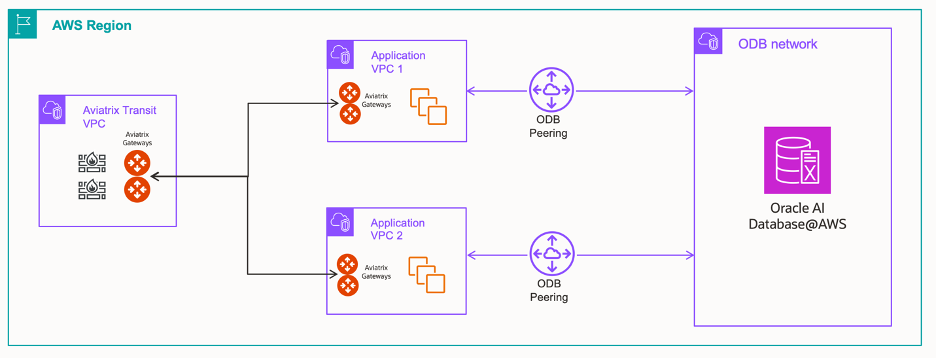
Key design considerations include:
- Latency: The direct path avoids traversing the Aviatrix overlay and is well suited to latency-sensitive workloads, such as payment processing, securities trading, high-volume transaction processing, and manufacturing execution systems.
- Peering limits: Oracle documentation specifies a default limit of 95 ODB peering connections per ODB network, which can be increased to 125 by opening an AWS Support case.
- Connectivity scope: Application VPCs must reside in the same AWS Region as the ODB network. This pattern does not provide connectivity from on-premises environments, other AWS Regions, or other cloud providers.
2. Aviatrix Integration with AWS TGW
In this design pattern, Aviatrix integrates with AWS Transit Gateway (TGW) through a TGW Connect attachment. Application-to-database traffic traverses the Aviatrix network and AWS TGW, then reaches the ODB network through an ODB peering connection in a transit VPC.
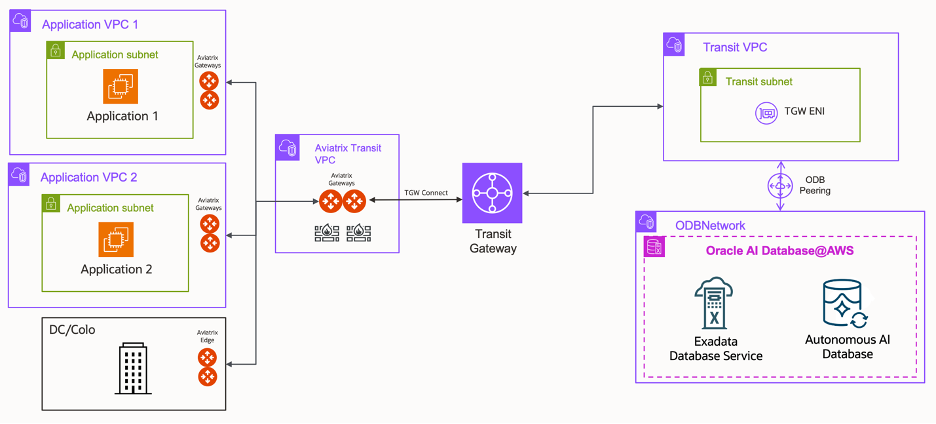
Key design considerations include:
- Visibility and security controls: Application-to-database traffic traverses the Aviatrix network, enabling centralized monitoring and, where configured, firewall inspection and enforcement of existing security policies.
- Connectivity scope: This design extends database connectivity to endpoints reachable through Aviatrix, including on-premises environments and other cloud providers, subject to the configured routing and security policies.
- Deployment considerations: This design uses an AWS TGW and a transit VPC in each AWS Region hosting an ODB network.
- Latency: The additional network hops may introduce higher latency compared with direct ODB peering. Actual latency depends on the traffic path and configured inspection services, while its impact depends on the application’s latency requirements.
3. Integrated Connectivity with ODB Peering and AWS TGW
This design pattern combines direct ODB peering with Aviatrix integration through AWS TGW. Latency-sensitive workloads in the same AWS Region as the ODB network use direct ODB peering, while workloads in on-premises environments, other AWS Regions, and other cloud providers traverse the Aviatrix overlay and AWS TGW.
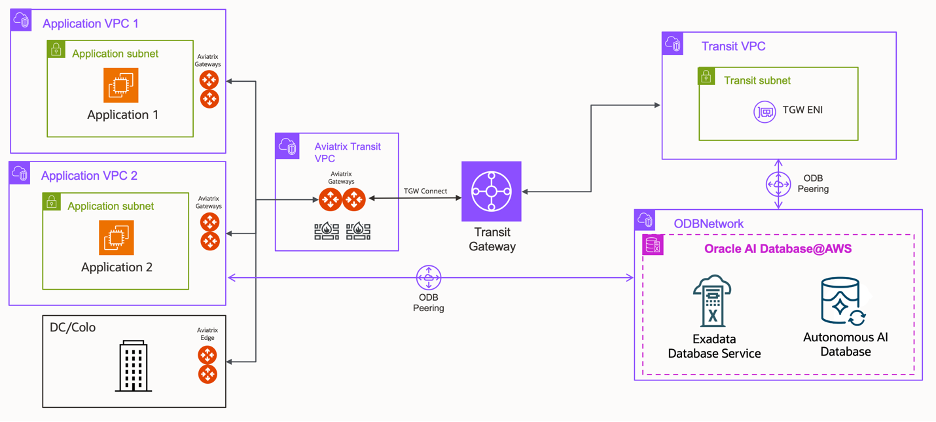
Key design considerations include:
- Latency: Direct ODB peering provides a shorter network path for latency-sensitive application-to-database traffic. Traffic using the Aviatrix overlay and AWS TGW follows additional network hops, with latency depending on the traffic path and configured inspection services.
- Peering limits: Oracle documentation specifies a default limit of 95 ODB peering connections per ODB network, which can be increased to 125 by opening an AWS Support case.
- Visibility and security controls: Traffic traversing the Aviatrix network can use its monitoring and configured inspection capabilities. Traffic using direct ODB peering bypasses these Aviatrix controls and relies on the security controls configured along the direct path and at the database.
- Connectivity scope: This design supports directly peered application VPCs in the same AWS Region and endpoints reachable through Aviatrix, including on-premises environments, other AWS Regions, and other cloud providers, subject to routing and security policies.
- Deployment considerations: This design combines direct peering for selected application VPCs with an AWS TGW and a transit VPC in each AWS Region hosting an ODB network.
4. Aviatrix Shared Services Using NAT
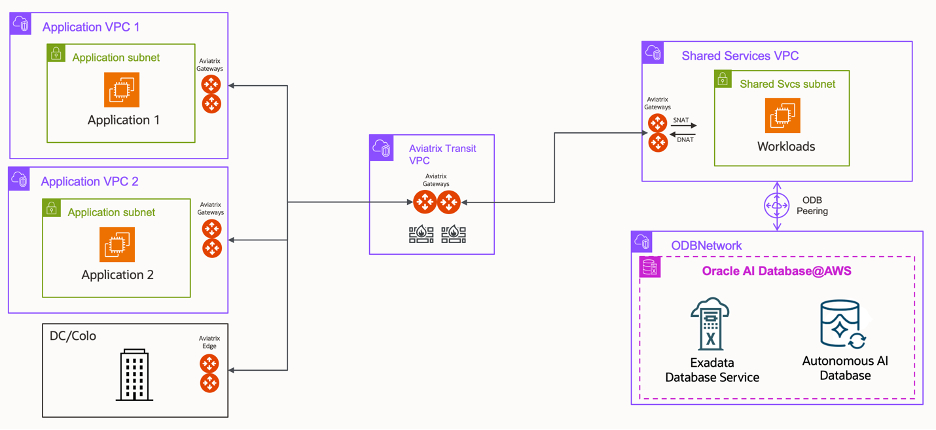
This design pattern provides an alternative for customers who want application-to-database connectivity through Aviatrix while avoiding the TGW-related costs and deployment requirements of AWS TGW integration. Customers deploy Aviatrix Spoke Gateways in a shared services VPC and use Aviatrix’s built-in NAT capabilities to reach the ODB network through ODB peering.
Key design considerations include:
- Visibility and security controls: Application-to-database traffic traverses the Aviatrix network, enabling centralized monitoring and, where configured, firewall inspection and enforcement of existing security policies. The Spoke Gateways apply source NAT, so the database sees the translated source IP address rather than the original application IP address.
- Connectivity scope: This design extends database connectivity to endpoints reachable through Aviatrix, including on-premises environments and other cloud providers, subject to the configured routing and security policies.
- Deployment considerations: Source NAT (SNAT) rules must be configured on the Aviatrix platform for application-initiated connections to the database. Separate connections initiated by the database toward applications require destination NAT (DNAT) and SNAT rules in this proposed design.
- Validation: Customers should validate the NAT configuration against their application connectivity requirements, including any database-initiated connections, and confirm that logging and source IP visibility meet their audit requirements.
5. Integrated Connectivity with ODB Peering and Aviatrix Shared Services
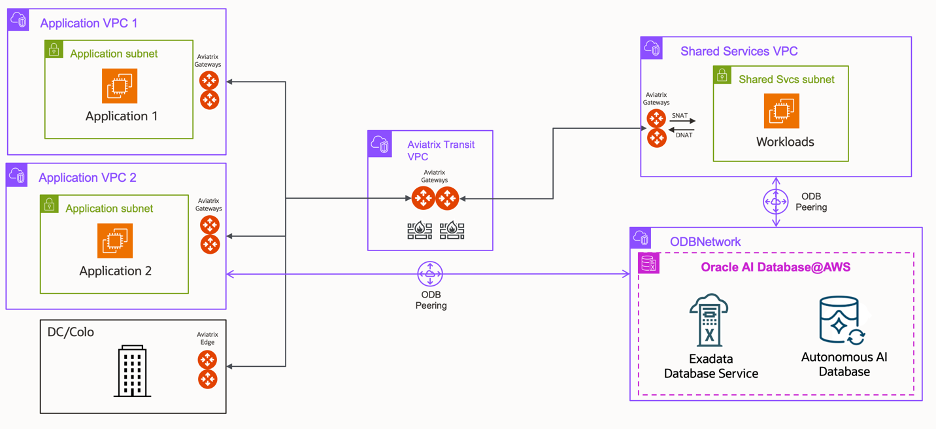
This design pattern combines direct ODB peering with Aviatrix shared services using NAT. Latency-sensitive workloads in the same AWS Region as the ODB network use direct ODB peering. Workloads in on-premises environments, other AWS regions, and other cloud providers traverse the Aviatrix overlay to Spoke Gateways in a shared services VPC, where NAT is applied before traffic reaches the ODB network through ODB peering.
Key design considerations include:
- Latency: Direct ODB peering provides a shorter network path for latency-sensitive application-to-database traffic. Traffic using the Aviatrix overlay follows additional network hops, with latency depending on the traffic path and configured inspection services.
- Peering limits: Oracle documentation specifies a default limit of 95 ODB peering connections per ODB network, which can be increased to 125 by opening an AWS Support case.
- Visibility and security controls: Traffic traversing the Aviatrix network can use its monitoring and configured inspection capabilities. For traffic using SNAT, the database sees the translated source IP address rather than the original application IP address. Traffic using direct ODB peering bypasses these Aviatrix controls and relies on the security controls configured along the direct path and at the database.
- Connectivity scope: This design supports directly peered application VPCs in the same AWS Region and endpoints reachable through Aviatrix, including on-premises environments, other AWS Regions, and other cloud providers, subject to routing and security policies.
- Deployment considerations: This design combines direct peering for selected application VPCs with Aviatrix Spoke Gateways in a shared services VPC peered with the ODB network. For connections using the shared services path, source NAT (SNAT) rules must be configured on the Aviatrix platform for application-initiated connections to the database. Separate database-initiated connections to applications using this path require destination NAT (DNAT) and SNAT rules in this proposed design.
- Validation: Customers should validate the NAT configuration against their application connectivity requirements, including any database-initiated connections, and confirm that logging and source IP visibility meet their audit requirements.
Final Thoughts
The following table summarizes the key differences among the five design patterns to help customers select an approach based on their connectivity, security, and operational requirements.
| Design Pattern | Direct application path | Aviatrix monitoring/inspection | NAT |
| 1. Direct ODB peering | Yes | Bypassed for database traffic | Not introduced by this pattern |
| 2. AWS TGW integration | No | Available where configured | Not introduced by this pattern |
| 3. Direct peering + TGW | For selected VPCs | On the Aviatrix path | Not introduced by this pattern |
| 4. Shared services | No | Available where configured | On the shared services path |
| 5. Direct peering + shared services | For selected VPCs | On the Aviatrix path | On the shared services path |
Related Resources
– Oracle Database@AWS (AWS documentation)
– Oracle AI Database@AWS (Oracle documentation)
– Networking architecture for Oracle AI Database@AWS deployment
– Oracle Database@AWS High Performance Networking
– Oracle DB@AWS – Transit Gateway Connectivity
– Transit Gateway use-cases in DB@AWS
– Oracle Database at AWS Networking Update: One ODB Network, Multiple VPC Peers
– Simplifying Network Architectures with Multi-VPC Peering for Oracle Database@AWS
– How to Migrate from a TGW-Centric Oracle Database at AWS Design to Multi-VPC ODB Peering